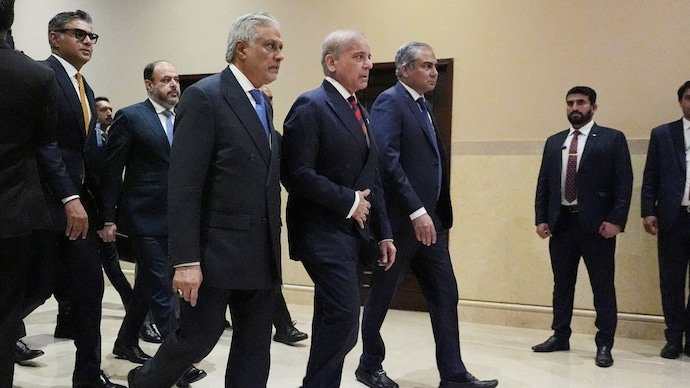
- Talks Fail, Ceasefire Hangs in Balance
- Pakistan Calls for Continued Restraint
- Marathon Talks End Without Breakthrough
- US Position: Firm Red Lines on Nuclear Programme
- Iran Pushes Back Against US Conditions
- Pakistan’s Mediation Faces a Reality Check
- Ceasefire Remains Fragile
- Key Takeaways from Islamabad Talks
- Conclusion: A Pause, Not a Resolution
Pakistan has urged the United States and Iran to uphold a fragile ceasefire after high-level talks hosted in Islamabad ended without an agreement. The مذاکرات, seen as a rare diplomatic opening between the two adversaries, collapsed after marathon discussions, raising concerns over regional stability and Islamabad’s ability to broker peace.
Talks Fail, Ceasefire Hangs in Balance
After nearly 24 hours of intense negotiations in Islamabad, US-Iran Talks concluded without a breakthrough, leaving the already fragile ceasefire under strain. Pakistan, which positioned itself as a key mediator, called on both sides to maintain restraint and continue dialogue despite the setback.
The talks marked the first direct, high-level engagement between Washington and Tehran in decades, making their failure particularly significant at a time of heightened tensions and global attention.
Pakistan Calls for Continued Restraint
In the aftermath of the failed negotiations, Pakistan emphasized the importance of preserving the ceasefire to prevent further escalation.
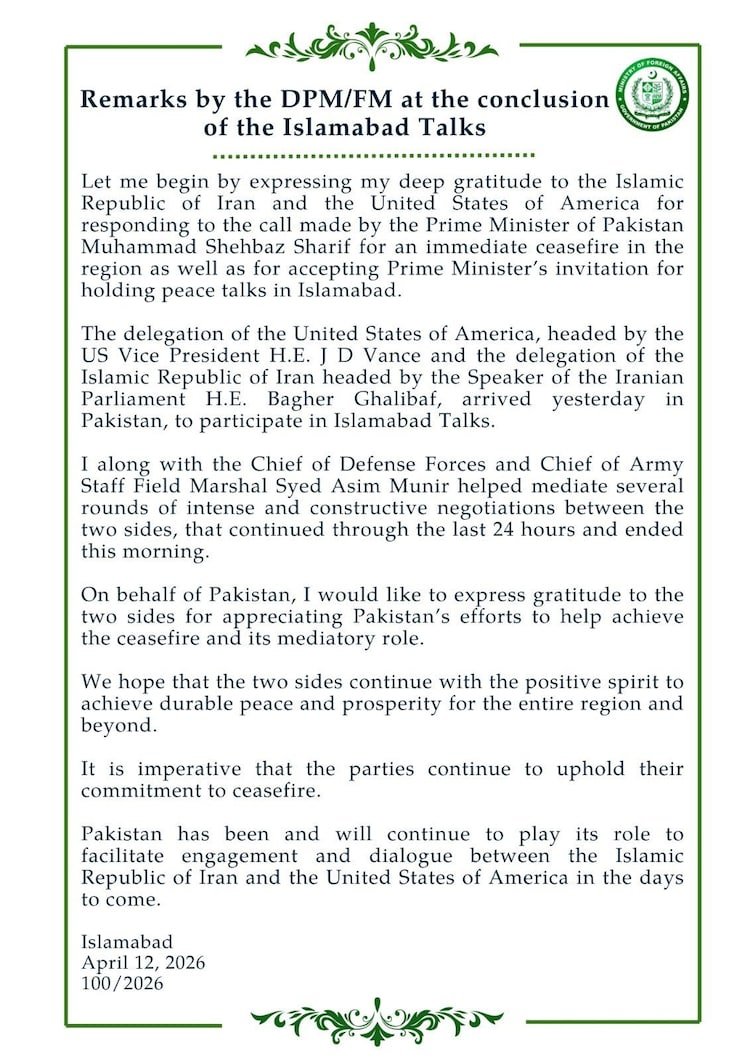
“It is imperative that the parties continue to uphold their commitment to ceasefire,” said Foreign Minister Ishaq Dar.
Dar added that Pakistan would continue to facilitate dialogue between the two sides, expressing hope that ongoing engagement could eventually lead to lasting peace.
The statement reflects Islamabad’s effort to maintain its role as a diplomatic bridge, even as the immediate outcome fell short of expectations.
Marathon Talks End Without Breakthrough
The negotiations, which stretched for over 21 hours, were marked by intense discussions and shifting dynamics. Initially, there were hopes that the talks could build on a recently announced two-week ceasefire.
However, deep differences between the US and Iran proved difficult to bridge.
According to sources, the atmosphere during the talks fluctuated significantly.
“There were mood swings from the two sides and the temperature went up and down during the meeting,” a source said.
Despite multiple rounds of engagement, both sides failed to reach even a preliminary framework agreement.
US Position: Firm Red Lines on Nuclear Programme
The US delegation, led by Vice President JD Vance, maintained a firm stance on key issues, particularly Iran’s nuclear programme.
Following the talks, Vance acknowledged the lack of progress while signaling that Washington’s position remained unchanged.
“We have not reached an agreement, and that is bad news-especially for Iran,” Vance said.
He emphasized that the US had clearly communicated its red lines and would not compromise on core security concerns.
This firm approach reflects Washington’s broader strategy of combining Diplomacy with pressure.
Iran Pushes Back Against US Conditions
Iranian officials, however, rejected the idea that they were solely responsible for the breakdown of talks. Reports from Iranian media suggested that what they described as “excessive” US demands played a significant role in derailing negotiations.
Key sticking points included:
- Iran’s nuclear programme
- Control and access to the Strait of Hormuz
- Sanctions and economic restrictions
Iranian representatives also highlighted the deep mistrust that continues to define relations between the two countries.
Expecting a full agreement after a single round of talks was unrealistic, a spokesperson indicated.
This underscores the complexity of theفاوضations and the long road ahead for any meaningful resolution.
Pakistan’s Mediation Faces a Reality Check
Pakistan had hoped the talks would reinforce its image as a capable diplomatic mediator on the global stage. The initiative was backed by Prime Minister Shehbaz Sharif and Army Chief Asim Munir, both of whom were actively involved in facilitating dialogue.
While the country succeeded in bringing both sides to the table, the failure to secure an agreement highlights the limits of its influence in resolving deeply entrenched conflicts.
Nevertheless, Islamabad continues to project optimism, positioning itself as a neutral platform for future negotiations.
Ceasefire Remains Fragile
The collapse of talks has placed the ceasefire in a precarious position. With both sides trading blame and maintaining hardline stances, the risk of renewed escalation remains high.
The ceasefire, originally seen as a stepping stone toward broader peace, now appears uncertain without a supporting diplomatic framework.
This raises concerns not only for regional stability but also for global markets, particularly in energy, given the strategic importance of the Strait of Hormuz.
Key Takeaways from Islamabad Talks
| Aspect | Outcome |
|---|---|
| Duration of Talks | Over 21 hours of negotiations |
| Result | No agreement reached |
| Main Disputes | Nuclear programme, sanctions, Strait of Hormuz |
| Pakistan’s Role | Facilitator and mediator |
| Current Status | Fragile ceasefire remains in place |
Conclusion: A Pause, Not a Resolution
The failure of US-Iran talks in Islamabad marks a significant setback in efforts to ease tensions, but it does not necessarily close the door on diplomacy. Pakistan’s call for restraint highlights the urgency of maintaining the ceasefire, even in the absence of a formal agreement.
For now, the situation remains a delicate balancing act. The willingness of both sides to engage-even without immediate success-offers a slim window for future negotiations. However, without trust and compromise, that window could close just as quickly.
In the complex world of Geopolitics, sometimes avoiding escalation is itself a form of progress. The challenge now is to turn this fragile pause into a sustainable path toward peace.
For breaking news and live news updates, like us on Facebook or follow us on Twitter and Instagram. Read more on Latest World on thefoxdaily.com.





COMMENTS 0