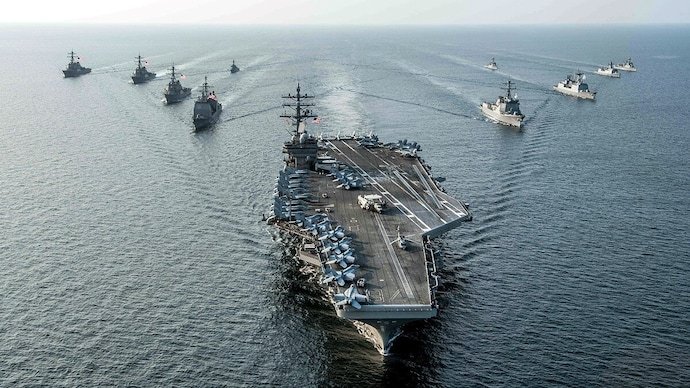
Iran may be moving down a path that appears unsettlingly familiar to what unfolded in Venezuela. Less than 45 days before the United States arrested Venezuelan President Nicolás Maduro and his wife, Washington had quietly repositioned one of its most powerful naval assets—the USS Gerald R. Ford carrier strike group—into the Caribbean.
Now, with tensions between Washington and Tehran sharply escalating and former US President Donald Trump issuing warnings over the execution of prisoners in Iran, the US Central Command (CENTCOM) has deployed another formidable force to the region: the USS Abraham Lincoln Carrier Strike Group.
India Today’s Open-Source Intelligence (OSINT) team has been tracking the movement of US naval assets across the Middle East. As American warplanes and aircraft carriers move closer to the Persian Gulf, Iran and its regional allies have repeatedly warned of an aggressive response to any potential US strike.
The flagship of Carrier Strike Group 3, the Nimitz-class nuclear-powered aircraft carrier USS Abraham Lincoln (CVN-72), transited the Strait of Malacca on January 19. The carrier was escorted by Arleigh Burke-class destroyers—USS Frank E. Petersen Jr. (DDG-121), USS Spruance (DDG-111), and USS Michael Murphy (DDG-112).
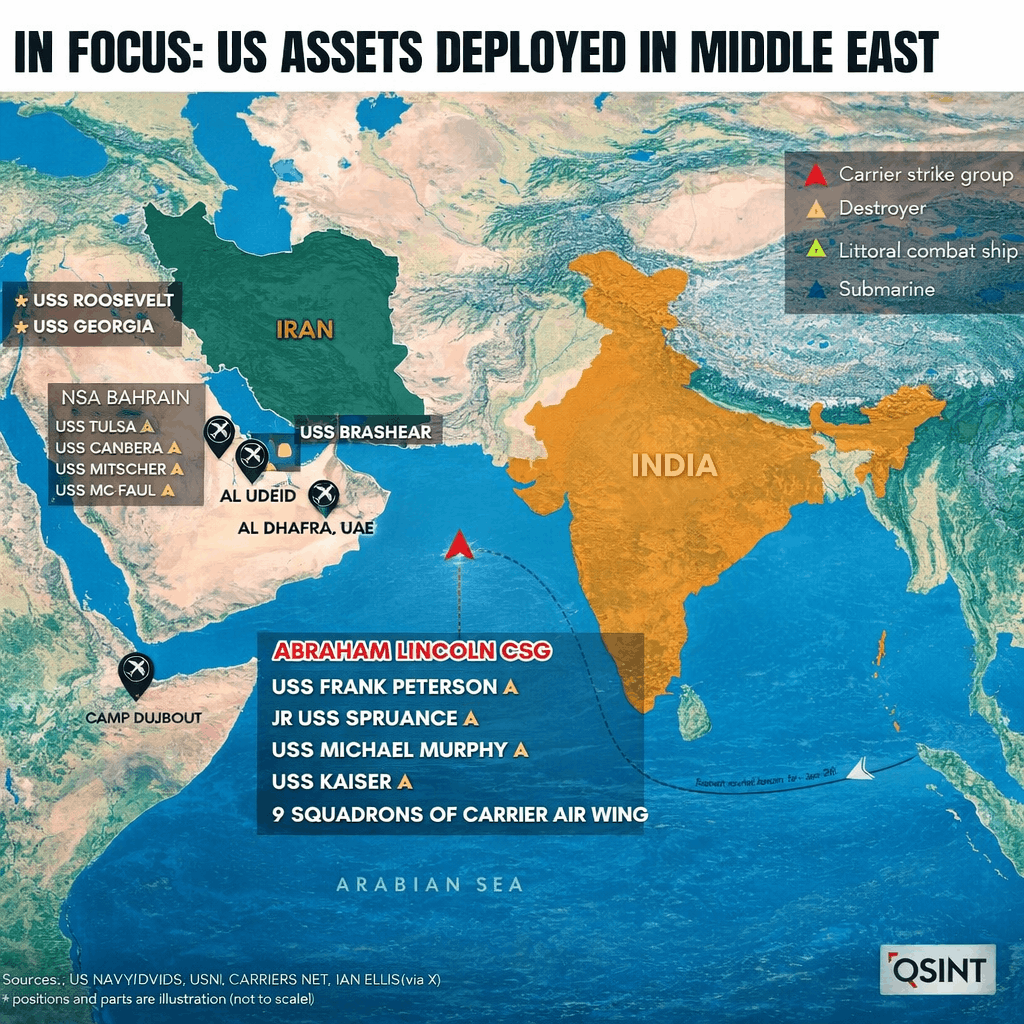
Scale of US Naval Presence in the Middle East
According to open-source naval tracking data and US military disclosures, at least one carrier strike group, six destroyers, four littoral combat ships, one submarine, and three logistics vessels are currently deployed across the Middle East region.
Western media reports confirm that as of Monday, the Abraham Lincoln—accompanied by three warships equipped with Tomahawk cruise missiles—entered CENTCOM’s area of responsibility in the western Indian Ocean. In theory, if the White House were to authorize military action against Iran, the carrier strike group could execute operations swiftly and with a high degree of independence.
The Abraham Lincoln Carrier Strike Group functions as a fully mobile airbase at sea, led by the aircraft carrier and supported by guided-missile destroyers, logistics ships, submarines, and Carrier Air Wing 9 (CVW-9).
A Floating Warfighting Ecosystem
The strike group is designed to conduct a wide spectrum of operations—from high-intensity wartime combat to deterrence and peacetime presence. Its integrated force structure allows it to influence the battlespace from the ocean floor to space.
After departing San Diego in late November 2025, the USS Abraham Lincoln operated extensively in the Philippine Sea and made a port visit to the US territory of Guam on December 11. The decision to redirect the carrier to the Middle East was taken barely two weeks ago, while the vessel was conducting live-fire drills and flight operations in the South china Sea.
Carrier Air Wing 9 forms the backbone of the strike group’s offensive and defensive power. It brings together strike, surveillance, electronic warfare, logistics, and command-and-control capabilities into a single, cohesive force.
Inside the Air Power of the USS Abraham Lincoln
The air wing includes stealth F-35C Lightning II fighter jets and F/A-18 Super Hornets, which carry out the bulk of strike missions. Specialized aircraft conduct electronic warfare by jamming enemy radars and communications, while airborne early warning platforms maintain persistent airspace surveillance.
Support aircraft and helicopters further enhance the carrier’s autonomy. CMV-22B Ospreys operated by the “Titans” handle long-range logistics, while MH-60S and MH-60R helicopters flown by the “Chargers” and “Raptors” perform search and rescue, maritime patrol, and anti-submarine warfare.
Together, these assets transform the USS Abraham Lincoln into a self-sustaining, long-range strike platform capable of projecting power deep inland.
Missile Firepower and Regional Air Assets
Maritime OSINT analyst Ian Ellis estimates that US naval forces currently deployed in the region are carrying approximately 1,018 Tomahawk cruise missiles, each with a range exceeding 1,500 kilometres. This arsenal provides the US with significant stand-off strike capability against high-value targets.
In addition, Al Udeid Air Base in Qatar is hosting US Air Force F-35A stealth fighter jets. These aircraft previously played a decisive role during Operation Midnight Hammer in June last year, when Iranian nuclear facilities at Natanz, Fordow, and Isfahan were targeted. F-35As were the first to penetrate Iranian airspace, suppressing air defenses ahead of B-2 bomber strikes.
Political Signalling and Strategic Messaging
In early January, Donald Trump warned that if “innocent protesters” were killed, the United States was “locked and loaded.” Days later, he urged Iranian demonstrators to continue protesting, stating that “help is on its way.” Soon after, Iranian security forces launched a sweeping crackdown that Human Rights groups claim resulted in thousands of deaths.
The redeployment of the Abraham Lincoln from the South China Sea now leaves only the USS George Washington (CVN-73) as the sole US aircraft carrier in the broader Indo-Pacific region. The forward-deployed carrier, based in japan, is currently undergoing maintenance.
The growing concentration of US naval and air power near Iran underscores Washington’s readiness to escalate if required, while also serving as a powerful signal of deterrence in an increasingly volatile region.
For breaking news and live news updates, like us on Facebook or follow us on Twitter and Instagram. Read more on Latest World on thefoxdaily.com.





COMMENTS 0