Washington Signals Military Strength as Diplomacy with Iran Resumes
In a significant show of force coinciding with renewed diplomatic engagement, the United States has deployed more than 50 advanced fighter jets to the Middle East within a 24-hour window. The move comes as indirect nuclear negotiations between Washington and Tehran resume in Geneva, highlighting what officials describe as a parallel strategy of military reinforcement and diplomatic outreach.
According to senior US officials, the rapid deployment includes some of the most sophisticated aircraft in the American arsenal — F-22 Raptors, F-35 Lightning II stealth fighters, and F-16 Fighting Falcons — alongside multiple aerial refueling tankers. The scale and speed of the operation underscore Washington’s intent to maintain strategic leverage while talks continue over Iran’s nuclear program.
A US official confirmed that more than 50 fighter jets were repositioned to the region in less than 24 hours. The buildup was first reported by Axios, citing sources familiar with the aircraft movements. Independent flight-tracking platforms and military aviation observers also recorded increased activity, noting formations of fighter jets accompanied by tanker aircraft, signaling preparations for sustained operations rather than a temporary deployment.
The deployment reflects a broader recalibration of US force posture in the Middle East at a time of heightened geopolitical sensitivity. Defense analysts view the move as both a deterrent message and a safeguard for American interests and regional allies.
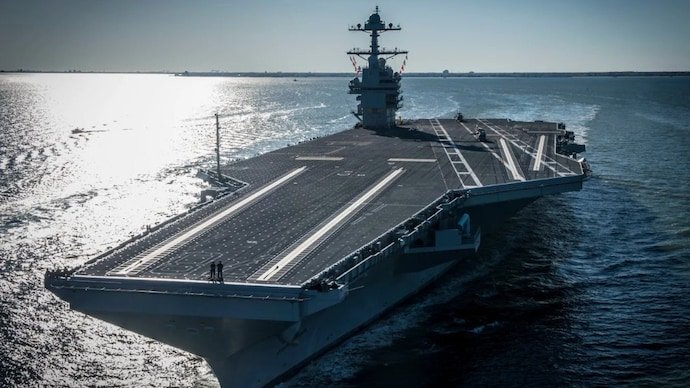
USS Gerald R. Ford Carrier Strike Group Moves Toward the Region
In parallel with the airpower surge, the USS Gerald R. Ford aircraft carrier strike group has departed the Caribbean and entered the mid-Atlantic, en route to the Middle East. A US Navy official, speaking on condition of anonymity due to operational sensitivity, confirmed the carrier’s movement earlier this week.
According to reports from the Associated Press, the Ford is sailing with three guided-missile destroyers — the USS Mahan, USS Bainbridge, and USS Winston Churchill. The strike group represents one of the most capable naval formations in the world, equipped with advanced radar systems, missile defense capabilities, and carrier-based air wings capable of conducting sustained combat operations.
While reports indicate that the carrier recently transited near the Strait of Gibraltar, officials caution that the group remains more than a week away from waters near Iran. Nevertheless, its movement significantly strengthens the US naval presence in the broader Middle East.
Earlier this year, the USS Abraham Lincoln carrier strike group and additional American aviation and naval assets were already positioned in the region. The addition of the Gerald R. Ford further enhances Washington’s ability to project power and respond rapidly to emerging threats.
Cautious Progress in US-Iran Nuclear Talks
Despite the visible military buildup, both US and Iranian officials have struck a cautiously optimistic tone regarding ongoing diplomacy. The second round of indirect nuclear discussions in Geneva reportedly made measurable progress, though substantial differences remain.
US officials described the talks as constructive but emphasized that “a lot of details” still need to be resolved. According to one American official, Iranian representatives agreed to return within two weeks with more comprehensive proposals aimed at addressing unresolved gaps in the negotiating positions. The discussions reportedly involved senior envoys, including representatives linked to former president Donald Trump’s diplomatic circle.
Iranian Foreign Minister Abbas Araghchi characterized the negotiations as “serious, constructive, and positive.” In remarks carried by Iranian state media, he stated that meaningful progress had been made compared to prior meetings and that a clearer framework for further engagement had emerged.
“Ultimately, we were able to reach a general understanding on a set of guiding principles,” Araghchi said, while cautioning that an agreement would not materialize quickly. His remarks suggest both momentum and realism regarding the complexity of nuclear negotiations.
Omani Foreign Minister Badr Albusaidi, who played a mediating role in facilitating the talks, echoed that sentiment. He noted that the negotiations concluded with “good progress towards identifying common goals and relevant technical issues,” signaling incremental but tangible diplomatic movement.
Strategic Dual-Track Approach: Deterrence and Dialogue
From a strategic standpoint, the United States appears to be pursuing a calibrated dual-track policy: reinforcing its military footprint while simultaneously engaging in diplomacy. Defense experts note that deploying advanced stealth fighters such as the F-22 and F-35 provides air superiority and deep-strike capability, reinforcing deterrence at a critical juncture.
At the same time, the continuation of talks in Geneva demonstrates that diplomatic channels remain open. The combination of military readiness and negotiation reflects a broader US strategy aimed at preventing escalation while maintaining pressure.
As developments unfold, the Middle East once again finds itself at the intersection of high-stakes diplomacy and strategic military positioning. Whether the parallel tracks of force projection and negotiation converge into a lasting agreement remains to be seen. For now, Washington’s message is clear: it is prepared to negotiate — and prepared to act.
For breaking news and live news updates, like us on Facebook or follow us on Twitter and Instagram. Read more on Latest World on thefoxdaily.com.






COMMENTS 0