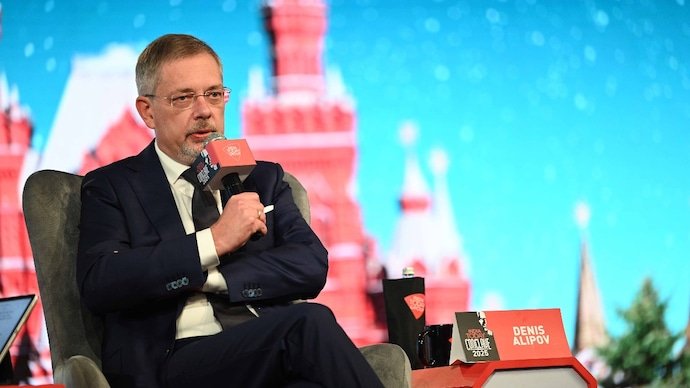
- Russian Ambassador Raises Concerns Over US Sanctions on Energy Trade
- Russia’s View on Escalating Conflict in West Asia
- Russia’s Position on Iran and Regional Stability
- US Attitude Toward Global Partnerships Criticized
- Global Energy Market Challenges and Rising Oil Prices
- Rise of a Multipolar Global Order
- Russia–Ukraine Conflict and NATO’s Role
- De-Dollarization and the Global Financial System
- India’s Growing Global Influence
At a time when global geopolitical tensions are rising sharply, Russian Ambassador to India Denis Alipov delivered a strong critique of American foreign policy during an exclusive interview with India Today Global. In a wide-ranging conversation, the ambassador addressed several key global issues including energy security, the Russia–Ukraine war, the growing tensions in West Asia, and the evolving global power structure.
Ambassador Alipov also spoke about India’s strategic autonomy, the impact of Western sanctions on Global energy markets, and Russia’s position on the ongoing conflicts affecting the international order. His remarks highlight the growing importance of Russia–India relations in an increasingly multipolar world.
During the discussion with journalist Geeta Mohan, Alipov addressed the recent developments regarding US sanctions related to Russian Oil. Washington has recently indicated that countries may purchase Russian oil due to energy concerns triggered by instability in the Middle East.
Previously, certain countries like India were granted limited exemptions to buy Russian crude oil despite Western sanctions imposed after the Russia–Ukraine conflict. However, the current global situation has forced a broader relaxation of restrictions.
Russian Ambassador Raises Concerns Over US Sanctions on Energy Trade
Responding to questions about the shift in US policy allowing more countries to buy Russian oil, Ambassador Alipov expressed skepticism about the reliability of such decisions.
According to him, there is always a possibility that Washington could reimpose sanctions at any moment. He stressed that the sanctions imposed on Russia have negatively affected not only Moscow but also many countries that depend on stable energy supplies.
Alipov described the sanctions as “unlawful and unilateral,” arguing that such measures disrupt global trade and undermine the energy security of countries that rely heavily on imported fuel.
He also criticized what he described as a double standard in Western policies, saying that Western countries often apply one set of rules for themselves and another for the rest of the world.
According to the ambassador, excluding Russia from global energy markets would create severe disruptions and lead to rising prices worldwide. Russia, he argued, plays an important role in stabilizing global energy supply and maintaining balance in the international energy market.
Russia’s View on Escalating Conflict in West Asia
During the interview, the discussion also shifted toward the rapidly escalating situation in West Asia. The region has been witnessing rising tensions following military confrontations involving Iran and Israel, along with broader geopolitical implications.
Ambassador Alipov expressed concern that the ongoing confrontation could escalate into a wider regional war if diplomatic efforts fail. He stressed that the only viable solution for the crisis is an immediate ceasefire and a return to negotiations.
According to Alipov, Russia supports diplomatic engagement as the primary path to resolving conflicts not only in the Middle East but also in other global hotspots such as Ukraine.
He also criticized what he described as the use of negotiations as a “smokescreen” by Western powers while preparing for military actions. In his view, such strategies damage trust in international diplomacy.
Russia, he said, has consistently called for de-escalation and peaceful dialogue, warning that further escalation could destabilize the entire Middle East region.
Russia’s Position on Iran and Regional Stability
Alipov confirmed that Russia has publicly supported Iran’s position at international platforms including the United Nations. However, he refrained from discussing any potential military or strategic assistance beyond diplomatic backing.
The ambassador emphasized that accusations regarding Iran’s nuclear weapons program remain controversial. According to him, there is no conclusive evidence that Iran possesses nuclear weapons or weapons-grade nuclear material.
While acknowledging Israel’s security concerns, he argued that military responses must remain proportionate and should not escalate into broader conflicts.
Alipov reiterated that negotiations between Iran and its adversaries remain the only viable solution for achieving long-term stability in the Middle East.
US Attitude Toward Global Partnerships Criticized
One of the strongest remarks during the interview came when Ambassador Alipov criticized the United States’ approach to international partnerships.
He argued that the US often treats other countries not as equal partners but as subordinate allies. According to him, Washington tends to dictate terms and policies instead of engaging in balanced cooperation.
“Everywhere it conducts business, the United States shows its arrogance,” Alipov said, adding that such an approach undermines trust and creates uncertainty in international relations.
He also stated that many countries would prefer to cooperate with the US as equal partners but feel constrained by Washington’s tendency to impose unilateral decisions.
Global Energy Market Challenges and Rising Oil Prices
The Russian envoy also discussed how geopolitical tensions and sanctions have affected global energy markets. According to him, instability in major oil-producing regions combined with sanctions on energy exporters has increased volatility in oil prices.
Countries such as Venezuela, Iran, and Russia — major energy producers — have all faced economic pressure from sanctions in recent years. This has created uncertainty in global energy supply chains.
Alipov warned that if current geopolitical volatility continues, the global economy could face long-term instability due to rising fuel costs and disrupted energy supplies.
| Key Issue | Russia’s Position | Impact on Global Politics |
|---|---|---|
| US Sanctions on Russian Oil | Russia calls them unlawful and harmful to energy markets | Creates volatility in global oil supply |
| Middle East Conflict | Russia supports immediate ceasefire and negotiations | Risk of wider regional war if tensions escalate |
| Global Energy Security | Russia sees itself as a stabilizing supplier | Important for countries like India |
| Multipolar World Order | Russia believes global power is shifting | Greater role for emerging powers like India and China |
Rise of a Multipolar Global Order
Another major theme of the interview was the transformation of the global power structure. Ambassador Alipov argued that the world is gradually moving away from a unipolar system dominated by a single superpower.
Instead, he said, a multipolar world order is emerging where several major countries play significant roles in shaping global politics and economics.
He pointed out that countries like India and china are becoming increasingly influential on the world stage. According to him, this shift is not driven by ideology but by objective global trends.
Alipov suggested that the United States and Western powers should adapt to this new reality and treat emerging powers as equal partners rather than attempting to dominate international decision-making.
Russia–Ukraine Conflict and NATO’s Role
The ambassador also addressed the ongoing Russia–Ukraine War and the role played by NATO in the conflict. He stated that diplomatic negotiations between Russia and Ukraine are still ongoing but remain complex and difficult.
Alipov described NATO as a military alliance that has historically taken an anti-Russian stance. According to him, NATO’s expansion and policies have contributed to instability in Europe rather than promoting shared security.
Unless NATO changes its policies toward Russia, he said, building a cooperative security framework in Europe will remain difficult.
De-Dollarization and the Global Financial System
Another key topic discussed during the interview was the growing debate around de-dollarization — the process through which countries reduce their reliance on the US dollar in international trade.
Alipov argued that the trend toward de-dollarization is largely a consequence of US sanctions policies. According to him, Russia did not voluntarily move away from the dollar; rather, restrictions on access to dollar transactions and the SWIFT financial system forced Moscow to explore alternative systems.
As a result, several countries are now considering alternative financial mechanisms to avoid exposure to unilateral sanctions imposed by any single nation.
India’s Growing Global Influence
Ambassador Alipov concluded by emphasizing India’s growing importance in the evolving global order. He noted that leaders from Europe, Canada, and other regions have increasingly been engaging with India in diplomatic and economic discussions.
According to him, this reflects India’s rising geopolitical and economic influence in the world. Along with China, India is becoming one of the key pillars of the emerging multipolar global system.
Alipov also stressed that global governance institutions such as the United Nations must be strengthened to ensure fair representation and balanced decision-making in international affairs.
He concluded that the world is currently facing a serious security crisis, and resolving it will require stronger cooperation, equal participation of major powers, and renewed commitment to international diplomacy.
For breaking news and live news updates, like us on Facebook or follow us on Twitter and Instagram. Read more on Latest World on thefoxdaily.com.




COMMENTS 0