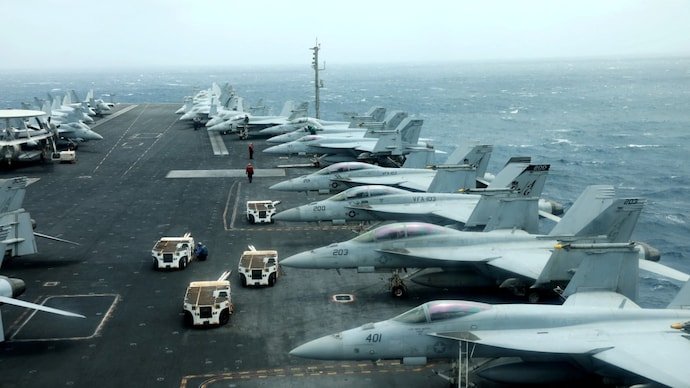
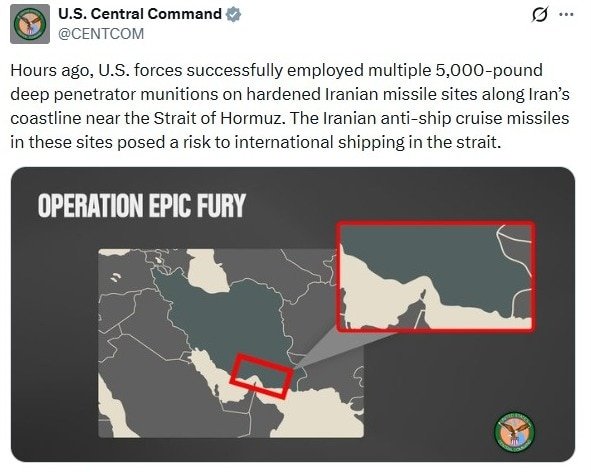
The United States has carried out precision Airstrikes on Iranian missile installations located along the southern coastline near the strategically critical Strait of Hormuz. According to US Central Command (CENTCOM), the operation involved the deployment of powerful 5,000-pound (approximately 2,200 kg) bunker-buster bombs aimed at neutralizing hardened missile positions.
These strikes are part of ongoing military efforts to address perceived threats to international maritime traffic in one of the world’s most vital oil transit chokepoints. The Strait of Hormuz handles a significant portion of Global energy shipments, making its security a top priority for international stakeholders.
US Targets Iranian Anti-Ship Missile Systems
In an official statement shared via Social Media, US Central Command confirmed that American forces successfully conducted strikes on fortified Iranian missile sites. The operation specifically targeted anti-ship cruise missiles that were considered a direct threat to vessels navigating through the Strait of Hormuz.
According to the military, these missile systems posed a serious risk to commercial and military shipping lanes, prompting swift action. The use of deep-penetration munitions indicates that the targeted sites were heavily reinforced and required specialized weaponry to ensure effective neutralization.
Details of the Military Operation
The strikes were executed during the early hours of Wednesday (IST), demonstrating the urgency and strategic importance of the mission. These bunker-buster bombs are designed to penetrate deeply buried or reinforced targets before detonation, making them particularly effective against underground missile facilities.
| Operation Detail | Information |
|---|---|
| Target Location | Iran’s southern coastline near Strait of Hormuz |
| Primary Target | Anti-ship cruise missile installations |
| Weapon Used | 5,000-pound (2,200 kg) bunker-buster bombs |
| Objective | Reduce threat to international shipping routes |
Geopolitical Context and NATO Response
The announcement of the strikes came shortly after US President Donald Trump indicated that several NATO allies were hesitant to actively participate in military operations related to Iran. While many allied nations have expressed political support, there appears to be reluctance to commit military resources on the ground or at sea.
Trump publicly criticized the lack of direct involvement, stating that although allies support the broader objectives, they are unwilling to contribute militarily. His remarks reflect growing frustration within the US administration regarding burden-sharing among allied nations.
In recent days, the US had urged partner countries to deploy naval forces to escort commercial shipping vessels through the Strait of Hormuz. However, responses from several nations have been cautious, with many opting to avoid direct involvement in the escalating conflict.
Global Reactions and Strategic Hesitation
Key international players have signaled their reluctance to escalate military engagement. Germany’s foreign minister, Johann Wadephul, reportedly stated that his country has no plans to become actively involved in the conflict. Similarly, France has taken a cautious stance, emphasizing the need for de-escalation before considering any military deployment.
These responses highlight a broader concern among global powers about the risks of further escalation in an already volatile region. Many countries appear to be prioritizing diplomatic solutions over direct military participation.
| Country | Position on Military Involvement |
|---|---|
| United States | Actively conducting military operations |
| Germany | No plans for active involvement |
| France | Prefers de-escalation before engagement |
| Other Allies | Cautious, no immediate deployment commitments |
Impact on Global Oil Supply and Economy
The Strait of Hormuz is one of the most critical maritime chokepoints in the world, with approximately 20% of global oil supply passing through it. Due to the ongoing conflict and rising security concerns, shipping activity in the region has been significantly disrupted.
The effective closure or restricted access to this vital route has led to sharp increases in global fuel prices, raising concerns about inflation and economic instability in multiple regions. Energy markets continue to react to developments, with volatility expected to persist as the situation evolves.
As tensions remain high and military actions continue, the international community is closely monitoring the situation. The coming days will be crucial in determining whether the conflict escalates further or moves toward a diplomatic resolution.
For breaking news and live news updates, like us on Facebook or follow us on Twitter and Instagram. Read more on Latest World on thefoxdaily.com.






COMMENTS 0