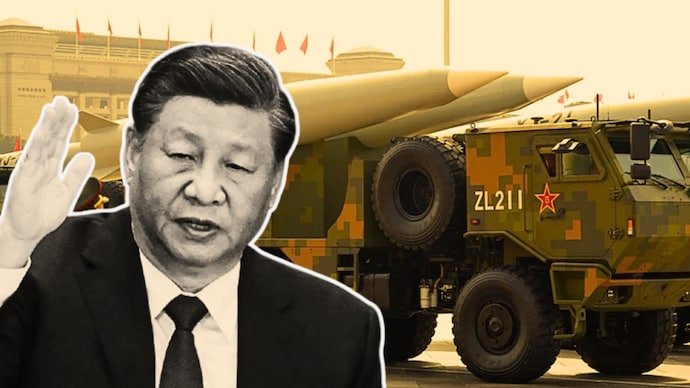
At the press of a button, china’s nuclear missiles stationed deep inside hardened silos in western regions such as Xinjiang are designed to travel thousands of kilometres. But according to sources citing US intelligence, some of these missiles may not have launched at all during a real crisis — not because of enemy action, but due to internal failures. Reports suggest that silo lids were too heavy to open and, more shockingly, that certain missiles were filled with water instead of fuel.
These revelations are now being linked to one of the most significant military purges under Chinese President Xi Jinping. The removal of top leadership from the People’s Liberation Army (PLA) Rocket Force in 2023 and 2024, and the recent reported detention of General Zhang Youxia, appear to be part of a broader crackdown aimed at corruption and restoring operational readiness in China’s strategic forces.
Zhang Youxia was China’s highest-ranking uniformed military officer and a close adviser to President Xi. After Xi himself, Zhang was the most senior figure in the Central Military Commission, the apex body overseeing China’s armed forces.
According to multiple reports, Zhang was detained on January 19 on allegations of accepting bribes in exchange for promotions, undermining the PLA’s combat readiness, and allegedly leaking sensitive information related to China’s nuclear weapons programme to the United States. While Chinese authorities have not officially confirmed these charges, state-linked commentary has hinted at the seriousness of the accusations.
The South China Morning Post, citing a recent article in PLA Daily, quoted a stern warning from the military establishment: “[We] must take strong and forceful measures to crack down on corrupt practices that undermine the building of combat abilities, and thoroughly investigate and root out those ‘big rats’ who tamper with military spending.”
Zhang’s downfall is widely seen as the most high-profile episode in a string of purges, particularly within the PLA Rocket Force — the unit responsible for managing China’s nuclear and conventional missile arsenal. The Rocket Force leadership was extensively reshuffled in 2023 and 2024, signalling deep concerns within the Communist Party about the reliability of China’s strategic deterrent.
Experts argue that Zhang’s detention goes beyond personal corruption and points to systemic problems affecting China’s military preparedness. Corruption, they say, directly weakens combat effectiveness and poses a strategic risk at a time when Beijing is seeking to project power in the region.
A 2024 Bloomberg report, citing US intelligence officials, claimed that “entire fields of silos in a Xinjiang missile complex were fitted with lids that prevented missiles from launching effectively.” The report further stated that the wider military purge stemmed from “serious equipment issues,” including missiles allegedly filled with water instead of fuel.
The allegations sparked intense debate among defence analysts. A January 2025 report by the Washington-based Centre for Strategic and International Studies (CSIS) noted that while some missiles may currently be non-operational, Xi Jinping’s aggressive response to corruption indicated a determination to rapidly strengthen China’s nuclear forces.
“Although some of China’s missiles may currently contain water, it cannot be expected that this will continue,” the CSIS report stated, adding that the purge reflects Xi’s resolve to eliminate vulnerabilities in China’s strategic deterrence.
Not all observers agree with the US intelligence assessment. Asia Times pushed back against the Bloomberg claims, arguing that China does not store liquid-fuelled missiles with propellant inside silos because it would corrode internal tanks. According to the report, missiles are typically kept empty until shortly before launch.
“There would be no reason to put water in the missiles unless it was deliberate sabotage,” Asia Times argued in a January 2024 analysis, suggesting that if true, the issue would point to internal subversion rather than routine corruption.
The timing of Zhang’s purge is also geopolitically significant. China has intensified military manoeuvres around Taiwan — which Beijing considers its territory under the One China Policy — while simultaneously adopting a more confrontational posture towards japan. These actions underscore the importance Xi places on ensuring the PLA is fully prepared for potential conflict.
Many Western intelligence analysts, including former CIA officials, believe 2027 could be a critical year in which China might attempt military action against Taiwan. In that context, any doubts about missile reliability or command integrity would be unacceptable for Beijing’s leadership.
“I think [the purges] show not that Xi is distracted from operational issues, but that he’s laser-focused on them,” Jonathan Czin, a senior fellow at the Brookings Institution, told The Telegraph. “He wants the military to be up to standard, and he’s willing to be unforgiving because he’s focused on the underlying objectives.”
Former CIA analysts cited by The Telegraph echoed this view, suggesting that Xi’s crackdown is as much about preparing the PLA for real-world contingencies as it is about stamping out corruption. The paper linked Zhang Youxia’s ouster directly to the Rocket Force purge, which reportedly began with concerns over heavy silo lids and water-filled missiles.
Together, these developments point to a sobering conclusion: China’s sweeping military purge may not simply be political theatre, but a response to deeply troubling flaws in the country’s most sensitive weapons systems — flaws that Xi Jinping appears determined to eliminate before they become a strategic liability.
For breaking news and live news updates, like us on Facebook or follow us on Twitter and Instagram. Read more on Latest World on thefoxdaily.com.



COMMENTS 0