As the United States sharpens its rhetoric and tariff threats against India over its continued purchases of Russian crude oil, Poland has emerged as a notable European voice backing New Delhi. The show of support comes amid growing strains in India–US relations, triggered by Washington’s push to economically penalise countries trading with Moscow.
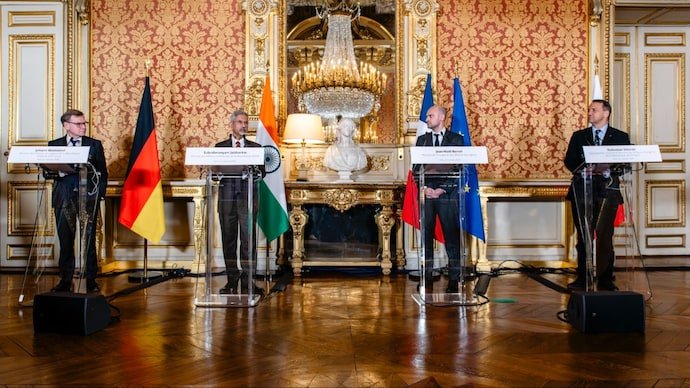
Polish Foreign Minister Radosław Sikorski, speaking in Paris during India’s first-ever engagement with the Weimar Triangle group, welcomed India’s recent steps to reduce Russian oil imports. His remarks stood in contrast to the increasingly confrontational tone adopted by the United States.
Standing alongside India’s External Affairs Minister S. Jaishankar and senior European leaders, Sikorski said, “I expressed my satisfaction that India has reduced Russian oil imports because this is fueling Putin’s war machine.”
He added that discussions on the issue would continue during his upcoming visit to India next week, signalling Warsaw’s preference for dialogue rather than coercive measures.
US Escalates Tariff Pressure on India
Sikorski’s comments came against the backdrop of rapidly deteriorating trade ties between Washington and New Delhi. US President Donald Trump has already imposed tariffs of up to 50% on several Indian imports, combining a 25% reciprocal levy with an additional 25% penalty linked directly to India’s purchases of Russian energy.
Adding to the pressure, Trump has reportedly approved a bipartisan bill that would empower the US administration to impose punitive tariffs of up to 500% on countries that “knowingly purchase” Russian oil or uranium. Republican Senator Lindsey Graham described the proposal as having the president’s backing, with a vote potentially taking place as early as next week.
Trump has warned publicly that tariffs on India could be increased “very quickly,” suggesting that Prime Minister Narendra Modi was aware of his displeasure over New Delhi’s energy dealings with Moscow.
Jaishankar’s Key Diplomatic Outreach in Europe
Amid these tensions, External Affairs Minister S. Jaishankar’s visit to Europe has taken on added significance. Addressing the gathering in Paris, Jaishankar stressed the importance of strengthening India’s partnerships with European powers at a time of heightened global uncertainty.
“What kind of society are we hoping to inhabit? What would be the norms and the other related issues?” Jaishankar asked, underlining Europe’s central role in global affairs. He added that deeper India–Europe ties could help bring greater stability to both global politics and the world economy.
During the visit, Jaishankar met with French Foreign Minister Jean-Noël Barrot, German representatives, and Poland’s Sikorski as part of India’s inaugural engagement with the Weimar Triangle.
The Weimar Triangle—formed in 1991 by France, Germany, and Poland—was created to promote European integration, political dialogue, security cooperation (particularly concerning Russia and Ukraine), and stronger economic and cultural ties. The grouping takes its name from the German city of Weimar, where the three countries first convened.
Jaishankar described the discussions as brief but candid, covering issues ranging from the Ukraine conflict and the Indo-Pacific to India–EU relations. He noted that India’s relationship with the European Union and its member states represented one of New Delhi’s “greatest unrealised potentials.”
In the coming weeks, India is set to host French President Emmanuel Macron, German Chancellor Friedrich Merz, and senior EU leaders—underscoring New Delhi’s effort to consolidate global partnerships as pressure from Washington intensifies.
India Recalibrates Its Energy Strategy
Parallel to the diplomatic outreach, India has been quietly recalibrating its energy strategy. Data from the Centre for Monitoring Indian economy (CMIE) shows that Russia’s share of India’s monthly crude oil imports ranged between 27% and nearly 39% up to November 2025.
Imports peaked in November at 7.7 million tonnes, accounting for over 34% of India’s total crude consumption. However, since then, Russia’s share has declined to below 25%, with indications that it may fall further in the current month.
According to the Centre for Research on Energy and Clean Air, India’s daily imports of Russian oil via non-sanctioned entities dropped to around 72.9 million euros in early January. This marks a sharp decline from a peak of 189 million euros in July 2023 and 130.5 million euros in late November.
Following fresh US sanctions, several major refiners—including Reliance Industries, HPCL, and MRPL—have halted imports of Russian oil. Others continue to source crude from non-sanctioned suppliers, reflecting India’s cautious and pragmatic approach.
Despite the reductions, India remains one of Russia’s largest oil consumers, having purchased an estimated 144 billion euros worth of crude since the Ukraine conflict began in 2022. This highlights the delicate balancing act New Delhi faces as it navigates geopolitical pressure, energy security, and economic stability.
Poland’s supportive stance, therefore, offers India valuable diplomatic breathing room in Europe, even as the US adopts an increasingly hardline approach on Russian oil.
For breaking news and live news updates, like us on Facebook or follow us on Twitter and Instagram. Read more on Latest World on thefoxdaily.com.



COMMENTS 0