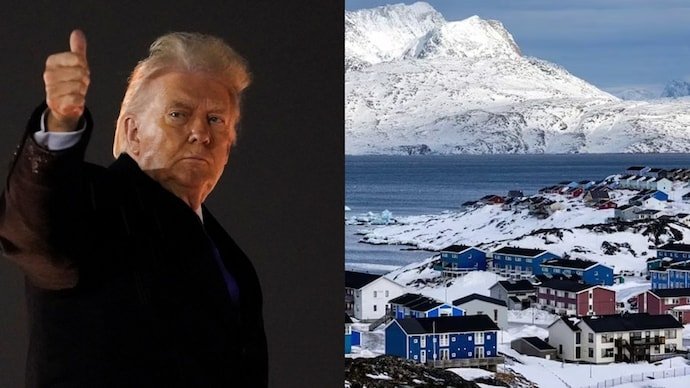
It is no secret that US President Donald Trump has renewed his long-standing interest in acquiring Greenland, the vast Arctic island that operates as an autonomous territory under Denmark and is part of the NATO alliance. Trump has repeatedly argued that Greenland’s strategic location and mineral wealth make it critical to US national security, and he has not ruled out the use of military force to achieve that goal.
On Friday, Trump escalated his rhetoric, suggesting that Washington may be forced to pursue more aggressive measures if diplomatic efforts fail. Speaking to reporters, he said, “I would like to make a deal the easy way. But we’re going to do it the hard way if we don’t take the simple route.” In the same remarks, he attempted to strike a conciliatory tone toward Copenhagen, adding that he admires Denmark and considers the country friendly toward him.
The comments come amid Greenland’s repeated insistence that the island is not for sale and growing unease in Denmark over Washington’s intentions. Against this backdrop, senior diplomats from both Denmark and Greenland met with White House officials on Thursday. Further talks involving representatives from Denmark, Greenland, and the United States are scheduled for next week as pressure mounts over the future of the Arctic territory.
Trump reinforced his stance by stating that the US would “do something on Greenland, whether they like it or not.” While he again referred to taking the “hard way” if necessary, he offered no details about what such an approach might involve.
In an interview with The New York Times, Trump argued that outright ownership of Greenland would provide advantages that agreements alone cannot deliver. “Ownership gives you things and elements that you can’t get from just signing a document,” he said, responding to Danish Prime Minister Mette Frederiksen’s warning that any American takeover of Greenland could mark the end of NATO and would not be supported by Greenland’s population.
With tensions rising, the Associated Press has examined the potential options available to the United States and the major obstacles that stand in the way of any attempt to take control of Greenland.
Military Action Could Reshape Global Alliances
Trump and senior US officials have argued that greater control over Greenland would enhance American security and open the door to expanded commercial and mining activity. However, Imran Bayoumi, associate director at the Atlantic Council’s Scowcroft Center for Strategy and Security, said the sudden focus on Greenland also reflects decades of neglect by previous US administrations toward Arctic strategy.
According to Bayoumi, the renewed interest stems from a growing realization that the United States lacks a comprehensive Arctic vision despite increasing geopolitical competition in the region. He said Washington is now scrambling to assert its presence without having laid the groundwork over previous decades.
Any attempt by the United States to seize Greenland by force would pose an existential challenge to NATO. While Greenland is the world’s largest island, it has a population of only around 57,000 people and no independent military. Denmark remains responsible for its defense, but its armed forces are vastly smaller than those of the US.
If Washington were to act militarily, it remains unclear how other NATO members would respond or whether they would come to Denmark’s defense. Frederiksen has warned that a military attack by one NATO member against another would bring the alliance to a standstill.
Lin Mortensgaard, an Arctic security expert at the Danish Institute for International Studies, disputed Trump’s claims that Greenland is under immediate threat from Chinese and Russian naval activity. She said there is no significant presence of surface warships near Greenland, though Russian submarines do operate across the Arctic region.
Mortensgaard added that while china and Russia have conducted joint military drills in the Arctic, these exercises have taken place closer to Alaska. China’s involvement, she noted, has largely been limited to scientific research vessels operating in the central Arctic Ocean.
Bayoumi expressed skepticism that Trump would ultimately resort to military force, noting that such a move would be unpopular across the US political spectrum and would fundamentally damage relations with long-standing allies.
Mortensgaard said Denmark and Greenland would likely welcome a stronger American military presence, pointing out that the US already has access to Greenland under a 1951 defense agreement.
Ulrik Pram Gad, another DIIS expert, questioned the logic of undermining NATO for control of territory where the US already enjoys extensive military access. He described such a move as strategically unnecessary.
Bilateral Agreements Could Offer an Alternative Path
US Secretary of State Marco Rubio has privately told lawmakers that the administration prefers to pursue the eventual purchase of Greenland rather than use force. Both Danish and Greenlandic officials, however, have repeatedly stated that the island is not for sale.
Key questions remain unresolved, including whether Greenland would be purchased from Denmark or from Greenland’s own government, and how much such a transaction might cost.
Bayoumi said the United States could significantly expand its military footprint in Greenland through diplomacy and cooperation without resorting to annexation.
Gad pointed to arrangements similar to those Washington has with certain Pacific island nations, where the US holds veto power over security decisions without formal ownership.
Under Compacts of Free Association with Palau, Micronesia, and the Marshall Islands, the United States is allowed to operate military bases and oversee security matters in exchange for defense guarantees and billions of dollars in economic assistance.
Whether such an arrangement would meaningfully improve America’s current security posture in Greenland is unclear, especially since existing agreements already allow the US to deploy personnel freely to the Pituffik Space Base in the island’s northwest.
Influence Campaigns Likely to Fall Short
Greenlanders have little interest in becoming part of the United States, according to Greenlandic lawmaker Aaja Chemnitz. While many favor greater autonomy or independence, joining the US is not seen as a popular option.
Gad said efforts to influence public opinion in Greenland are unlikely to succeed, citing the island’s small population and linguistic barriers that make large-scale persuasion campaigns difficult.
Last August, Denmark’s foreign minister summoned the top US diplomat in Copenhagen over concerns that external actors were attempting to shape Greenland’s future. Danish media reported that individuals linked to Trump had conducted covert influence activities on the island.
Even if the US were to gain control of Greenland, Gad said the financial burden would be substantial. Greenlanders currently hold Danish citizenship and benefit from Denmark’s welfare system, including free Healthcare and education.
“To match that,” Gad said, “Trump would have to build a welfare state for Greenlanders that he does not want for his own citizens.”
Dispute Unlikely to Be Resolved Anytime Soon
According to Danish officials, the number of US troops stationed in Greenland has declined sharply since World War II, falling from several thousand across multiple bases to about 200 personnel at the remote Pituffik Space Base. The facility plays a key role in missile warning, missile defense, and space surveillance for both the US and NATO.
US Vice President JD Vance recently criticized Denmark for failing to invest adequately in Greenland’s missile defense. Mortensgaard countered that the criticism is misplaced, noting that the Pituffik base is operated by the US precisely to provide early missile detection.
Gad suggested that Denmark’s best option may be to update the existing defense agreement and have Trump formally endorse it. However, he said that outcome is unlikely because Greenland remains a politically useful topic for the US president.
“Trump can simply mention the word ‘Greenland,’ and the debate starts all over again,” Gad said, noting that the issue is often raised when the president seeks to shift attention away from domestic political challenges.
For breaking news and live news updates, like us on Facebook or follow us on Twitter and Instagram. Read more on Latest World on thefoxdaily.com.






COMMENTS 0