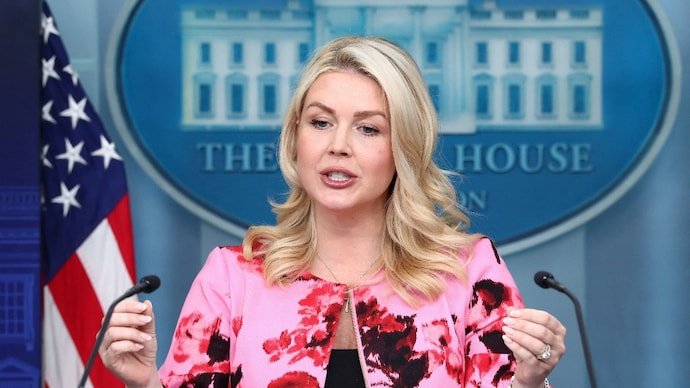
The White House has triggered fresh controversy during the ongoing Iran conflict after making explosive claims about the deaths of senior Iranian officials. According to Press Secretary Karoline Leavitt, several high-ranking Iranian leaders are no longer alive because they misled the United States during negotiations.
The statement comes at a time when backchannel diplomatic discussions between Washington and Tehran are reportedly still underway, even as military tensions continue to rise across the region.
Speaking at a White House briefing, Leavitt suggested that earlier rounds of negotiations failed due to dishonesty from Iranian leadership, leading to severe consequences.
“When the president says ‘more reasonable,’ these individuals appear more cooperative in private discussions than previous leaders—many of whom are no longer alive because they lied to the United States and dragged negotiations on,” she said. “That was unacceptable to the president.”
Her remarks have intensified global concerns about the direction of the conflict and the role of diplomacy moving forward.
Talks Continue Despite Rising Threats
Despite the strong rhetoric, Leavitt confirmed that discussions with Iran are still ongoing behind closed doors. She emphasized that the United States remains cautious and will closely monitor Iran’s commitments.
“Anything they say to us in private will be tested,” she stated. “We will ensure they follow through on their commitments.”
She also warned that failure to honor these commitments would result in serious military consequences, reinforcing the administration’s dual approach of diplomacy backed by force.
Leavitt described the current moment as a “historic opportunity” for Iran to abandon its nuclear ambitions and reach a deal with the United States, while cautioning that refusal could lead to “grave consequences.”
Trump May Seek Arab Funding for War Effort
During the same briefing, the White House hinted at a potential shift in how the war effort could be financed. President Donald Trump is reportedly considering asking Arab nations, particularly in the Gulf region, to contribute financially to the ongoing military campaign.
When questioned about the possibility, Leavitt responded, “I think it’s something the president would be quite interested in calling them to do.”
Although no formal plan has been announced, the idea reflects growing concerns within the administration over the rising costs of the conflict, especially amid resistance from the US Congress to approve additional funding.
REPORTER: ‘Who’s paying for the COST OF THIS WAR? Will those Arab countries step up?’
LEAVITT: ‘I think it’s something the president would be QUITE interested in calling them to do’ https://t.co/YNiSqqEUHd pic.twitter.com/JcTHdQl4ef
— RT (@RT_com) March 30, 2026
| Key Issue | Details |
|---|---|
| White House Claim | Iranian leaders allegedly killed due to misleading the US in negotiations |
| Ongoing Talks | Backchannel diplomacy continues despite rising tensions |
| Military Warning | US threatens consequences if Iran fails to honor commitments |
| War Funding Plan | Possible request for financial support from Arab nations |
| Strategic Goal | Pressure Iran to abandon nuclear ambitions and reach agreement |
Trump Signals “Regime Change”
A day before the briefing, President Donald Trump made bold remarks regarding the impact of US and Israeli strikes on Iran’s leadership. Speaking aboard Air Force One, he suggested that the scale of losses had effectively resulted in a “regime change.”
“They are all dead, and the one regime was completely dismantled. The next regime is mostly gone,” Trump stated.
He further described the current leadership as “very reasonable” and indicated that the United States is now dealing with an entirely new set of decision-makers in Tehran.
According to reports, the initial strikes that began on February 28 resulted in the deaths of Iran’s Supreme Leader Ayatollah Ali Khamenei, several top military officials, and members of their families. His son, Mojtaba Khamenei, was later named as his successor.
Threats Rise Alongside Diplomacy
Even as negotiations continue, President Trump has intensified his warnings toward Iran. He recently threatened to target Iran’s energy infrastructure if an agreement is not reached in the near future.
In addition, US officials confirmed ongoing communication with Mohammad Bagher Ghalibaf, Iran’s parliamentary speaker, who has issued warnings that American forces could face retaliatory attacks.
Iran, however, has not officially confirmed whether it is engaged in direct negotiations with the United States, adding further uncertainty to the situation.
Conflict Expands Across the Region
The conflict, which began with joint US-Israeli strikes on Iran on February 28, has since spread across the Middle East, drawing in multiple actors and destabilizing Global energy markets.
Israel has carried out strikes in Tehran and targeted Hezbollah-linked positions in Beirut, while Iran has launched missile attacks toward Israel and threatened Gulf nations.
NOW – White House’s Leavitt suggests Iran is lying about no negotiations taking place with the U.S. pic.twitter.com/wBYHIAzRIH
— Disclose.tv (@disclosetv) March 30, 2026
The Strait of Hormuz remains largely disrupted, raising serious concerns about global oil supply chains. The waterway is a critical route for international energy transport, and its instability has already impacted oil prices worldwide.
Meanwhile, the United States has increased its military presence in the region. Elements of the 82nd Airborne Division have been deployed, signaling Washington’s readiness to escalate if necessary.
As both diplomatic efforts and military operations continue simultaneously, the situation remains highly volatile, with global implications for security, energy markets, and international relations.
For breaking news and live news updates, like us on Facebook or follow us on Twitter and Instagram. Read more on Latest World on thefoxdaily.com.





COMMENTS 0