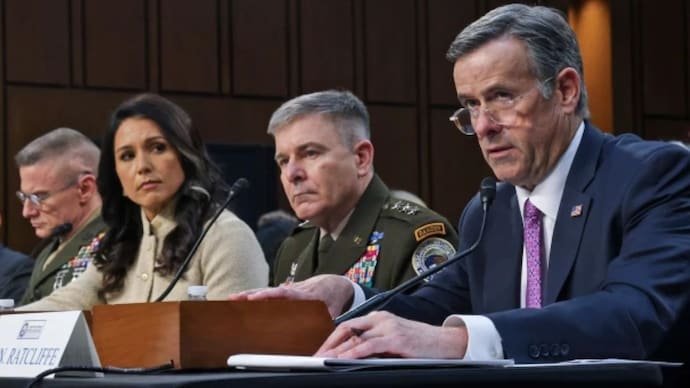
A growing divide between the White House and America’s top intelligence officials is becoming increasingly visible, as conflicting statements and subtle shifts in language cast doubt on the official rationale for the ongoing conflict with Iran. What emerged during a recent Senate Intelligence Committee hearing was not just testimony—but a revealing glimpse into internal disagreements at the highest levels of the U.S. government.
At the center of the controversy is Director of National Intelligence Tulsi Gabbard, whose written testimony suggested that Iran’s nuclear enrichment program had been effectively dismantled. According to the document submitted to lawmakers, key facilities had been destroyed and there were no clear signs of reconstruction efforts underway.
However, in a notable departure, Gabbard chose not to repeat this critical assessment during her verbal testimony before the committee. The omission immediately drew attention and sparked sharp questioning from lawmakers.
SENATE HEARING EXPOSES CRACKS
Senator Mark Warner was quick to challenge Gabbard, pointing out that she had excluded a crucial line that directly contradicted the administration’s justification for Military action. He pressed her on whether the intelligence community still stood by the written conclusion.
Gabbard confirmed that the assessment remained valid, reinforcing the idea that Iran’s nuclear capabilities may have already been neutralized prior to the escalation of conflict.
This revelation complicates the White House’s position. If Iran no longer posed an active nuclear threat, the argument that military intervention was necessary to prevent imminent danger becomes significantly weaker.
DIFFERENT OFFICIALS, DIFFERENT DEFINITIONS
Adding to the confusion is the inconsistent terminology used by senior officials. CIA Director John Ratcliffe described Iran as an “immediate threat,” a phrase that carries different legal implications than “imminent threat,” which is often used to justify preemptive military action under international law.
In contrast, Gabbard deliberately avoided labeling the threat as imminent, while Secretary of State Marco Rubio framed the U.S. response as a preventative move aligned with a potential Israeli strike rather than a direct reaction to an urgent threat.
These varying interpretations from key decision-makers have created a fragmented narrative, leaving both lawmakers and the public struggling to understand the true basis for the war.
| Official | Position | Statement on Iran Threat | Implication |
|---|---|---|---|
| Tulsi Gabbard | Director of National Intelligence | Avoided calling it “imminent”; written claim program was destroyed | Suggests threat may not justify war |
| John Ratcliffe | CIA Director | Called Iran an “immediate threat” | Raises urgency but lacks legal clarity |
| Marco Rubio | Secretary of State | Described action as “preventative” | Frames war as strategic, not reactive |
RESIGNATION ADDS TO TURMOIL
The situation intensified further with the resignation of Joe Kent, Director of the National counterterrorism Center and a close ally of Gabbard. His departure came just a day before the Senate hearing, amplifying speculation about internal disagreements within the administration.
In his resignation letter, Kent reportedly argued that Iran did not pose an immediate threat to the United States and suggested that the push for war may have been influenced more by external political pressures than by intelligence findings.
His exit marked the first high-level resignation tied directly to the conflict, signaling deeper fractures within the national security establishment.
POLITICAL BACKLASH BUILDS
Criticism of the war is not limited to intelligence circles. Prominent conservative figures have also voiced strong opposition, accusing the administration of abandoning its commitment to avoiding foreign entanglements.
Lawmakers such as Senator Rand Paul have raised constitutional concerns, while Congressman Thomas Massie has called for a formal congressional vote to authorize military action. These demands highlight growing unease about both the legality and necessity of the conflict.
The debate has also spilled into the media and public discourse, where influential voices are questioning whether the administration has been fully transparent about the intelligence behind its decisions.
THE STRATEGY BEHIND CAREFUL WORDING
Political analysts suggest that the carefully chosen language used by officials is unlikely to be accidental. By avoiding definitive statements and relying on nuanced terminology, key figures may be attempting to protect themselves from future political or legal consequences.
This strategic ambiguity allows officials to maintain flexibility while preserving plausible deniability, especially in a situation where the long-term outcomes of the conflict remain uncertain.
A WAR ON TWO FRONTS
As the situation continues to evolve, it is becoming clear that the conflict is not confined to the battlefield. A parallel struggle is unfolding within Washington itself—one defined by competing narratives, institutional tensions, and questions over accountability.
With each new revelation, the gap between intelligence assessments and political messaging appears to widen. The decisions made in this environment will not only shape the course of the Iran war but could also redefine the relationship between intelligence agencies and political leadership in the years ahead.
For breaking news and live news updates, like us on Facebook or follow us on Twitter and Instagram. Read more on Latest World on thefoxdaily.com.




COMMENTS 0