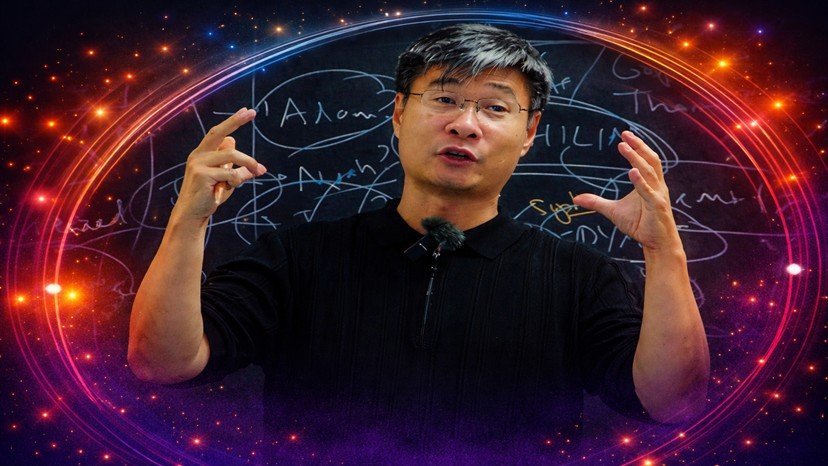
In recent months, a relatively unknown figure named Jiang Xueqin has rapidly gained global attention, earning nicknames like “china’s Nostradamus.” His rise to fame has been fueled by viral interviews, bold geopolitical predictions, and a growing online following. But as his influence expands, so do questions about his background, credibility, and the narratives he promotes.
The Viral Moment That Sparked Global Attention
A defining moment in Jiang Xueqin’s rise came during a lengthy interview with American commentator Tucker Carlson. After nearly 68 minutes of discussion, Carlson remarked emotionally that listening to Jiang made him feel like he might cry — a statement that quickly captured public attention and helped the video go viral.
Since then, Jiang’s content — often featuring whiteboard explanations, game theory frameworks, and sweeping historical patterns — has attracted millions of viewers. His YouTube channel, Predictive History, now boasts over two million subscribers, and his ideas are widely shared across Social Media platforms.
In countries like India, where Global energy developments are closely watched, his predictions about geopolitical instability and oil supply disruptions have found a particularly receptive audience.
The “Professor” Label and Questions of Credibility
Jiang is frequently referred to as “Professor Jiang” in online videos and media mentions, a title that suggests academic authority. However, closer examination reveals a different picture.
He is not currently a university professor. Instead, Jiang has been working as a philosophy and history teacher at Moonshot Academy, a private high school in Beijing, since 2022. While he did study at Yale University and graduated with a degree in English literature in 1999, he does not hold a traditional academic position.
Some critics argue that the use of the “professor” title may create a misleading impression of scholarly authority, especially for audiences unfamiliar with his background.
| Aspect | Details |
|---|---|
| Full Name | Jiang Xueqin |
| Birth Year | 1976 |
| Education | Yale University (English Literature) |
| Current Role | High School Teacher (Moonshot Academy, Beijing) |
| Public Image | “Professor,” geopolitical commentator |
| Online Presence | Predictive History YouTube Channel (2M+ subscribers) |
A Complex Personal Journey
Understanding Jiang’s ideas requires a closer look at his personal history. Born in Guangdong, China, his early life was shaped by hardship and family struggles.
His father, once a respected teacher, lost his status during the Cultural Revolution and later moved to Canada, where he worked low-paying jobs and faced discrimination. This experience reportedly had a deep emotional impact on Jiang, influencing his worldview.
Growing up in difficult circumstances, Jiang described himself as socially isolated and academically uncertain. At 16, he applied to Yale University, eventually gaining admission after intensive preparation. However, his time at Yale was marked by feelings of alienation and disillusionment.
He later came to believe that success was not purely merit-based, but instead influenced by networks and relationships — a concept often referred to as “guanxi” in Chinese society.
The Predictions That Made Him Famous
Jiang’s rise to prominence is largely tied to two widely discussed predictions: that Donald Trump would win the 2024 US presidential election, and that tensions between the United States and Iran would escalate into military conflict.
While both developments did occur, critics argue that these predictions were not entirely unique, as similar forecasts had been made by other analysts. However, Jiang’s ability to present them in a compelling and simplified narrative helped amplify their reach.
Notably, Jiang himself has acknowledged limitations in his predictive approach, stating in interviews that he does not focus on precise timelines or detailed outcomes.
Controversial Ideas and Criticism
Jiang’s work often ventures into controversial territory, blending historical analysis with speculative theories. His discussions sometimes include references to complex global conspiracies, religious narratives, and long-term geopolitical strategies involving multiple actors.
Critics have described his approach as relying on selective historical comparisons and unverified assumptions. While some viewers find his ideas insightful, others question their factual basis and methodological rigor.
The “Missing China” Question
One of the most frequently raised concerns about Jiang’s commentary is his relative silence on issues related to China. Despite discussing global power dynamics extensively, he rarely addresses sensitive topics such as China’s domestic challenges, economic pressures, or geopolitical ambitions.
This omission has led some observers to question whether his analysis presents a balanced global perspective or selectively focuses on certain narratives.
Influence and Growing Global Reach
Despite the controversies, Jiang’s influence continues to grow. His content resonates with audiences seeking alternative explanations for global events, particularly in an era marked by uncertainty and rapid change.
He has positioned himself as a storyteller of large-scale historical patterns, offering interpretations that connect past events with present-day developments. For many viewers, this approach provides a sense of clarity — even if it raises further questions.
Conclusion: Influence Without Clear Answers
Jiang Xueqin’s rise highlights the power of digital platforms in shaping modern discourse. From a relatively unknown teacher to a globally recognized commentator, his journey reflects both the opportunities and challenges of the information age.
While his predictions and narratives have captured widespread attention, understanding their foundation — and their limitations — remains essential. As his audience continues to expand, so too does the importance of critically examining the ideas behind the influence.
For breaking news and live news updates, like us on Facebook or follow us on Twitter and Instagram. Read more on Latest World on thefoxdaily.com.




COMMENTS 0