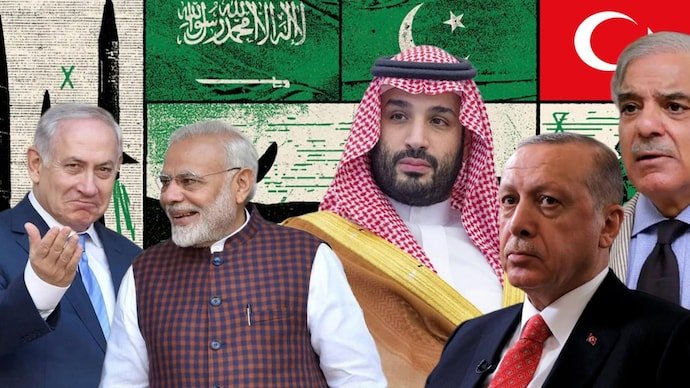
Reports indicating that Turkey is in advanced negotiations to join Pakistan and Saudi Arabia in a NATO-style defence alliance point to a potentially consequential shift in the security architecture of South and West Asia. Often described by analysts as a “Muslim NATO,” this emerging trilateral alignment brings together three distinct yet complementary power centres: Saudi Arabia’s vast financial and energy influence, Pakistan’s nuclear deterrent and missile capability, and Turkey’s expanding military-industrial base combined with recent battlefield experience.
This is not a distant or abstract geopolitical experiment for New Delhi. The implications touch directly upon India’s core security interests—Kashmir, regional deterrence stability, and a widening strategic competition that stretches from the eastern Mediterranean to the Indo-Pacific. As this alignment matures, it intersects with India’s most sensitive strategic fault lines.
From Bilateral Understandings to a Strategic Bloc
The foundation of this emerging partnership lies in the Strategic Mutual Defence Agreement signed between Saudi Arabia and Pakistan in 2025. While the precise language of the agreement has not been made public, diplomatic sources suggest that it includes elements of collective defence similar in spirit to NATO’s Article 5, under which an attack on one member is treated as an attack on all.
Turkey’s inclusion would transform this arrangement from a bilateral pact into a structured trilateral security bloc. According to sources cited by Bloomberg, negotiations to induct Ankara have progressed significantly, making the formalisation of this axis increasingly plausible.
Turkey’s role is particularly significant. Possessing NATO’s second-largest military after the United States, Ankara has long been a central pillar of the US-led alliance. However, growing uncertainty over Washington’s long-term global commitments has prompted Turkey to reassess its strategic options. Exploring alternative defence frameworks reflects a calculated shift rather than a temporary diplomatic experiment.
Pakistan–Turkey: A Deepening Military Nexus
India’s concerns are rooted in recent operational realities, not theoretical projections. During the four-day India–Pakistan military confrontation in May 2025—referred to as Operation Sindoor—Turkey offered open and direct support to Islamabad.
Ankara reportedly supplied Pakistan with trained personnel and a substantial number of unmanned systems, including Bayraktar TB2 drones and loitering munitions. These assets were used against Indian positions, marking one of the clearest instances of Turkish involvement in a South Asian military engagement. Indian intelligence sources later confirmed the presence of Turkish operatives on the ground, with reports indicating that at least two were killed during the operation.
Beyond drones, defence cooperation between Turkey and Pakistan has expanded rapidly across air, naval, and training domains. Turkey has delivered warships such as PNS Babur and PNS Khaiber, while Turkish shipyards are assisting Pakistan in constructing Babur-class corvettes based on the MILGEM design. Turkish Aerospace Industries is also overseeing the mid-life upgrade of 42 Pakistan Air Force F-16 fighter aircraft, significantly extending their operational viability.
UN COMTRADE data shows that Pakistan imported over $5 million worth of arms and related equipment from Turkey in 2024 alone, a figure that likely understates the true scale of collaboration given ongoing joint production and training initiatives.
Saudi Arabia’s Often Underestimated Role
Saudi Arabia’s importance in this alignment is frequently underplayed, yet Riyadh brings critical strategic weight. Its financial power, energy leverage, and influence across the Gulf and broader Islamic world make it a pivotal actor. More consequentially, reports suggest that Pakistan’s nuclear deterrent could factor into Saudi defence planning under the existing agreement—an assertion with profound implications for regional and extra-regional deterrence dynamics.
Turkey’s entry would also reset Ankara–Riyadh relations after years of rivalry over Sunni leadership and Middle Eastern influence. Shared concerns regarding Iran, Syria, and regional stability have driven both sides to move beyond past frictions and expand defence and economic cooperation.
What This Means for India
Even if a formal Pakistan–Turkey–Saudi axis does not immediately trigger direct military confrontation, its strategic impact is undeniable. Retired Indian Air Force Air Marshal Anil Chopra has warned that such an alliance would significantly complicate India’s security calculus.
Writing in The Eurasian Times, Chopra argues that this emerging bloc could pose challenges not only for India but also for Israel, Armenia, Cyprus, and Greece—countries with existing tensions or overlapping strategic interests involving Turkey. He notes that India’s growing defence and diplomatic engagements with Greece and Cyprus, along with its deep strategic partnership with Israel, may gain heightened importance in this evolving environment.
The repercussions extend beyond South Asia. India’s substantial energy, trade, and diaspora interests across West Asia mean that any shift in regional power balances directly affects New Delhi’s strategic planning. A trilateral military bloc could further complicate already delicate relationships involving the US, NATO, Iran, and Russia, placing India within a more crowded and volatile geopolitical theatre.
A Broader Strategic Realignment
From Ankara’s perspective, this alignment reflects a changing global order. As the United States increasingly prioritises its own interests and those of Israel, regional powers are reassessing alliances and crafting alternative security structures. Turkey seeks to position itself as a central node linking South Asia, the Middle East, Africa, and Europe.
For Pakistan, the alliance offers strategic depth and external backing against India. For Saudi Arabia, it provides diversified security assurances in an increasingly uncertain regional landscape. Collectively, the three represent a convergence of ambition, capability, and intent.
The Question Before New Delhi
India is not without options. Its expanding partnerships with the United States, France, Greece, Cyprus, and Israel offer meaningful strategic counterweights. However, the crystallisation of a Saudi–Pakistan–Turkey defence axis underscores a sobering reality: developments in West Asia and the Mediterranean can no longer be viewed as peripheral to India’s core security concerns.
This is not merely about symbolism or diplomatic signalling. It is about alliances, deterrence, and the future distribution of power across a vast arc stretching from the Indian Ocean to the eastern Mediterranean.
As this so-called “Muslim NATO” begins to take clearer shape, the question confronting India is both direct and unavoidable: is New Delhi prepared for a geopolitical environment in which its adversaries operate not in isolation, but as part of a coordinated and ideologically aligned security bloc?
For breaking news and live news updates, like us on Facebook or follow us on Twitter and Instagram. Read more on Latest World on thefoxdaily.com.





COMMENTS 0