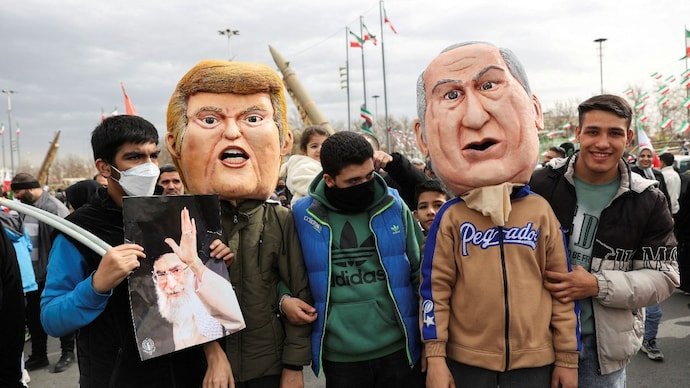
Iran marked the 47th anniversary of the 1979 Islamic Revolution on Wednesday — a historic uprising that brought Ayatollah-led clerical rule to power. While state-backed rallies, parades, and patriotic speeches dominated public spaces in Tehran, new satellite imagery indicates that the Islamic Republic is simultaneously reinforcing key nuclear installations using earth and mud embankments.
According to a report by The Jerusalem Post, which cited high-resolution satellite images and expert analysis, Iran has been strengthening defensive positions at the Isfahan Nuclear Complex. The move comes amid growing fears of a possible US military strike and escalating rhetoric between Washington and Tehran.
Satellite Images Show Protective Earthworks at Isfahan Nuclear Complex
Analysts reviewing recent satellite photographs observed large quantities of earth and soil placed around sensitive infrastructure, including facility gates and tunnel entrances. Experts believe these fortifications are intended to reduce the impact of potential Airstrikes and complicate any ground operation targeting Iran’s enriched uranium stockpiles.
The Institute of Science and International Security told The Jerusalem Post that backfilling tunnel entrances could serve as a buffer against aerial bombardment while also hindering access routes. This defensive layering appears to be part of a broader strategic effort to harden nuclear and ballistic missile facilities across the country.
Jonathan Hackett, a former US Marine Corps intelligence specialist, told the publication that activity observed in late January and early February 2026 likely reflects “a larger push to create defensive layers to the Islamic Republic’s nuclear and ballistic missile facilities in anticipation of a possible US strike.”
Hackett also noted that Iran’s Islamic Revolutionary Guard Corps (IRGC) has reportedly increased deployments to secure ballistic missile infrastructure nationwide. These actions align with Iran’s long-standing “Mosaic Doctrine,” a defense strategy designed to disperse military assets and enhance survivability in the event of an initial strike, enabling rapid retaliation against regional adversaries.
Former British Army intelligence officer Lynette Nusbacher suggested that the visible fortification efforts may also serve as a geopolitical signal amid ongoing diplomatic engagements. “Iran is protecting these facilities in ways that are observable from satellites,” she told The Jerusalem Post, adding that such preparations can be reversed more easily than rebuilding destroyed infrastructure after a sustained bombing campaign.
Security analyst Efrat Sopher described the developments as preparation for a potential “kinetic engagement,” though she questioned whether the current defensive measures would offer sufficient protection against advanced aerial strikes.
Revolution Anniversary Marked by Protests and Political Messaging
Despite visible military preparations, Iran proceeded with large-scale commemorations of the Islamic Revolution anniversary. According to the Associated Press (AP), thousands of supporters gathered in Tehran and other cities, waving images of Supreme Leader Ayatollah Ali Khamenei and chanting anti-US and anti-Israel slogans.
State television broadcast footage of mass rallies that included symbolic burnings of American flags and chants of “Death to America.” However, AP also reported that in some residential areas of Tehran, dissenting voices were heard the previous evening, with individuals shouting “Death to the dictator!” during state-sponsored fireworks displays.
The anniversary events reflected what observers described as a split-screen reality: public displays of regime support alongside undercurrents of domestic frustration and international uncertainty.
Nuclear Talks, Mistrust, and Diplomatic Maneuvering
Amid the heightened atmosphere, Iranian President Masoud Pezeshkian addressed crowds at Tehran’s Azadi Square, signaling openness to renewed nuclear negotiations with the United States. He reiterated that Iran is “not seeking nuclear weapons” and is “ready for any kind of verification.”
However, the International Atomic Energy Agency (IAEA) — the UN’s nuclear watchdog — has faced ongoing limitations in its ability to fully inspect and verify aspects of Iran’s nuclear program in recent months.
Pezeshkian acknowledged deep mistrust toward Western powers, stating: “The high wall of mistrust that the United States and Europe have created through their past statements and actions does not allow these talks to reach a conclusion.” At the same time, he emphasized Iran’s commitment to dialogue aimed at “peace and stability in the region.”
Qatar Diplomacy and US Military Presence in the Region
Parallel to the anniversary events, senior Iranian security official Ali Larijani traveled from Oman to Qatar — a key regional mediator that hosts a significant US military presence. According to Qatar’s state-run news agency, Emir Sheikh Tamim bin Hamad Al Thani held discussions with US President Donald Trump regarding regional security and de-escalation efforts.
Iranian Foreign Minister Abbas Araqchi recently described ongoing nuclear discussions mediated by Oman as off to a “good start,” though he reiterated Tehran’s reservations. Speaking to Russian state media outlet RT, Araqchi said Iran still does “not have full trust for the Americans,” referencing previous negotiations that were disrupted by military escalation.
Meanwhile, reports from AP and Axios indicate that in addition to the USS Abraham Lincoln carrier strike group already deployed in the region, the United States may consider dispatching another aircraft carrier group. President Trump was quoted as saying, “We have an armada that is heading there, and another one might be going.”
A Region Caught Between Commemoration and Confrontation
The convergence of mass revolutionary celebrations, visible nuclear fortifications, diplomatic outreach, and expanded US naval deployments underscores the fragile balance currently shaping Middle Eastern Geopolitics.
As Iran honors the legacy of the 1979 Islamic Revolution — a turning point that reshaped its political and strategic trajectory — it is simultaneously preparing for potential military confrontation while cautiously exploring diplomatic compromise.
The defensive earthworks at nuclear facilities, particularly in Isfahan, symbolize more than engineering measures. They reflect a broader posture of deterrence, resilience, and strategic signaling at a time when negotiations and conflict appear to be unfolding side by side.
For breaking news and live news updates, like us on Facebook or follow us on Twitter and Instagram. Read more on Latest World on thefoxdaily.com.



COMMENTS 0