- Additional THAAD and Patriot Deployments Signal Heightened Preparedness
- Tracking the Aircraft Carrier: Satellite Monitoring from Virginia
- Why THAAD Deployment Is Strategically Significant
- Satellite Imagery Suggests THAAD Presence in Jordan
- Understanding THAAD’s Operational Capabilities
- Iran’s Missile Arsenal and Regional Escalation Risks
- Patriot Systems at Al Udeid Air Base
- Will a Second Aircraft Carrier Change the Strategic Balance?
As geopolitical tensions intensify in the Middle East, critical questions are emerging about whether the United States will deploy a second aircraft carrier strike group to the region following the reinforcement of advanced missile defense systems such as THAAD and Patriot batteries. With the situation evolving rapidly, strategic military movements are being closely monitored by defense analysts worldwide.
former president Donald Trump has not publicly clarified whether military force would be used against Iran. However, US defense planners are operating under the assumption that any American strike could trigger a calibrated Iranian response. In such a scenario, protecting Israel and US troops stationed across Middle Eastern bases becomes a strategic priority. Robust, layered air defense systems are therefore essential to deter or intercept retaliatory missile attacks.
Additional THAAD and Patriot Deployments Signal Heightened Preparedness
Multiple Western media reports indicate that the United States has deployed additional Terminal High Altitude Area Defense (THAAD) batteries to the Middle East. Furthermore, a Reuters analysis of Planet Labs satellite imagery confirmed that MIM-104 Patriot air defense systems were positioned at Al Udeid Air Base near Doha, Qatar, between January 17 and February 1. These deployments suggest a deliberate strengthening of US and allied defensive infrastructure in the region.
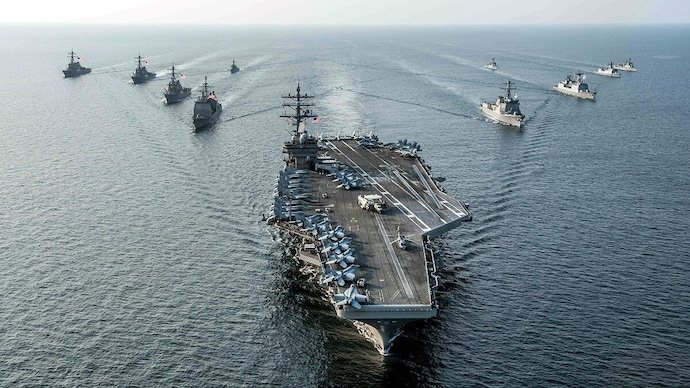
In an exclusive American media report, Pentagon sources revealed that a second US aircraft carrier strike group has been ordered to prepare for potential deployment to the Middle East. While official confirmation remains pending, such a move would significantly elevate America’s maritime strike capability in the region.
Tracking the Aircraft Carrier: Satellite Monitoring from Virginia
Defense analysts have been closely tracking the carrier’s movements off the coast of Virginia, where it has been conducting training exercises. Satellite imagery provides early indicators of deployment readiness, offering insights into force projection timelines and operational logistics. Monitoring these patterns helps experts assess whether preparations align with standard exercises or signal imminent deployment.
The addition of another aircraft carrier strike group would substantially increase the United States’ ability to conduct sustained air operations, provide deterrence, and support regional allies in the event of escalation.
Why THAAD Deployment Is Strategically Significant
The deployment of an additional THAAD battery represents a significant commitment of high-value US ballistic missile defense resources. Currently, the United States operates only eight active-duty THAAD batteries worldwide. According to a Congressional Research Service (CRS) report, one battery was deployed to the Middle East in October 2023 and remains active there. Another was approved for deployment to Israel in October 2024 to reinforce its air defense network.
Given the limited number of available units, each THAAD deployment reflects a serious assessment of threat levels. The Pentagon has not disclosed the precise location of the newly deployed systems, likely to preserve operational security. Publicly identifying exact positions could expose these assets to preemptive strikes or Suppression of Enemy Air Defenses (SEAD) operations.
Satellite Imagery Suggests THAAD Presence in Jordan
High-resolution satellite imagery released by Shanghai-based commercial aerospace intelligence firm MizarVision appears to show that US forces have completed deployment of a THAAD battery at Muwaffaq Salti Air Base near Amman, Jordan. It is important to note that independent verification of the unedited imagery was not available at the time of reporting.
The annotated images indicate six launcher positions arranged in a dispersed configuration, a probable AN/TPY-2 radar installation positioned separately from the launchers, and clustered support vehicles consistent with a Tactical Fire Control and Communications (TFCC) unit. This layout closely resembles a standard THAAD fire unit configuration.
Understanding THAAD’s Operational Capabilities
A single THAAD battery consists of six truck-mounted launchers capable of carrying up to 48 hit-to-kill interceptors. It includes the AN/TPY-2 radar system for advanced tracking and targeting, along with a sophisticated fire-control unit. Unlike conventional missile systems, THAAD interceptors destroy incoming threats through kinetic impact rather than explosive warheads.
The system is designed to intercept short-, medium-, and limited intermediate-range ballistic missiles during their terminal phase, either inside or just outside the Earth’s atmosphere. This capability makes THAAD a critical component of layered missile defense, particularly against high-speed ballistic threats.
Iran’s Missile Arsenal and Regional Escalation Risks
Following last summer’s two-week conflict—during which Israel targeted Iranian nuclear facilities and other military installations, with subsequent US involvement—Iran has claimed it has replenished its missile stockpiles. If accurate, this development significantly alters the regional threat landscape.
The reinforcement of US missile defense assets appears aligned with assessments that Iran retains substantial retaliatory capabilities. The strategic objective is deterrence: to signal readiness while minimizing the risk of miscalculation.
Patriot Systems at Al Udeid Air Base
Satellite imagery analyzed by Reuters shows Patriot missile launchers mounted on M983 Heavy Expanded Mobility Tactical Trucks (HEMTT) at Al Udeid Air Base in early February. This base serves as one of the most critical US military hubs in the Middle East.
The PATRIOT Air and Missile Defense (AMD) system forms a core element of the US integrated air and missile defense architecture. It remains the only operational US system capable of intercepting incoming tactical ballistic missile threats while also defending against high-performance aircraft.
A standard Patriot battery comprises approximately 90 personnel, though only three soldiers are required inside the engagement control station during combat operations. The system’s flexibility and reliability have made it a cornerstone of American and allied air defense strategies for decades.
Will a Second Aircraft Carrier Change the Strategic Balance?
The potential deployment of a second US aircraft carrier strike group would dramatically expand American airpower and deterrence capabilities in the Middle East. Carrier strike groups bring not only fighter aircraft but also guided missile cruisers, destroyers, and integrated electronic warfare capabilities.
When combined with advanced missile defense systems such as THAAD and Patriot batteries, the presence of an additional carrier would create a layered defense and offense posture. This structure is designed to deter aggression, reassure allies, and maintain strategic stability during periods of heightened tension.
Whether the second carrier ultimately sails to the region remains to be officially confirmed. However, the movement of missile defense systems and satellite-tracked naval activity clearly indicate that Washington is preparing for multiple contingencies.
As developments unfold, satellite intelligence, defense briefings, and regional military movements will continue to offer vital insights into one of the most closely watched security situations in the world.
For breaking news and live news updates, like us on Facebook or follow us on Twitter and Instagram. Read more on Latest World on thefoxdaily.com.






COMMENTS 0