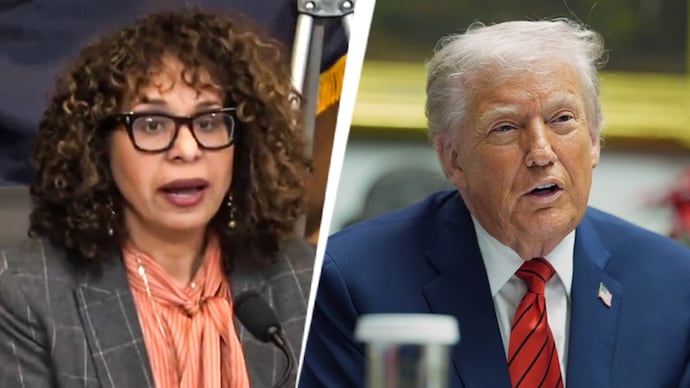
As debates intensify over trade friction and tariff hikes, both Democratic and Republican senators underscored the strategic significance of the US-India relationship on Wednesday. Speaking during a congressional review of the US-India Strategic Partnership, Democrat Sydney Kamlager-Dove delivered a sharp warning, suggesting that Donald Trump risks becoming the president “who lost India” by imposing punitive tariffs, hiking visa fees, and allowing political grievances to shape foreign policy.
“The Biden administration handed President Trump a bilateral relationship at its strongest point when he took office earlier this year. These accomplishments resulted from decades of strategic discipline and joint effort,” Dove said. “What happened next? Flush, flush, flush — decades of American diplomatic capital wasted to satisfy Trump’s personal grievances at the cost of our national interests. Unless he changes course, Trump will be the American president who lost India — or rather, chased India away — while empowering Russia, threatening the transatlantic alliance, and provoking instability in Latin America.”
The lawmaker stressed that US competitiveness in sectors such as defense, energy, AI, space, and frontier technology relies on a stable relationship with India. She criticized Trump’s decision to impose 50% tariffs on Indian imports — one of the highest tariff rates outside Brazil — as well as the additional 25% surcharge on India’s purchase of Russian Oil.
“Leader-level engagement between the two nations has effectively stalled,” Dove said. She also added that the 25% tariff linked to India’s Russian oil imports “looks pointless when individuals like Steve Witkoff are reportedly making backdoor deals with Putin’s advisors to undermine Ukraine in exchange for business interests.”
The congresswoman condemned the administration’s decision to introduce a staggering $100,000 fee on H-1B visas, which are overwhelmingly held by Indian professionals. She called the move “a rejection of the extraordinary contributions Indians have made to America’s science, technology, innovation, and medical sectors.”
Dove emphasized that the US-India relationship will be a defining factor in shaping the 21st-century world order. She also criticized the president’s “personal obsession with a Nobel Peace Prize,” arguing that such distractions undermine long-term strategic goals. “When historians study Trump’s hostility toward India, they will trace it back to this fixation — an obsession that is absurd, but the damage it causes is not,” she said.
Other Democrats Echo Concerns Over Anti-India Rhetoric
Fellow Democratic Lawmakers Ami Bera and Pramila Jayapal echoed concerns about rising anti-India sentiment in the US and the implications of overly pressuring New Delhi over its relationship with Moscow. Bera, one of the most influential Indian American members of congress, argued that Washington should strengthen — not strain — India’s ties with Russia amid the ongoing crisis in Ukraine.
Jayapal added that Indian Americans play a pivotal role in the US economy, leading major corporations and driving innovation. She warned that any hostile rhetoric targeting Indian immigration would endanger “social cohesion and America’s innovation advantage.”
Republicans Highlight India as a Strategic Partner
Republican congressman Bill Huizenga emphasized that American companies are eager to expand into the Indian market “on a level playing field,” praising India as one of the world’s fastest-growing major economies.
“The US-India relationship is no longer just important — it is a defining partnership of the 21st century,” Huizenga said. He added that strong bilateral ties are essential for promoting a free Indo-Pacific, supporting resilient supply chains, and ensuring that democratic norms — not authoritarian regimes — set the global rules.
Huizenga noted that the proposed new trade agreement between President Trump and Prime Minister Narendra Modi could further strengthen the partnership. “I look forward to hearing from our witnesses on how the world’s largest economy and the soon-to-be third-largest economy can jointly counterbalance China and advance a secure, open Indo-Pacific,” he stated during the hearing.
For breaking news and live news updates, like us on Facebook or follow us on Twitter and Instagram. Read more on Latest World on thefoxdaily.com.






COMMENTS 0