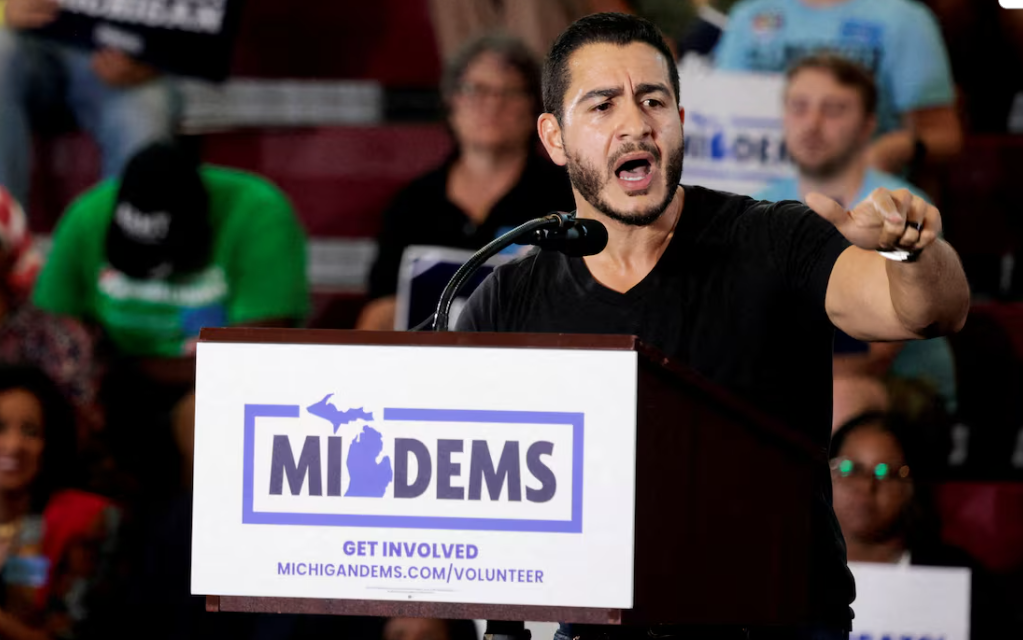
The 2026 U.S. midterm elections are entering a politically charged phase, with Republicans increasingly making Islam, Muslim candidates and alleged concerns about extremism part of their campaign messaging. The debate is unfolding in several key states and congressional races as Democrats seek to regain control of Congress from President Donald Trump’s Republican Party.
The issue has gained national attention after Republican Vice President JD Vance sharply criticized Abdul El-Sayed, a Muslim Democrat running for the U.S. Senate in Michigan. At the same time, Republican officials in Texas and Alabama have raised concerns involving Muslim-led developments, religious facilities and what they describe as the influence of radical Islam.
Critics argue that such rhetoric risks treating an entire religious community as a security concern, while Republicans say their campaigns are focused on legitimate questions involving terrorism, extremism, public safety and the role of religion in American public life.
Abdul El-Sayed Becomes a Central Figure in the Debate
Abdul El-Sayed has emerged as one of the most prominent Muslim political candidates in the 2026 election cycle. The American-born Democrat is seeking a U.S. Senate seat in Michigan and could become the first Muslim senator in the United States if elected.
His campaign has attracted national attention partly because of comments he made after a March attack involving a vehicle being driven into a suburban Detroit synagogue while children were inside the building.
El-Sayed condemned the attack but also discussed the circumstances surrounding the alleged assailant, including the deaths of some of the man’s relatives in Lebanon in an Israeli airstrike. El-Sayed later acknowledged that his remarks could have been misunderstood and apologized.
Vance subsequently attacked El-Sayed at a rally, describing him as “very, very evil” and accusing him of defending terrorism.
The confrontation illustrates how statements involving the Middle East, Israel, terrorism and Muslim identity can quickly become campaign issues in U.S. elections.
El-Sayed Pushes Back Against Republican Attacks
El-Sayed has rejected the characterization of his political views as sympathetic to terrorism. In responding to criticism from Vance, he shifted the discussion toward domestic economic and political concerns.
His argument was that issues such as healthcare costs, food and gasoline prices, trade policy and war deserve greater attention from voters.
This creates a broader political question for the 2026 midterms: will voters prioritize cultural and national-security disputes, or will economic pressures such as the cost of living remain the dominant concern?
That question could prove particularly important for Democrats and Republicans competing in closely divided states and congressional districts.
Texas Race Brings Sharia Law Debate Into Campaign Politics
Texas has become another major battleground in the debate over Islam and American politics.
Republican Governor Greg Abbott, who is campaigning for another term, has attacked a proposed Muslim-led development and called for an investigation into what he described as efforts to establish “sharia courts.”
The developers and civil rights groups dispute the characterization. Abbott’s campaign has argued that its actions are focused on alleged illegal conduct rather than religious beliefs.
The controversy demonstrates how references to sharia can become politically powerful in U.S. campaigns. Sharia broadly refers to Islamic religious and legal principles, but the term is frequently used in American political debates in ways that can imply a threat to the country’s constitutional system.
The important distinction for voters is between lawful religious practice and conduct that actually violates U.S. law. Religious communities in the United States operate within the country’s legal and constitutional framework, while allegations of criminal or unlawful activity require evidence and due process rather than assumptions based on faith.
Alabama Republican Campaign Uses National-Security Language
In Alabama, Republican U.S. Senator Tommy Tuberville, who is running for governor, has also made radical Islam part of his campaign messaging.
Tuberville warned that “the enemy is inside the gates,” referring to what he described as radical Islam.
The political significance of the statement is notable because Muslims make up less than half a percent of Alabama’s population. The rhetoric therefore appears aimed less at describing a large local voting bloc and more at connecting national security concerns with the broader national political debate.
Republican campaigns argue that concerns about terrorism and extremism are legitimate subjects for political discussion. Critics counter that repeatedly associating Islam or Muslims with security threats can blur the distinction between violent extremist groups and millions of ordinary American Muslims.
How Large Is the Muslim Population in the United States?
The political significance of Muslim voters has grown alongside the country’s Muslim population.
According to the Pew Research Center figures cited in the report, the number of Muslims in the United States has increased from approximately 2.4 million in 2007 to about 5.5 million. Muslims now represent roughly 1.6% of the U.S. population.
Although Muslims remain a relatively small share of the national population, their political importance can be greater in particular cities, states and congressional districts where communities are concentrated.
That makes Muslim voters potentially significant in close elections, especially when candidates are competing by narrow margins.
Muslim Political Representation Is Expanding
The 2026 campaign debate is also taking place against a backdrop of growing Muslim representation in American politics.
New York City elected its first Muslim mayor, Zohran Mamdani. In Virginia, Ghazala Hashmi became the first Muslim woman elected to statewide office when she became lieutenant governor.
El-Sayed’s Senate campaign could take representation one step further if he wins election to the U.S. Senate.
This represents an important shift in American political participation. Muslim Americans are increasingly appearing not only as voters but also as candidates seeking influential public offices.
That development is likely to make questions about Muslim identity, religious freedom and political representation more visible during election campaigns.
The Debate Has Reached the U.S. House
The issue is not limited to high-profile statewide races.
Republican Representatives Keith Self and Chip Roy of Texas have organized what they call the “Sharia Free America Caucus.” Republican Representative Randy Fine of Florida has also introduced legislation that he says is intended to address the rise of sharia law in the United States.
The emergence of these initiatives suggests that concerns about Islamic law are becoming part of a broader Republican political strategy rather than remaining isolated to individual candidates.
For Democrats, the challenge is determining how aggressively to respond without allowing Republican messaging to dominate the conversation. For Republicans, the political calculation is whether focusing on national security and cultural issues will motivate voters without alienating moderates and Muslim Americans.
Why Israel, Iran and Gaza Are Influencing the Political Debate
The debate over Muslims cannot be separated from the wider political conflict surrounding Israel, Iran and the Middle East.
Public attitudes toward Israel have shifted, particularly among Democrats, with polling showing increased sympathy for Palestinians and greater opposition to U.S. military assistance to Israel.
Those changes have created a politically sensitive environment in which candidates’ positions on the Middle East can become connected to questions about identity and national security.
For Muslim voters and other Americans concerned about the conflict, foreign policy may be an important electoral issue. For Republican candidates, criticism of positions they view as overly sympathetic to Palestinians or insufficiently supportive of U.S. allies can become part of a broader campaign message about national security.
The risk is that legitimate foreign-policy disagreements can become intertwined with assumptions about a candidate’s religion or the beliefs of an entire community.
Cost of Living Remains a Major Political Pressure Point
Despite the growing attention surrounding religion and national security, economic concerns remain central to the political environment.
The report notes that public support for President Donald Trump is around 33%, while voters are concerned about the cost of living, the U.S.-Israeli war on Iran and Trump’s tariffs on foreign goods.
This creates an important strategic question for Republicans. If voters are primarily focused on groceries, gasoline, housing and household finances, campaigns centered heavily on cultural or religious issues may not address their most immediate concerns.
That may explain why the 2026 election is becoming a competition between two different political narratives: Republicans emphasizing security, immigration, extremism and cultural issues, and Democrats attempting to focus attention on economic pressures and the consequences of Republican policies.
Experts Question Whether the Rhetoric Is Political Fear-Mongering
Aaron Hughes, a University of Rochester religious studies professor who studies Islam and Judaism, argued that Republicans are increasing their focus on Muslims as they struggle to gain political traction on issues such as living costs, immigration and the Iran war.
Hughes described the approach as fear-mongering and criticized what he saw as a tendency to connect a broad religious community with Hamas and Iran.
His argument highlights an important distinction in election politics: criticism of a government, political organization or extremist movement is different from making assumptions about people based on their religion.
Muslim Americans are not politically uniform. They hold different views on abortion, same-sex marriage, taxation, foreign policy, immigration and other major issues. Some positions held by Muslim Americans can also overlap with traditionally conservative Republican positions.
This political diversity makes it difficult to treat Muslim voters as a single ideological bloc.
Democrats Have Also Faced Criticism Over Anti-Muslim Rhetoric
The controversy has not been limited entirely to Republicans.
Ashik Siddique, co-chair of the Democratic Socialists of America, argued that Islamophobia should not be attributed to only one political party. He pointed to comments made by Andrew Cuomo during his unsuccessful independent campaign for New York City mayor.
Cuomo questioned how Mamdani would have responded during the September 11, 2001 attacks, linking the mayoral candidate’s Muslim identity to one of the most traumatic events in modern American history.
The episode demonstrates how religious identity can become a political weapon across party lines, even though the current national campaign rhetoric is more heavily associated with Republican candidates.
The History of Minority Groups as Campaign Targets
The use of minority communities in election messaging has a long history in American politics. Campaigns have frequently attempted to mobilize voters by portraying particular groups as threats to security, culture or economic stability.
The 2026 debate therefore fits into a larger historical pattern in which political candidates use identity-based issues to define an opponent or motivate their supporters.
The controversy surrounding Haitian immigrants in Springfield, Ohio, during the 2024 presidential campaign provides a recent example. False claims that Haitian immigrants were eating pets spread widely and became part of the political debate.
That episode demonstrated how rapidly claims involving minority communities can move from local controversies into national political campaigns.
Texas Airport Prayer Facilities Add a New Dimension
The debate over religion has also moved beyond election rallies and campaign advertisements.
In August, Abbott called for a federal investigation into two Texas airports over Islamic ritual washing facilities. He argued that government-owned airports should not favor one religion over another.
Houston Mayor John Whitmire, a Democrat, said the airport’s ablution and prayer facilities are available to all travelers, employees and stakeholders regardless of faith, and that no group receives preferential access.
The dispute highlights a recurring challenge in public institutions: how to accommodate religious practices while ensuring equal treatment for people of different faiths and for those with no religious affiliation.
Public facilities can provide reasonable accommodations for religious practices without necessarily endorsing a religion. The central issue is whether access is genuinely equal and whether public resources are administered according to neutral rules.
What the 2026 Midterms Could Mean for Muslim Political Participation
The growing focus on Muslims could have effects beyond individual campaigns.
Political attacks can motivate targeted communities to become more politically active, particularly when voters believe their religious or cultural identity is being used against them.
At the same time, candidates who successfully build broader coalitions may demonstrate that Muslim political participation is increasingly part of the mainstream American electoral landscape.
The emergence of Muslim candidates at local, state and federal levels suggests that representation is likely to remain an increasingly visible feature of U.S. politics.
A Key Election Question: Security Debate or Identity Politics?
The central issue may ultimately be how voters distinguish between legitimate security concerns and religious stereotyping.
Political candidates have the right to debate terrorism, extremist organizations, foreign governments and national security. Those issues can have serious consequences for American communities and U.S. foreign policy.
But the political conversation becomes substantially different when criticism of specific conduct is extended to Muslims as a broad religious category.
That distinction could become increasingly important as the 2026 midterm campaign develops.
| Political Issue | Republican Emphasis | Critics’ Concern |
|---|---|---|
| National security | Extremism, terrorism and security threats | Risk of associating ordinary Muslims with extremist movements |
| Sharia law | Opposition to perceived attempts to establish religious courts | Potential confusion between religious practice and unlawful activity |
| Middle East policy | Security and support for U.S. allies | Foreign-policy disagreements becoming linked to Muslim identity |
| Muslim political candidates | Scrutiny of candidates’ statements and associations | Concern that religious identity becomes a campaign target |
What to Watch Before the November 3 Midterms
- Michigan: Abdul El-Sayed’s Senate campaign and whether attacks over his comments continue to shape the race.
- Texas: Whether Greg Abbott’s campaign continues emphasizing the Muslim-led development and alleged sharia-related concerns.
- Alabama: How Tommy Tuberville’s national-security messaging affects the governor’s race.
- House races: Whether more Republican candidates adopt similar rhetoric involving Islam and sharia law.
- Muslim voter turnout: Whether heightened political attention increases participation among Muslim Americans.
- Economic issues: Whether inflation, living costs and tariffs ultimately prove more important to voters than cultural issues.
- Middle East policy: How developments involving Israel, Iran and the wider region influence U.S. voting behavior.
Conclusion: Muslim Identity Becomes a Bigger Political Fault Line Ahead of the 2026 Midterms
The 2026 U.S. midterm elections are bringing Muslim identity and Islam into a more prominent political spotlight. Republican candidates in Michigan, Texas and Alabama have used issues involving Muslim candidates, sharia law and radical Islam to make national security and cultural questions part of their campaigns.
Critics argue that the rhetoric unfairly targets Muslims and risks turning a diverse religious community into a political symbol of extremism. Republicans counter that their concerns focus on security, illegal activity and the proper role of religion in public institutions rather than on Islam itself.
The debate is occurring as Muslim Americans gain greater political representation. With Muslim candidates and elected officials reaching increasingly prominent positions, the community is becoming more visible within the American electoral system.
The ultimate political test will be whether identity-based attacks resonate with voters or whether economic concerns such as the cost of living, healthcare, gasoline prices and tariffs remain more influential.
As the November 3 midterms approach, the distinction between legitimate political scrutiny and broad religious stereotyping is likely to remain one of the most closely watched features of the campaign.
For breaking news and live news updates, like us on Facebook or follow us on Twitter and Instagram. Read more on Latest Business on thefoxdaily.com.

COMMENTS 0