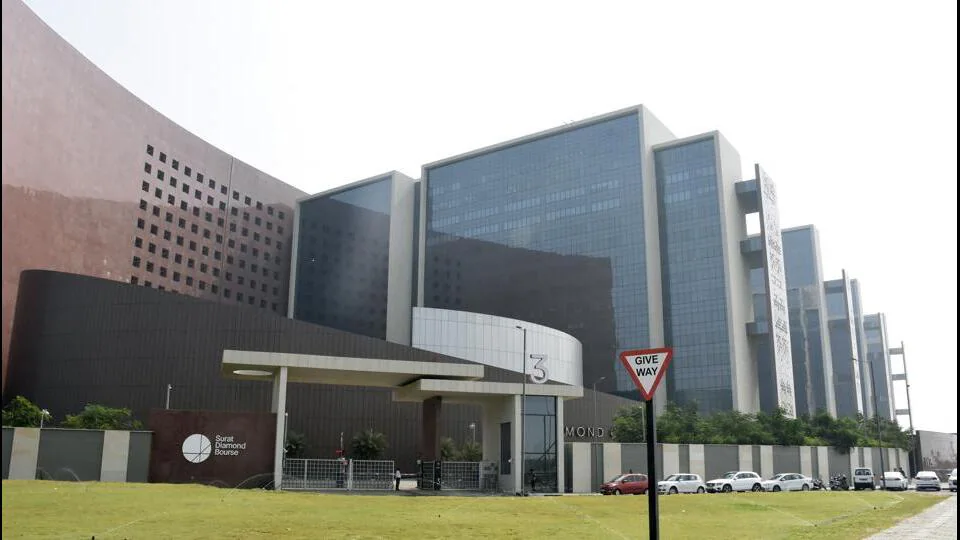
Surat Diamond Bourse (SDB) chairman Govind Dholakia has renewed his appeal to members to begin operations at the complex after Diwali, urging diamond traders and businesses to stop waiting for competitors and take the initiative to make the facility operational. Despite being designed as a major hub for diamond trading and related services, around 95% of its 4,700 offices remain non-operational, according to an SDB official.
Dholakia, who is also a Rajya Sabha MP and the founder of Shree Ram Krishna Exports, said the bourse represented the industry’s investment, pride and future. In a letter to members dated October 20, he said he would shift his own office to the complex after Diwali, regardless of whether other members moved in.
The appeal highlights a continuing challenge for the ambitious project: attracting businesses to a purpose-built trading centre when established commercial networks, logistical concerns and a difficult period for the Diamond Industry have discouraged companies from relocating.
Govind Dholakia Urges Diamond Traders to Move to SDB
Dholakia has called on members to take responsibility for making the Surat Diamond Bourse fully operational instead of waiting for other businesses to move first. He has said the complex could serve companies dealing in both natural and lab-grown diamonds, potentially creating opportunities across different segments of the industry.
In his October 20 letter, Dholakia indicated that he would set an example by moving his own office after Diwali. His message was intended to encourage other members to follow suit and help build business confidence at the complex.
Dholakia took over as chairman of the bourse in March 2024. As the head of an organisation designed to bring diamond businesses together under one roof, he faces the challenge of turning the facility’s large physical capacity into an active commercial ecosystem.
An SDB official said the chairman’s message was that members needed to work collectively to restart operations. The official added that the diamond industry had faced difficult conditions over several years, beginning with the Russia-Ukraine war, although the outlook had improved in recent months.
Only 250 of 4,700 Surat Diamond Bourse Offices Operational
The scale of the challenge is evident in the number of offices currently operating at the complex. According to an SDB official, only around 250 of the 4,700 offices were operational, leaving the vast majority unused for active business operations.
Inaugurated by Prime Minister Narendra Modi in December 2023, the Surat Diamond Bourse is part of the Diamond Research and Mercantile City, commonly known as DREAM City. The project was developed as part of the Gujarat government’s plan to establish a major business district in Surat on government-allotted land.
The complex spans approximately 6.7 million square feet and is widely described as the world’s largest office complex. Its 4,700 offices range in size from 300 square feet to 115,000 square feet, with the overall development designed to accommodate around 67,000 people.
The bourse comprises nine interconnected towers, each with 15 floors. Its facilities include banking services, customs offices, secure vaults and a jewellery mall, offering infrastructure intended to support diamond traders and related businesses.
Although nearly 90% of the offices have reportedly been leased, occupancy does not necessarily mean that businesses have started operating from the premises. According to the SDB official, occupants are paying maintenance charges even when their offices are not fully operational, adding to the financial burden of maintaining unused commercial space.
Why Diamond Trading Remains Concentrated in Mumbai
One of the main challenges facing the Surat Diamond Bourse is the established division between diamond manufacturing and trading in India. Surat is a global centre for cutting and polishing rough diamonds, while much of the trading activity that the bourse was designed to attract continues to take place in Mumbai, around 300 kilometres away.
Mumbai has an established network of international buyers, brokers, financial service providers and other businesses that support diamond trading. These connections make it difficult for a new trading centre to persuade companies to move away from an ecosystem they have relied on for years.
Many diamond businesses operate through family arrangements in which one member manages manufacturing in Surat while another oversees trading in Mumbai. Relocating a trading office could disrupt existing relationships with customers, suppliers and brokers, making the move more complicated than simply transferring staff and equipment to a new building.
The Surat Diamond Bourse was intended to bridge the gap between manufacturing and trading by creating a central location where businesses could operate alongside one another. However, the concentration of commercial relationships in Mumbai has remained a significant obstacle to that ambition.
Incentives Have Not Been Enough to Attract Businesses
When the Surat Diamond Bourse opened, its management offered incentives, including a waiver of maintenance charges, to encourage businesses to relocate from Mumbai’s Bharat Diamond Bourse (BDB). Despite these efforts, the incentives were not sufficient to persuade a large number of firms to shift their operations.
The decision to move involves more than the cost of renting or maintaining an office. Companies must consider the impact on employees, their access to international buyers, the continuity of customer relationships and the cost of running operations across two locations during a transition.
The experience of Kiran Gems and Diamonds illustrated these difficulties. The prominent diamond company had moved to SDB when Vallabhbhai Lakhani was chairman but reopened its Mumbai office in early 2024. SDB officials said at the time that the arrangement was temporary and that the company would continue operating in both cities.
Maintaining offices in Mumbai and Surat can help companies preserve existing business relationships while exploring opportunities at the new bourse. However, it can also increase operating expenses, particularly when staff, infrastructure and other resources must be maintained at both locations.
Location and Connectivity Create Additional Challenges
The Surat Diamond Bourse is located in Khajod, on the outskirts of Surat, rather than in the city’s established diamond trading areas. Traditional commercial centres such as Mahidharpura, Varachha and Katargam already have networks of traders and supporting businesses, giving companies established reasons to remain where they are.
Businesses have cited the cost of relocating staff and operations, access to international buyers and the need to preserve existing commercial relationships among the factors influencing their decisions. The distance between Khajod and established trading centres also raises questions about the time and expense involved in daily travel.
Public transport has been another concern. Businesses have pointed to inadequate connectivity to the complex as a potential barrier for employees and traders travelling from other parts of Surat. SDB officials have said that bus services now connect traders to the premises.
Improved transport links could make the complex easier to access, but connectivity is only one part of the problem. Companies must also weigh the cost of maintaining two offices, moving employees and persuading customers and business partners to conduct transactions at a new location.
Global Diamond Industry Downturn Adds to the Pressure
The Surat Diamond Bourse’s efforts to attract businesses have coincided with a difficult period for the global diamond industry. The downturn has been associated with factors including sanctions affecting Russian rough diamonds, weak demand in China and US tariffs introduced in 2025.
Data from the Gem and Jewellery Export Promotion Council (GJEPC) cited in the supplied report shows that India’s exports of cut and polished diamonds declined from $15.97 billion in 2023-24 to $12.16 billion in 2025-26.
The decline has placed pressure on businesses across the diamond supply chain, including manufacturers, exporters and smaller units. In such conditions, companies may be more reluctant to take on the additional expenses and uncertainty associated with shifting their operations to a new commercial centre.
The timing of the downturn has therefore complicated SDB’s efforts to establish itself as a major trading destination. Even companies that see potential benefits in the complex may be cautious about changing their business arrangements while demand and export performance remain under pressure.
Government Measures Aim to Support the Diamond Sector
The Gujarat government introduced a relief package in 2025 aimed at supporting artisans and micro-units affected by difficulties in the diamond industry. The Centre also introduced the Diamond Imprest Authorisation scheme, which allows duty-free imports of small-cut diamonds under the scheme’s applicable conditions.
These measures were intended to provide support to parts of the diamond supply chain during a challenging period. However, industry support and the relocation of trading businesses address different issues. While relief measures can help companies and workers manage financial pressure, attracting traders to SDB also requires an active network of buyers, sellers, brokers and service providers.
For the bourse, building that network remains central to its long-term commercial prospects. A larger concentration of businesses could make it more convenient for traders to conduct transactions and access supporting services in one place. Achieving that concentration, however, depends on enough companies being willing to relocate and establish regular operations.
Can an Improved Industry Outlook Bring Traders to SDB?
The outlook for the diamond industry has improved in recent months, according to the SDB official quoted in the report. Nevertheless, a recovery in demand alone may not be sufficient to persuade businesses to move into the complex.
The central challenge is to create a self-reinforcing business environment. Traders may be reluctant to relocate while few other companies are operating at SDB, but the bourse is likely to become more attractive as more buyers, sellers and brokers establish a presence there.
Dholakia’s decision to move his office after Diwali is intended to encourage members to break this cycle. By urging businesses to act independently rather than wait for competitors, he is seeking to build momentum towards broader occupancy and commercial activity.
The number of operational offices will remain an important measure of whether the initiative is gaining traction. With only around 250 of the 4,700 offices reportedly operating, the complex has substantial unused capacity despite its extensive infrastructure and high level of leasing.
Ultimately, the Surat Diamond Bourse’s success will depend not only on the size of the complex or the facilities it offers, but also on whether it can attract sustained trading activity. Better connectivity, a stronger industry outlook and a growing concentration of businesses could support that effort, but established networks in Mumbai and the costs of relocating remain significant hurdles.
Dholakia’s appeal after Diwali is therefore both a call for immediate action and an attempt to address the longer-term challenge of establishing Surat as a major destination for diamond trading, alongside its existing role as a global manufacturing hub.
For breaking news and live news updates, like us on Facebook or follow us on Twitter and Instagram. Read more on Latest Business on thefoxdaily.com.


COMMENTS 0