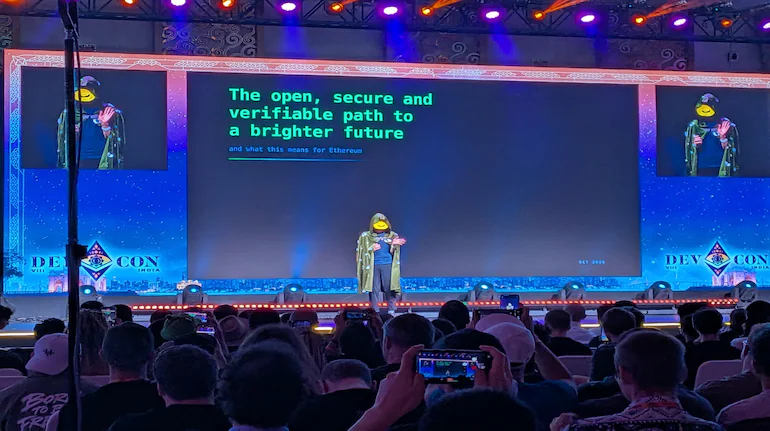
Ethereum co-founder Vitalik Buterin has warned developers and technology users about the growing privacy risks associated with Artificial Intelligence, saying sensitive personal information should not automatically be entrusted to powerful technology companies. He has encouraged developers to consider local AI models and limit the information shared with remote systems.
Speaking at Ethereum’s flagship conference, Devcon 8, on November 3, Buterin highlighted the importance of protecting user data as AI becomes increasingly integrated into everyday digital activities. The event is being hosted in India for the first time.
Buterin said AI is becoming an important part of how people think, work and interact with technology. However, he cautioned that allowing private information to flow into third-party servers could expose users to data misuse, security breaches and other risks.
Vitalik Buterin Warns About AI Data Privacy Risks
Buterin compared artificial intelligence to a second brain, emphasising that people should be careful about where their AI interactions and personal information are stored.
“We need to be able to trust our AI. Everything is dependent on AI…AI is super important. It’s basically becoming a second brain. But you don’t want your second brain’s thoughts to be going into a third-party corporation’s servers,” he said.
He also warned that information stored on external servers could potentially be used in ways users did not intend or exposed through hacking incidents.
His comments highlight a broader concern about the growing concentration of personal data within large technology platforms. AI systems can process documents, conversations, business information and other sensitive material, making data protection an increasingly important issue for developers and users.
As AI tools become more capable, users may share more detailed information with them. This creates additional questions about who controls that data, how long it is retained and whether it could be accessed by unauthorised parties.
Local AI Models Could Help Protect Sensitive Information
Buterin recommended that developers consider using local AI models to reduce the amount of private information shared with external services. Local models operate on a user’s own device or infrastructure rather than sending every request to a remote AI provider.
This approach can help users retain greater control over sensitive information, although the level of protection depends on how the system is configured and secured.
Buterin also discussed the possibility of combining local models with remote frontier AI systems. Instead of sending complete user requests to an external model, a local system could first remove or sanitise private information.
“Where needed, you can use a remote frontier model, in ways that minimise that frontier model’s authority. And I think there’s interesting work on that. There’s the idea that you can use a local model in order to sanitize. We can rewrite and remove private information from requests that go to a remote model,” he said.
Such an approach could allow developers to benefit from the capabilities of advanced remote AI systems while limiting the exposure of sensitive user information.
Why Developers Should Limit the Authority of Remote AI Systems
Beyond Data Privacy, Buterin cautioned developers against placing excessive trust in powerful corporations and remote AI models. He urged them to examine whether requests and instructions generated by external systems genuinely serve users’ interests.
The concern extends beyond the collection of personal information. AI tools may be integrated into applications that can access files, accounts, software systems and other resources. If developers grant these tools broad permissions without appropriate safeguards, mistakes or malicious instructions could create additional security risks.
Limiting the authority of remote models can help reduce potential damage if a system behaves unexpectedly or is compromised. Developers can also introduce controls that restrict what an AI model can access or do without explicit authorisation.
Buterin’s comments underline the importance of treating AI security as a design priority rather than an issue to address only after a breach occurs.
AI Security Concerns Grow Amid Major Crypto Hacks
Buterin’s warning comes at a time when the technology and cryptocurrency industries are facing growing concerns about data breaches and cybersecurity vulnerabilities.
He referred to the broader threat posed by weaknesses in software and hardware systems, which can expose sensitive user information. The risks are particularly relevant to blockchain applications and cryptocurrency platforms, where security failures can result in significant financial losses.
The discussion also comes amid attention surrounding a reported $6.3 billion cryptocurrency asset heist involving Binance. The incident has highlighted the scale of potential security threats facing the digital asset industry.
Security breaches can affect more than financial holdings. Depending on the systems involved, attackers may also gain access to personal information, account credentials and other sensitive data.
As AI becomes more closely connected with digital platforms, developers will need to consider how vulnerabilities in one part of a system could affect other connected services.
Buterin Warns Crypto Traders Against Social Media Token Narratives
During the conference, Buterin also discussed innovative products being developed on Ethereum’s blockchain, including decentralised social media platforms. He emphasised the importance of reliable information sources and cautioned cryptocurrency traders against making investment decisions based on misleading narratives circulating on X, formerly known as Twitter.
He argued that social media can influence public opinions on controversial issues, but users should be careful about accepting information without examining the interests behind it.
Buterin warned traders against buying cryptocurrencies simply because a token is being promoted or discussed heavily on social media.
“We need to be able to trust our sources of information and our sources of connection to other people. Today, social media is supposed to be a source for formula opinions on controversial issues in society,” he said.
He further cautioned that people and organisations creating online narratives may have incentives that do not necessarily align with the interests of ordinary users.
His message was particularly relevant to cryptocurrency markets, where token promotions, speculative claims and misleading online discussions can influence trading decisions. Investors who rely only on social media commentary may overlook important information about a project’s technology, financial structure and risks.
Decentralised Social Media and the Need for Reliable Information
Buterin’s discussion of decentralised social media reflects a broader effort within the Ethereum ecosystem to explore alternatives to traditional online platforms.
Decentralised social networks aim to give users greater control over their online identities, content and interactions. Such platforms can offer different approaches to data ownership and communication compared with services controlled by centralised companies.
However, decentralisation does not automatically eliminate misinformation, manipulation or security threats. Users still need reliable information sources and ways to assess the credibility of content shared online.
For cryptocurrency traders, this distinction is important. Even on decentralised platforms, promotional campaigns and misleading claims can circulate widely. Independent research remains essential before making financial decisions.
What Buterin’s Warning Means for the Future of AI and Web3
Buterin’s remarks connect two important challenges facing the technology industry: protecting personal data in an AI-driven world and maintaining trust in increasingly complex digital networks.
For AI developers, his suggestions point towards greater use of local processing, data sanitisation and restricted permissions for remote models. These measures could help reduce unnecessary exposure of sensitive information while allowing developers to use advanced AI capabilities.
For the blockchain industry, his comments reinforce the need for stronger security practices and more reliable information channels. Decentralised platforms and cryptocurrency projects still require safeguards against hacking, misinformation and manipulation.
The wider challenge will be to ensure that technological progress does not come at the cost of user privacy and control. As AI and blockchain applications become more interconnected, developers will need to build systems that prioritise transparency, security and responsible data handling.
Outlook: AI Innovation Must Be Matched With Privacy and Security
Vitalik Buterin’s comments at Devcon 8 highlight the importance of developing artificial intelligence without handing excessive control over personal information to third-party companies. His recommendation to use local AI models and sanitise requests sent to remote systems offers one possible approach to reducing data exposure.
His warning against blindly trusting powerful corporations also raises questions about permissions, accountability and the security of AI-powered applications. At the same time, his comments on social media token narratives underline the need for cryptocurrency users to evaluate information carefully rather than follow online hype.
As AI adoption accelerates and blockchain applications continue to evolve, privacy, cybersecurity and trustworthy information will remain central challenges. Buterin’s message is that innovation should strengthen user control rather than make individuals more dependent on systems they cannot fully trust.
For breaking news and live news updates, like us on Facebook or follow us on Twitter and Instagram. Read more on Latest Business on thefoxdaily.com.






COMMENTS 0