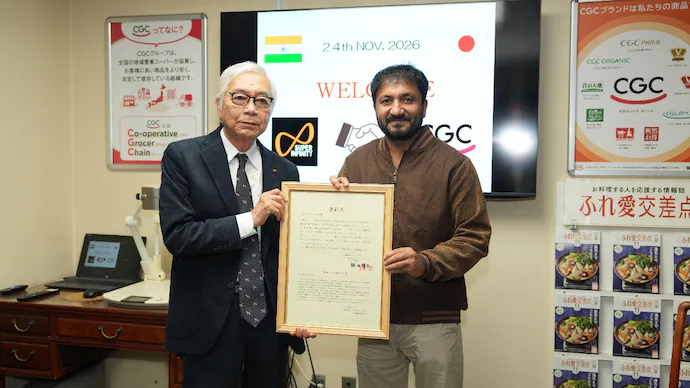
Indian mathematician and Super 30 founder Anand Kumar has received Japan’s Special Achievement Award in recognition of his contribution to education and his sustained efforts to make quality learning accessible to children from economically disadvantaged backgrounds. The honour acknowledges his work in helping talented students overcome financial barriers and pursue better academic opportunities through innovative teaching initiatives.
The award was presented by Atsuhiro Horiuchi, Chairman and CEO of Japan’s CGC Group. The recognition highlights Kumar’s work through Super 30, the Patna-based educational programme that provides free coaching to academically gifted students from underprivileged families, as well as Super Infinity, his newer initiative aimed at making mathematics more engaging and accessible to children across the world.
The recognition places renewed attention on an educational approach that focuses on ability rather than financial circumstances. It also reflects the growing international interest in learning models that use accessible teaching methods to help children develop confidence in subjects such as mathematics.
Why Japan Honoured Anand Kumar
According to the award citation, Kumar was recognised for his efforts to provide free, high-quality education to underprivileged students through Super 30 and help them access opportunities that might otherwise remain beyond their reach.
The citation also acknowledged his work in taking mathematics education beyond geographical and economic barriers through Super Infinity. The initiative seeks to make the subject easier to understand and more enjoyable, particularly for children who may find conventional classroom teaching difficult or intimidating.
The distinction recognises two connected aspects of Kumar’s educational work. Super 30 focuses on preparing talented students from financially disadvantaged backgrounds for competitive examinations, while Super Infinity aims to make mathematical learning more accessible to a wider group of children.
These initiatives address different stages of the education journey, but share a common objective: reducing the barriers that prevent children from developing their academic potential. The award therefore recognises not only a coaching programme but also Kumar’s broader effort to rethink how difficult subjects can be taught and understood.
Super 30: The Programme That Changed Anand Kumar’s Educational Journey
Anand Kumar launched Super 30 in Patna in 2002 with the aim of helping talented students from economically weaker families prepare for the entrance examinations of the Indian Institutes of Technology (IITs).
For many students, the financial cost of preparing for highly competitive engineering entrance examinations can be a major obstacle. Private coaching, study materials, accommodation and other expenses can make specialised preparation inaccessible to families with limited resources.
Super 30 was developed around a different model. It provides selected students with free academic coaching and support, allowing them to prepare for competitive examinations without having to bear the costs associated with commercial coaching programmes.
The initiative became widely known because of its focus on students whose academic ambitions were not matched by their families’ financial resources. Its approach challenged the assumption that access to advanced examination preparation should depend primarily on the ability to pay.
By concentrating on talented students from disadvantaged backgrounds, the programme sought to create a pathway from limited educational resources to opportunities in some of India’s most competitive engineering institutions.
How Super 30 Addresses Educational Inequality
India has a large and diverse education system in which students do not always have equal access to experienced teachers, specialised coaching or learning resources. The difference can be particularly significant between students from affluent households and those from low-income families.
Students in smaller towns and economically disadvantaged communities may have the ability and motivation to succeed but lack access to the preparation required for highly competitive examinations. Super 30 attempts to address part of this gap by providing intensive coaching without charging selected students for the programme.
The model also highlights an important distinction between academic potential and financial privilege. A student’s ability to understand mathematics, science or other complex subjects is not necessarily determined by household income. However, access to quality instruction can strongly influence how far that ability develops.
Super 30’s public profile has helped bring this issue into wider discussions about educational opportunity, merit and the importance of targeted support for disadvantaged students.
Super Infinity: Anand Kumar’s New Approach to Mathematics Education
While Super 30 is primarily associated with preparing students for IIT entrance examinations, Anand Kumar is now extending his educational vision through Super Infinity, an initiative focused on making mathematics simpler, more engaging and accessible to children.
Mathematics is a foundational subject, but many students develop anxiety or lose confidence when they struggle to understand abstract concepts. Traditional teaching methods can sometimes place heavy emphasis on memorising formulas and following fixed procedures, leaving students with limited opportunities to explore the reasoning behind mathematical ideas.
Super Infinity aims to make the learning experience more engaging by presenting mathematics in ways that children can understand and enjoy. Its broader ambition is to take mathematical education beyond geographical and economic boundaries, making it relevant to children from different backgrounds.
The initiative represents an expansion of Kumar’s educational philosophy. Rather than focusing exclusively on students preparing for a particular competitive examination, it seeks to address the wider challenge of helping children develop an interest in mathematics at an earlier stage of their education.
Why Making Mathematics Enjoyable Matters
Mathematics plays an important role in science, technology, engineering, finance and everyday decision-making. A strong understanding of the subject can help students develop logical reasoning, problem-solving abilities and confidence in handling complex information.
However, negative early experiences with mathematics can discourage children from pursuing subjects and careers that require quantitative skills. When students repeatedly encounter concepts they cannot understand, they may begin to believe that mathematics is beyond their ability.
Teaching approaches that encourage curiosity and explain concepts through engaging examples can help change that perception. Making mathematics enjoyable does not mean reducing academic standards. Instead, it involves finding clearer ways to explain difficult ideas and giving students opportunities to understand how mathematical principles work.
Super Infinity’s focus on accessibility reflects this wider educational challenge. If children can develop confidence in mathematics, they may be better prepared to explore advanced subjects and future learning opportunities.
Japan Shows Interest in Super Infinity’s Japanese-Language Initiative
Kumar’s recognition in Japan also brought attention to the international possibilities of his latest educational initiative. During his meeting with Atsuhiro Horiuchi, the CGC Group chairman and CEO expressed interest in Super Infinity’s ongoing Japanese-language initiative.
Horiuchi reportedly observed that children in Japan were also looking for more engaging ways to learn mathematics beyond traditional classroom methods. The discussion suggests that the challenges Kumar is attempting to address are not limited to India or developing education systems.
Students in different countries may face similar difficulties when mathematical concepts are presented in ways that do not match their learning needs. Language, teaching styles and access to educational resources can differ, but the challenge of making abstract subjects understandable is shared across education systems.
The Japanese-language initiative could help Super Infinity reach learners beyond its initial audience by making its educational approach more accessible to Japanese-speaking children. It also points towards the importance of adapting learning material to local languages rather than assuming that a single language or teaching format will work equally well everywhere.
However, the expression of interest should be distinguished from a confirmed international partnership or formal expansion agreement. The available announcement highlights Horiuchi’s interest in the initiative, but does not establish specific implementation arrangements, timelines or the number of students expected to participate.
CGC Group’s Role in Recognising Anand Kumar
The Special Achievement Award was presented by Japan’s CGC Group, a major Japanese business group with a substantial network of member companies and stores.
According to the information accompanying the announcement, CGC Group has 202 member companies and 5,083 stores, with annual business turnover exceeding 5.72 trillion Japanese yen.
The group’s recognition of Kumar highlights an intersection between the business community and educational initiatives. While companies and educational organisations operate in different sectors, businesses can play a role in drawing attention to social contributions, supporting learning initiatives and encouraging efforts that address long-standing barriers to opportunity.
In this case, the award acknowledges an educational mission that has developed from a local programme in Bihar into a broader effort to make learning more accessible. The interest in Super Infinity also gives the recognition an international dimension, particularly as the initiative explores ways to reach children in different language environments.
Anand Kumar Says the Award Belongs to Students
Reacting to the recognition, Anand Kumar said the honour did not belong to him alone. He dedicated it to children across the world who continue to pursue their dreams despite difficult personal and financial circumstances.
Kumar said his central purpose had remained unchanged from Super 30 to Super Infinity: ensuring that no child is denied access to quality education because of financial constraints.
He also thanked Horiuchi and the CGC Group for the award, adding that the recognition would encourage him to continue working towards expanding access to quality education.
His response reflects the philosophy behind his educational initiatives. Rather than presenting the award solely as an individual achievement, Kumar connected it to the students whose aspirations and determination are at the centre of his work.
For students from low-income households, financial limitations can influence access to everything from school resources to specialised examination preparation. Kumar’s remarks underline the importance of creating systems in which a lack of money does not automatically close the door to academic progress.
What the Japan Award Means for India’s Education Efforts
Kumar’s recognition in Japan is significant for India’s broader conversation about educational inclusion. The country has a large population of young learners, but access to quality teaching and specialised academic support remains uneven across regions and income groups.
Programmes such as Super 30 demonstrate one way of addressing this challenge: identifying talented students who lack financial resources and providing them with focused academic support. Super Infinity represents a different but complementary approach by attempting to make a foundational subject more approachable for children before they reach advanced academic stages.
Together, the initiatives highlight two important priorities for education. The first is ensuring that capable students are not excluded from opportunities because they cannot afford specialised preparation. The second is improving the way essential subjects are taught so that more children can develop the skills and confidence needed for future learning.
The award also offers an opportunity to draw attention to educational work originating outside India’s largest metropolitan centres. Super 30 began in Patna, Bihar, and its recognition in Japan illustrates how locally developed initiatives can attract international attention when they address challenges shared by communities across countries.
At the same time, an award alone cannot resolve the structural problems affecting education. Wider access requires sustained investment in schools, teacher development, learning materials, digital resources and support for students from disadvantaged households. Initiatives such as Super 30 and Super Infinity can contribute to this effort, but their long-term impact will depend on their ability to reach learners and deliver meaningful educational outcomes.
From a Patna Classroom to International Recognition
Anand Kumar’s journey from launching Super 30 in 2002 to receiving Japan’s Special Achievement Award reflects the expanding reach of his educational work. What began as an effort to help economically disadvantaged students prepare for IIT entrance examinations has developed into a broader mission centred on making learning more accessible.
Super 30 continues to represent the importance of giving talented students a fair opportunity, regardless of their financial background. Super Infinity extends that philosophy towards a wider group of children by focusing on making mathematics easier to understand and more enjoyable to learn.
The interest expressed by Japan’s CGC Group in the Japanese-language initiative adds another dimension to this effort. It suggests that the need for engaging mathematics education is not confined to one country and that approaches developed in India may have relevance for learners elsewhere.
For Kumar, however, the central message remains focused on students rather than recognition. His stated goal is to ensure that financial hardship does not determine a child’s access to quality education. Japan’s Special Achievement Award brings international attention to that mission and to the continuing importance of making educational opportunity more inclusive.
For breaking news and live news updates, like us on Facebook or follow us on Twitter and Instagram. Read more on Latest Education on thefoxdaily.com.

COMMENTS 0