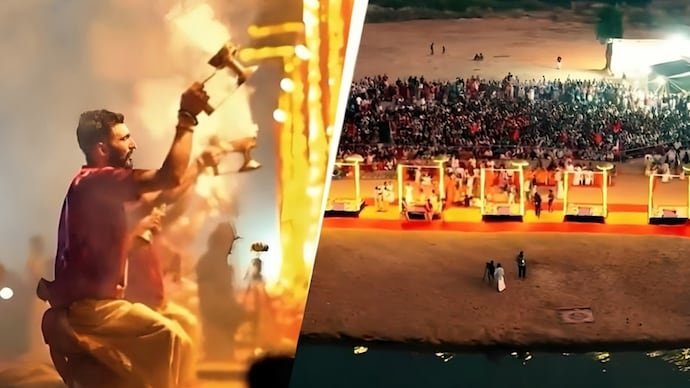
As devotees step into the sacred waters for the holy dip, the glow of thousands of diyas illuminates the night sky, while the rhythmic chanting of Vedic hymns fills the air without pause. Sadhus clad in saffron line the riverbanks, creating a scene that blends devotion, history, and spectacle. This is the Maha Magha Mahotsavam—popularly described as Kerala’s own Kumbh Mela—which has made a historic comeback to God’s Own Country after a gap of nearly 250 years.
Modeled on the iconic Kumbh Melas of northern India, the southern version began on January 18 on the banks of the Bharathapuzha, also known as the ‘Dakshin Ganga’. The 18-day religious congregation has already drawn tens of thousands of devotees to the ghats over the past two weeks.
The timing of the festival is particularly significant, as it coincides with the run-up to the crucial Kerala Assembly elections. With the Left Democratic Front government attempting to retain power amid a strong challenge from the congress-led United Democratic Front, some political observers have described the revival of Kerala’s Kumbh Mela as a subtle soft-Hindutva outreach in the state’s charged electoral climate.
“Keralam is witnessing the historic resurgence of the #MahaMaghaMahotsavam, popularly known as the Keralam #KumbhMela, after an almost 250-year hiatus. Seeing this holy congregation return to the banks of the Bharathappuzha, a part of my own heritage in Kondayur, is deeply moving,” tweeted BJP leader and former Union Minister Rajeev Chandrasekhar.
Kerala Kumbh’s Historic Return
The revival of this massive spiritual gathering is largely credited to Swami Anandavan Bharati Maharaj, a senior monk of the Juna Akhada—one of the oldest and largest monastic orders in India. Interestingly, Swami Anandavan is also a former leader of the CPI(M)’s student wing. During the most recent Kumbh Mela in Prayagraj, he was appointed the Mahamandaleshwar, or chief, of the akhada for South India.
The Maha Magha Mahotsavam has received backing from prominent spiritual and political figures, including Mata Amritanandamayi and Kerala Devaswom Minister V.N. Vasavan. Organisers estimate that the event could attract more than 10 lakh devotees over its full duration.
Efforts to revive this ancient cultural and religious tradition have been underway for several years. The current edition was formally inaugurated on January 18 by Kerala Governor Rajendra Vishwanath Arlekar, who hoisted the ceremonial flag that had been carried in a grand procession from Angadippuram Aliparamba Kalari.
In his address, the Governor praised Kerala’s initiative to restore the Sanatana Dharma tradition, while also emphasizing that the revival should not be interpreted as being against any other faith or belief system.
Why Was the Kerala Kumbh Discontinued?
The Maha Magha Mahotsavam is being held at the historic Mamankam grounds, a site that once hosted a grand medieval festival along the banks of the Bharathapuzha every twelve years. Mamankam played a crucial role in Kerala’s political history and martial traditions during the medieval period.
However, following the British takeover of the Malabar region, the Mamankam tradition gradually declined and eventually faded away. According to Swami Anandavan Bharati, a firm resolve to revive the festival was taken after the Prayagraj Maha Kumbh.
“The British rulers stopped this event nearly 270 years ago. After Independence, there were a few attempts to revive it, and two or three programs were held, but unfortunately, there was no continuity,” Swami Anandavan told ANI, explaining the long interruption in the tradition.
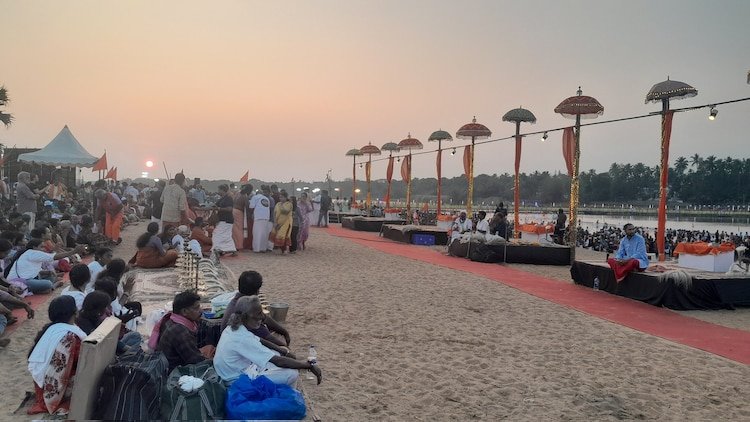
Lighting Up the Banks of Bharathapuzha
Every evening, as dusk settles, the banks of the Bharathapuzha transform into a breathtaking spectacle of light and devotion. The ‘Nila Aarti’—another name for the river—is performed by priests from the Kashi Vishwanath Temple in Uttar Pradesh, the same priests who conduct the famed Ganga Aarti at Varanasi’s Dashashwamedh Ghat.
Sharing his emotions, BJP state president Rajeev Chandrasekhar said that witnessing this sacred gathering return to the Bharathappuzha, a river deeply connected to his roots in Kondayur, was profoundly moving.
To ensure the smooth and safe conduct of the event, the Kerala government has put extensive security measures in place. Bomb detection squads have been deployed, and more than 300 police personnel are stationed at the venue. Entry into the main yajna shala is permitted only after thorough security checks.
Facilitating travel for pilgrims, the Kerala State Road Transport Corporation (KSRTC) is operating over 100 special services from various parts of the state. In addition, indian railways has introduced a special train service connecting Rishikesh and Varanasi with Ernakulam.
Despite the grandeur, the event has not been without controversy. Earlier this month, a dispute erupted after the tax department ordered a halt to the construction of a temporary bridge across the Bharathapuzha for the festival.
Organisers strongly opposed the move, alleging that it was an attempt to disrupt the Maha Magha Mahotsavam. The BJP also criticized the Pinarayi Vijayan-led government, accusing it of trying to undermine the event.
“The sudden and unexplained stoppage of construction is clearly part of a conspiracy to sabotage the Kumbh Mela and demoralize devotees,” senior BJP leader Kummanam Rajasekharan alleged.
Eventually, the state government intervened to resolve the issue, allowing construction to resume after acknowledging the potential political and social fallout, especially with Assembly elections just months away.
For breaking news and live news updates, like us on Facebook or follow us on Twitter and Instagram. Read more on Latest India on thefoxdaily.com.




COMMENTS 0