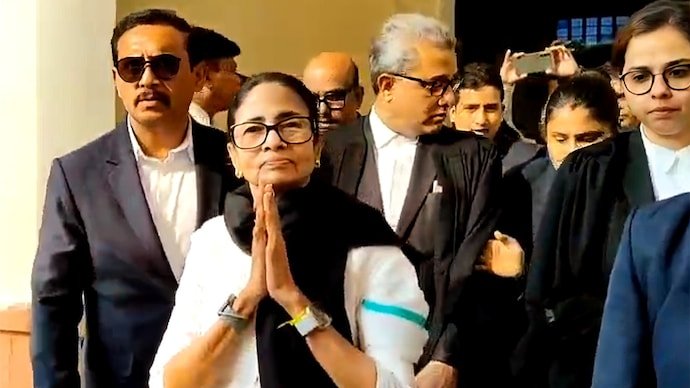
West Bengal Chief Minister Mamata Banerjee’s convoy rolled up to the gates of the Supreme Court on Wednesday morning, bringing with it the charged politics of an election-bound Bengal to the heart of New Delhi. At the centre of her visit was a direct challenge to the Election Commission of India (ECI) and its ongoing Special Intensive Revision (SIR) of the state’s electoral rolls.
Clad in her familiar white sari, Mamata Banerjee stood out with a black shawl draped over her shoulder as she arrived well ahead of the scheduled hearing. The Chief Minister later said the black shawl symbolised solidarity with families she claims have been affected by the SIR exercise and the protests surrounding it, asserting that over 100 deaths were linked to the process.
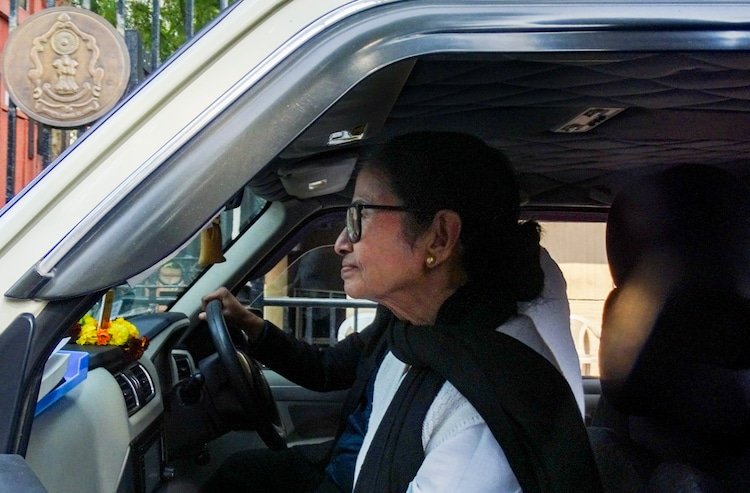
What unfolded next was not just a legal appearance but a carefully choreographed political moment. Banerjee carried her long-running political fight into the courtroom with visible resolve, marking a rare crossover of street politics, constitutional authority, and personal intervention.
In a move that legal observers described as extraordinary, Mamata Banerjee became the first sitting Chief Minister to personally argue her case before the Supreme Court of India. While chief ministers routinely approach the apex court through legal teams, personal appearances of this nature are virtually unheard of.
Surrounded by senior advocates and protected by Z+ security, Banerjee moved briskly through the Supreme Court corridors. She paused briefly to fold her hands in greeting, as lawyers lined the hallways—some bowing respectfully, others raising their phones to capture the moment—while she deftly avoided media questions.
Upon entering Courtroom No. 1, Banerjee was offered a front-row seat as a petitioner-in-person. However, she chose to sit alongside her legal team in the visitors’ gallery at the back, waiting for her case to be called.
The tension inside the courtroom was palpable. When an individual attempted to take a selfie with the Chief Minister inside the courtroom, security personnel immediately intervened, blocking access and confiscating phones to preserve decorum.
Lawyers and observers crowded into the expansive Courtroom No. 1 to witness what was expected to be a landmark hearing on the Special Intensive Revision of West Bengal’s electoral rolls.
Despite the anticipation and Banerjee’s high-profile presence, the bench—comprising Chief Justice of India Justice Suryakant, Justice Joymalya Bagchi, and Justice Vipul M. Pancholi—chose to take up other matters first, delaying the SIR hearing.
It was only around 12:45 pm that Banerjee, accompanied by Trinamool congress MP and senior advocate Kalyan Banerjee, moved to the front row as the matter was finally called.
Physically smaller than many of the senior lawyers around her, Mamata Banerjee nevertheless commanded the courtroom’s attention. With quiet intensity, she urged the Supreme Court to “protect Democracy in West Bengal,” framing the case as one with far-reaching constitutional implications.
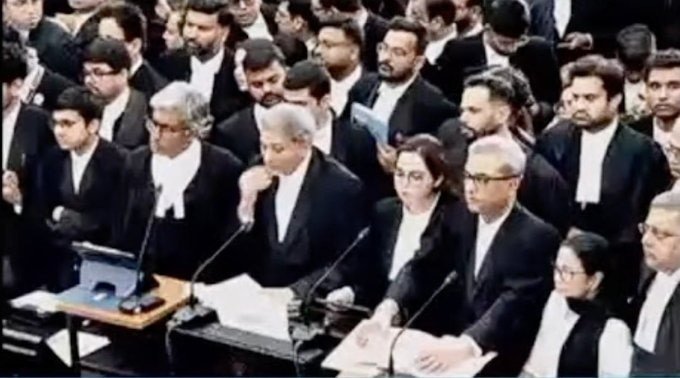
Maintaining the decorum expected of a constitutional authority, Banerjee initially allowed her senior counsel to present the legal and factual framework of the case. At intervals, she leaned in to whisper instructions to West Bengal government counsel Debanjan Mondal.
The Chief Minister departed from established convention when she sought permission to intervene directly after the Election Commission’s lawyer argued that voter names were not being removed for “minor spelling mistakes.”
With folded hands, Banerjee requested the court’s permission to place certain points on record herself.
“Lawyers always fight the case, but when everything is over and justice is not delivered, justice cries in private,” Banerjee said, quoting Rabindranath Tagore. “That is why I am here. I have written six letters to the Election Commission, but I have not received a response.”
The bench initially questioned why the executive head of a state had chosen to argue personally, with the Chief Justice observing that West Bengal was already represented by some of the country’s finest legal minds.
In response, Banerjee said she was appearing not as a party leader but as “an ordinary person.” When the bench remarked that she seemed to be attempting something beyond that role, Banerjee clarified that she stood before the court as a litigant.
“You may say I am a bound worker from a typical household, making me a less significant individual,” she said. “I am here because I live in Bengal.” Standing beside her, Kalyan Banerjee nodded in agreement, a faint smile appearing on his face.
Before allowing her to continue, the Chief Justice remarked, “Nobody can deny that you are a resident, Madam.”
Senior advocate Sanjoy Ghosh, observing the proceedings, later described the hearing as “unprecedented,” noting that it was rare for a sitting Chief Minister to appear in person and argue her case.
“The development was extraordinary. Both the Chief Minister and the court deserve credit for maintaining the dignity of the proceedings. While she ensured her grievance was clearly articulated, the bench also upheld the importance of institutional procedure,” Ghosh said.
During her arguments, Banerjee alleged that the SIR process was being used primarily for voter deletion rather than verification and mapping.
She claimed that mistranslations from Bengali to English were being flagged as “logical discrepancies,” leading to deletions by micro-observers deputed from BJP-ruled states who, she alleged, did not understand the Bengali language.
Banerjee said Bengalis had initially welcomed the Supreme Court’s earlier direction allowing Aadhaar cards, domicile certificates, and other state-issued identity documents. However, she alleged that the Election Commission later rejected these documents to selectively target West Bengal ahead of elections.
“Why was there such a rush to complete a task that should have taken two years, during harvest season and puja, when many people were not even in the city, in just four months after twenty-four years?” she asked, alleging that notices were served at inappropriate times.
Banerjee also drew attention to what she described as the suffering of Booth Level Officers (BLOs), citing over 150 deaths and alleging that some officers died by suicide due to work-related stress. She placed newspaper clippings and photographs on record to support her claims.
“Why was Bengal singled out? Why not start in Assam or the northeastern states?” Banerjee asked, calling the process “anti-women.”
She cited cases where women voters were flagged for mismatches after marriage due to changes in surname or address.
“If a woman moves to her in-laws’ home after marriage or changes her surname, it is treated as a mismatch. People who move cities for work are also deleted for ‘logical discrepancies.’ This is not verification; this is mapping failure,” she said.
Banerjee went on to describe the Election Commission as a “WhatsApp commission,” alleging that micro-observers sitting inside ECI offices were effectively making decisions, bypassing Electoral Registration Officers (EROs) and Assistant EROs.
“Names are being removed only by micro-observers, most of whom come from BJP-ruled states. Neither government documents nor domicile certificates are being accepted,” she alleged.
Tensions peaked when ECI lawyers accused the West Bengal government of non-cooperation. Appearing for the Commission, senior counsel Rakesh Dwivedi argued that the state had failed to appoint adequate Sub-Divisional Magistrates and Class II officers as AEROs, necessitating the deployment of micro-observers.
Banerjee forcefully rejected the charge, interrupting even her own counsel, Shyam Divan.
“They are telling stories I do not believe,” she said, asserting that the state had provided all available officials and that the number of SDMs depended on district strength.
As the hearing concluded, the Chief Justice issued notice to the Election Commission, sought its response, and directed the executive head of the state to ensure sufficient officials were deputed for verification. Banerjee nodded swiftly, assuring the court of compliance.
Outside the courtroom, Banerjee was once again surrounded by lawyers and journalists. One advocate even presented her with a copy of his book, while videos of lawyers following her to her vehicle later went viral on social media.
By the end of the day, Mamata Banerjee had ensured that West Bengal’s electoral battle was no longer confined to political rallies or street protests. Instead, the heart of the campaign had firmly entered the halls of the Supreme Court of India.
For breaking news and live news updates, like us on Facebook or follow us on Twitter and Instagram. Read more on Latest World on thefoxdaily.com.




COMMENTS 0