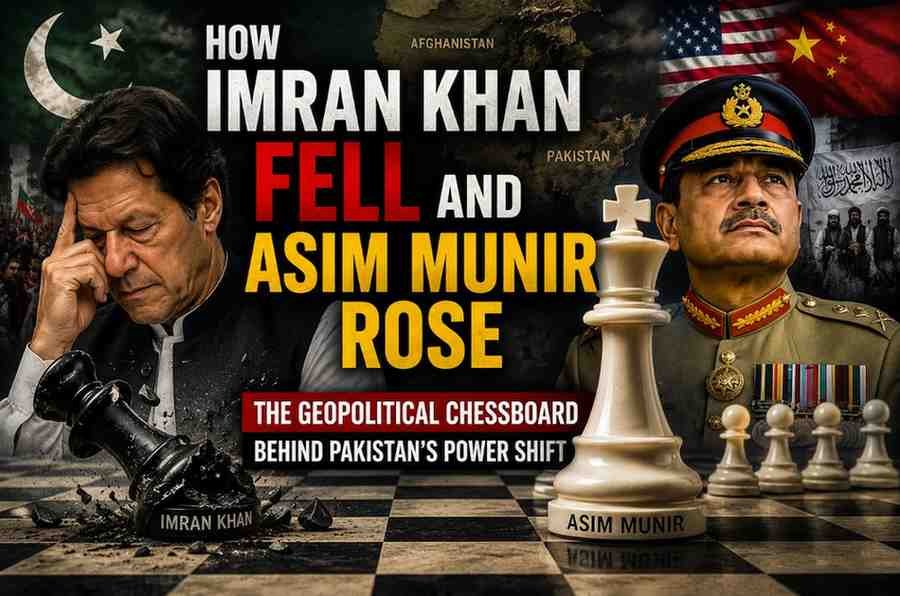
- Why Imran Khan Became a Problem for Both Washington and Rawalpindi
- The Moscow Visit That Changed Everything
- The Cipher Case Became Political Dynamite
- Why Asim Munir Emerged as the Central Figure
- The Pakistan Military’s Strategic Calculation
- Was Imran Khan’s Removal a Regime Change?
- How the Ukraine War Changed Pakistan’s Alignment
- The Rise of Asim Munir After Operation Sindoor
- Why Pakistan Still Matters Enormously to Washington
- The Bigger Pattern: Pakistan as a Geopolitical Battlefield
- Conclusion: The Imran-Munir Power Shift Reflects a Larger Global Reality
Pakistan has always been more than just a country struggling with political instability. It is a geopolitical crossroads where global rivalries, Military interests, intelligence networks, and regional ambitions collide with extraordinary intensity.
Prime ministers rise dramatically and fall abruptly. Military chiefs quietly become the true centres of power. Civilian governments often appear temporary, while the security establishment remains permanent.
But the dramatic chain of events involving former Prime Minister Imran Khan and current military strongman Field Marshal Asim Munir may represent one of the most consequential power shifts in Pakistan since the post-9/11 era.
According to emerging reports and growing geopolitical analysis, the fall of Imran Khan was not merely the result of domestic political infighting or parliamentary arithmetic. Instead, many observers now view it as part of a much larger strategic realignment shaped by Pakistan’s military establishment, Washington’s regional priorities, the Ukraine war, and shifting Middle Eastern Geopolitics.
At the centre of this unfolding story lies an uncomfortable question:
Was Pakistan’s political transition after 2022 simply constitutional politics or a carefully managed geopolitical correction?
Why Imran Khan Became a Problem for Both Washington and Rawalpindi
Imran Khan did not initially enter power as an anti-American revolutionary figure.
In fact, during the early years of his government, many international observers viewed him as a pragmatic leader attempting to balance Pakistan’s traditional security establishment with economic reform and diplomatic repositioning.
But over time, his foreign policy approach began diverging sharply from both Washington’s expectations and the Pakistani military’s long-standing strategic habits.
Khan increasingly promoted what he described as “strategic autonomy.”
That included:
- Refusing American military base requests after the Taliban takeover in Afghanistan
- Attempting a more independent Russia policy
- Strengthening ties with China
- Reducing overt dependency on Washington
- Publicly criticising aspects of Western foreign policy
His famous “Absolutely not” response regarding US military bases became symbolically important far beyond Pakistan.
To many Pakistanis, it projected sovereignty.
To parts of the security establishment and Western policymakers, however, it raised concerns about Pakistan drifting unpredictably during an increasingly unstable global Environment.
The Moscow Visit That Changed Everything
The defining geopolitical rupture came in February 2022.
On the exact day Russia launched its military operation in Ukraine, Imran Khan was in Moscow meeting Russian President Vladimir Putin.
The optics were devastating diplomatically.
Even if Pakistan did not formally endorse Russia’s actions, the images of Khan shaking hands with Putin at that precise historical moment created a perception problem that echoed across Western capitals.
For Washington, the visit appeared to signal that Pakistan was becoming less aligned with US strategic priorities during one of the most important geopolitical crises in decades.
For Pakistan’s military establishment, the timing risked destabilising carefully balanced international relationships especially with the United States, IMF-linked financial structures, and Western defence networks.
That moment increasingly appears to have accelerated the breakdown between Imran Khan and powerful institutions inside Pakistan.
The Cipher Case Became Political Dynamite
No episode better symbolises Pakistan’s political crisis than the infamous cipher Controversy.
The diplomatic cable allegedly sent from Pakistan’s ambassador in Washington to Islamabad became the emotional and political centrepiece of Imran Khan’s narrative after his removal from office.
According to Khan and his supporters, the cable contained evidence suggesting senior US officials were deeply unhappy with his leadership and preferred political change in Islamabad.
The alleged remark that “all will be forgiven” if the no-confidence vote succeeded became politically explosive.
For Khan’s supporters, the cable represented proof of foreign interference.
For critics, it became an example of Khan weaponising diplomatic communication for domestic political survival.
Regardless of interpretation, the cipher transformed public perception permanently.
Millions of Pakistanis increasingly came to believe that:
- External pressure influenced domestic politics
- The military establishment sided against Khan
- Pakistan’s sovereignty was compromised
- The political system was manipulated behind closed doors
The result was one of the most polarised political environments in Pakistan’s modern history.
Why Asim Munir Emerged as the Central Figure
While much public attention focused on Imran Khan’s downfall, another story was unfolding quietly in the background: the steady rise of Asim Munir.
Munir’s trajectory through Pakistan’s security structure positioned him uniquely at the intersection of intelligence, military authority, and geopolitical alignment.
Before becoming Army Chief, he served as head of Pakistan’s Inter-Services Intelligence (ISI), arguably the country’s most powerful institution after the army itself.
Reports now suggest that tensions between Khan and Munir began years before Khan’s removal from office.
One particularly controversial claim involves Khan’s 2019 Iran visit.
According to accounts cited in geopolitical reporting, Munir allegedly adopted a far more confrontational posture toward Iranian officials than Pakistan’s civilian leadership preferred.
This detail matters because Iran sits at the centre of multiple competing geopolitical interests involving:
- The United States
- Saudi Arabia
- Israel
- China
- Regional Sunni-Shia dynamics
Pakistan’s military establishment has historically attempted to balance relations carefully across these competing power centres.
Any independent diplomatic shift toward Tehran carried strategic implications.
The Pakistan Military’s Strategic Calculation
Pakistan’s military establishment has traditionally prioritised strategic continuity over ideological experimentation.
For decades, Rawalpindi has viewed close relations with major powers as essential for:
- Economic survival
- Military financing
- Diplomatic leverage
- Strategic balancing against India
- Internal political stability
From the Cold War to the Afghan jihad to the War on Terror, Pakistan repeatedly positioned itself as a strategically indispensable partner.
Imran Khan’s growing unpredictability increasingly conflicted with that institutional approach.
His attempts to maintain distance from Washington while simultaneously strengthening ties with Russia and China created anxieties within sections of the establishment that Pakistan risked strategic isolation.
Was Imran Khan’s Removal a Regime Change?
Technically and constitutionally, Imran Khan lost power through a parliamentary no-confidence vote.
That fact remains important.
However, politics is often shaped not only by legal procedures but by the forces operating behind them.
Critics of the transition argue that while the vote itself was constitutional, the political environment surrounding it reflected coordinated pressure involving:
- The military establishment
- Opposition parties
- Foreign diplomatic interests
- Institutional influence networks
Khan’s supporters frequently described this as the “London Plan” or “foreign conspiracy.”
Whether those claims can be conclusively proven remains heavily debated.
But politically, the perception itself became extremely powerful.
And in politics, perception often matters almost as much as evidence.
How the Ukraine War Changed Pakistan’s Alignment
One of the most overlooked aspects of Pakistan’s political transformation after Khan’s removal was the country’s gradual geopolitical repositioning.
Following the change in government:
- Pakistan moved closer to Western diplomatic positions
- Relations with Washington stabilised
- IMF financial support gained renewed importance
- Reports emerged of indirect military supplies linked to Ukraine
The timing was difficult to ignore.
Pakistan’s severe economic crisis made international financial assistance essential.
At the same time, global powers were aggressively consolidating alliances after Russia’s invasion of Ukraine.
Pakistan’s strategic value once again increased dramatically.
The Rise of Asim Munir After Operation Sindoor
The consolidation of Asim Munir’s power accelerated further after India’s Operation Sindoor in 2025.
Although the military confrontation exposed vulnerabilities in Pakistan’s defence Infrastructure, Rawalpindi successfully shaped a domestic narrative portraying the Conflict as a national resistance success.
That narrative allowed Munir’s political stature to expand rapidly.
His rise soon moved beyond the traditional role of army chief.
| Position | Impact on Power Structure |
|---|---|
| Army Chief | Control over Pakistan Army |
| Field Marshal | Symbolic elevation and prestige |
| Chief of Defence Forces | Authority across military branches |
| Extended Tenure | Long-term institutional continuity |
The creation of the Chief of Defence Forces role effectively centralised unprecedented authority under Munir.
He now exercises influence across:
- The army
- The air force
- The navy
- Strategic command structures
- Nuclear oversight frameworks
Very few figures in Pakistan’s history have accumulated comparable institutional power.
Why Pakistan Still Matters Enormously to Washington
Despite periodic tensions, Pakistan remains strategically critical for the United States.
Its importance comes from several factors:
- Nuclear weapons capability
- Geographic proximity to Iran, Afghanistan, China, and India
- Counterterrorism networks
- Military intelligence infrastructure
- Influence over regional stability
As the Middle East becomes increasingly volatile and tensions involving Iran intensify, Pakistan’s strategic location becomes even more important.
Washington may not control Pakistan directly, but maintaining a stable and cooperative security relationship remains a high priority.
The Bigger Pattern: Pakistan as a Geopolitical Battlefield
Pakistan’s political turbulence cannot be understood in isolation from its geopolitical role.
For decades, the country has operated simultaneously as:
- A strategic ally
- A security dependency
- A regional balancing actor
- A military state
- A battleground for influence between global powers
That pattern stretches across multiple historical eras:
- The Cold War
- The Soviet-Afghan conflict
- The War on Terror
- The China-US rivalry
- The Ukraine conflict
- The emerging Iran crisis
Pakistan’s leadership transitions are therefore rarely just domestic political events. They often intersect directly with wider international strategic calculations.
Conclusion: The Imran-Munir Power Shift Reflects a Larger Global Reality
The fall of Imran Khan and the rise of Asim Munir represent far more than a conventional civilian-versus-military political struggle.
They reflect the deeper reality of how global geopolitics continues to shape Pakistan’s internal power structure.
Imran Khan attempted to project a more independent foreign policy identity at a moment when global powers were becoming increasingly intolerant of strategic ambiguity.
Asim Munir, meanwhile, emerged as the figure capable of restoring institutional predictability for both Pakistan’s military establishment and external strategic stakeholders.
Whether one views the transition as constitutional politics, establishment engineering, geopolitical correction, or regime management depends largely on political perspective.
But one fact remains difficult to ignore:
In Pakistan, power rarely changes hands without larger geopolitical forces moving quietly beneath the surface.
And as the Middle East crisis deepens, US-China rivalry intensifies, and regional security dynamics continue shifting, Pakistan’s military-led power structure under Asim Munir may become even more strategically significant in the years ahead.
For breaking news and live news updates, like us on Facebook or follow us on Twitter and Instagram. Read more on Latest World on thefoxdaily.com.






COMMENTS 0