- Why Xi Jinping Used the Phrase “Law of the Jungle”
- The Strait of Hormuz Is Becoming the Center of Global Anxiety
- China’s Middle East Strategy Is Based on Stability, Not Ideology
- Why Beijing Is Worried About Uncontrolled Escalation
- Xi and Putin Are Increasingly Coordinating Global Messaging
- Trump’s Beijing Visit Revealed an Unusual Strategic Reality
- The Conflict Is Accelerating the Shift Toward a Multipolar World
- How the War Is Affecting Global Markets
- Why China Is Being Careful Not to Fully Confront Washington
- The Historical Echo Behind Xi’s Warning
- The Middle East Conflict Could Reshape Global Alliances
- Conclusion: Xi’s Warning Was About More Than the Middle East
The world’s major powers are no longer speaking cautiously about the Middle East Conflict. They are increasingly speaking in terms of global systemic risk.
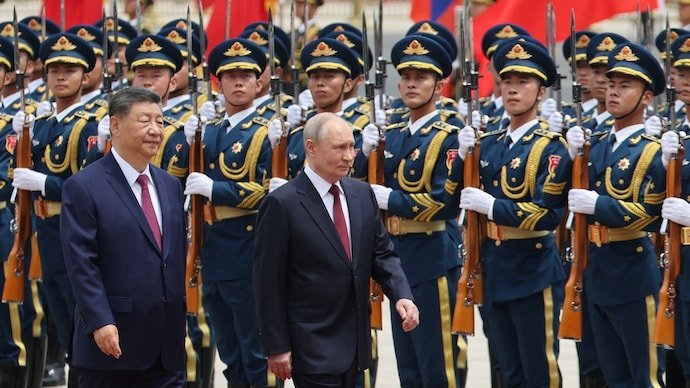
That shift became unmistakably clear when Chinese President Xi Jinping warned Russian President Vladimir Putin in Beijing that the world was in danger of “reversing into the law of the jungle” if the ongoing Middle East war continues unchecked.
Xi’s remarks, delivered during high-level talks with Putin amid the escalating US-Israeli military campaign against Iran, were not merely diplomatic rhetoric. They reflected Beijing’s growing concern that prolonged warfare in the Gulf could destabilise energy markets, fracture global trade systems, weaken international institutions, and intensify great-power rivalry across multiple regions.
While China has largely maintained a measured diplomatic posture since the conflict began, Xi’s language marked one of Beijing’s strongest public warnings yet.
More importantly, the statement revealed something deeper: China increasingly sees the Middle East crisis not as a regional war, but as a potential turning point in the global balance of power.
Why Xi Jinping Used the Phrase “Law of the Jungle”
The phrase “law of the jungle” carries enormous geopolitical significance.
In diplomatic language, it refers to a world where military force, coercion, and unilateral action replace international law, multilateral institutions, and negotiated order.
Xi’s warning suggested that Beijing fears the current conflict could normalise a dangerous pattern:
- Powerful states bypassing diplomacy
- Military escalation becoming the preferred policy tool
- International institutions losing influence
- Global trade becoming increasingly weaponised
- Strategic choke points turning into conflict zones
For China, this is not merely a philosophical concern. It is directly tied to economic survival and long-term strategic stability.
China’s economic rise has depended heavily on predictable trade routes, stable energy imports, and a relatively open global trading system.
A prolonged Middle East war threatens all three.
The Strait of Hormuz Is Becoming the Center of Global Anxiety
One of the biggest reasons behind Beijing’s alarm is the Strait of Hormuz.
The narrow waterway between the Persian Gulf and the Arabian Sea remains one of the most strategically important energy corridors on Earth.
A massive portion of the world’s oil exports passes through it every day.
As tensions escalated following the US-Israeli campaign against Iran, Tehran reportedly tightened oversight and pressure around shipping lanes in the region, increasing fears of broader maritime disruption.
For China, the implications are enormous.
China is one of the world’s largest energy importers, and much of its oil supply depends on uninterrupted Gulf shipping routes.
Any serious disruption in the Strait of Hormuz could:
- Drive oil prices sharply higher
- Disrupt manufacturing supply chains
- Increase inflation globally
- Slow economic growth
- Create instability in financial markets
This explains why Xi specifically linked the war to disruptions in energy supply and international trade order.
China’s Middle East Strategy Is Based on Stability, Not Ideology
Unlike the United States, China has traditionally avoided deep military involvement in Middle Eastern conflicts.
Beijing’s regional strategy has generally focused on:
- Energy security
- Trade expansion
- Infrastructure investments
- Diplomatic balancing
- Economic partnerships
China maintains important relationships simultaneously with:
- Iran
- Saudi Arabia
- The UAE
- Israel
- Other Gulf states
That balancing strategy becomes increasingly difficult during prolonged wars.
Unlike Cold War-era blocs where countries were often forced to choose sides, China’s modern geopolitical model depends on maintaining economic engagement with multiple rival powers simultaneously.
A major regional war threatens that approach.
Why Beijing Is Worried About Uncontrolled Escalation
One critical insight often overlooked in mainstream coverage is that China fears not only the current war, but also the possibility of uncontrollable escalation.
The Middle East conflict now intersects with several highly sensitive geopolitical fault lines:
- US-Iran hostility
- Israel-Iran tensions
- Global energy security
- Russia-West competition
- China-US strategic rivalry
That combination creates a dangerous risk of regional conflict spilling into broader international confrontation.
From Beijing’s perspective, prolonged instability could trigger:
- Global economic fragmentation
- Expanded sanctions warfare
- Maritime militarisation
- Supply chain disruption
- Increased military alliances and bloc politics
All of those developments would undermine China’s long-term economic and geopolitical interests.
Xi and Putin Are Increasingly Coordinating Global Messaging
Xi’s meeting with Putin also highlighted the growing strategic alignment between Beijing and Moscow.
While China and Russia do not operate as formal military allies, both governments increasingly share concerns about:
- Western military interventions
- US global dominance
- Sanctions-driven diplomacy
- The current international power structure
Xi’s call for a “more just and reasonable global governance system” reflects a broader China-Russia narrative that the current global order disproportionately reflects Western interests.
Both countries have repeatedly advocated for a more multipolar world where power is distributed across several major states rather than concentrated primarily in Washington and its allies.
The Middle East war has become another arena where Beijing and Moscow are coordinating diplomatic messaging around that theme.
Trump’s Beijing Visit Revealed an Unusual Strategic Reality
One particularly interesting aspect of the situation is that even amid growing US-China rivalry, both Washington and Beijing appear to share certain concerns regarding the Gulf crisis.
During Donald Trump’s recent visit to Beijing, both sides reportedly agreed that:
- The Strait of Hormuz must remain open
- Global energy flows should not be disrupted
- Iran should not obtain nuclear weapons
That rare overlap reveals a deeper strategic reality:
Even rival superpowers depend heavily on global economic stability.
Neither the United States nor China benefits from a prolonged collapse of Gulf energy routes.
However, the differences emerge in how each side believes stability should be achieved.
Washington prioritises military deterrence and strategic pressure, while Beijing publicly emphasises negotiation, de-escalation, and economic continuity.
The Conflict Is Accelerating the Shift Toward a Multipolar World
Another major insight behind Xi’s remarks is that the Middle East war may accelerate the transition toward a more fragmented multipolar world order.
Several global trends are converging simultaneously:
- US-China competition
- Russia-West tensions
- Energy insecurity
- Supply chain restructuring
- Regional military conflicts
- Rising nationalism
The result is a global environment where international cooperation is becoming more difficult.
Xi’s warning about the “law of the jungle” reflects fears that countries may increasingly prioritise raw power over collective governance mechanisms.
In practical terms, that could mean:
- More regional arms races
- Expanded military alliances
- Frequent economic coercion
- Weaker international institutions
- Greater geopolitical unpredictability
How the War Is Affecting Global Markets
The economic impact of the Middle East conflict is already becoming visible across international markets.
| Sector | Impact of Middle East Conflict |
|---|---|
| Oil Markets | Rising crude prices and supply uncertainty |
| Shipping | Higher insurance and freight costs |
| Manufacturing | Supply chain disruptions |
| Inflation | Energy-driven price increases |
| Global Trade | Pressure on maritime routes and logistics |
Countries dependent on imported energy are especially vulnerable.
China, India, Japan, South Korea, and many European economies all closely monitor Gulf stability because disruptions can rapidly affect domestic fuel prices and industrial production.
Why China Is Being Careful Not to Fully Confront Washington
Despite its criticism of escalating warfare, China has so far avoided directly confronting the United States over the conflict.
This cautious approach reflects Beijing’s broader diplomatic strategy.
China wants to:
- Protect energy security
- Avoid direct military entanglement
- Preserve trade relationships
- Expand diplomatic influence gradually
- Present itself as a stabilising global actor
At the same time, Beijing also wants to avoid appearing weak or passive during major international crises.
That balancing act explains why Xi’s language became sharper while still avoiding outright confrontation with Washington.
The Historical Echo Behind Xi’s Warning
Xi’s comments also carry historical undertones.
China’s leadership frequently frames modern international relations through the lens of historical instability, colonialism, and great-power competition.
The phrase “law of the jungle” evokes fears of a world where smaller nations become vulnerable to coercion by stronger military powers.
That narrative aligns with China’s broader diplomatic messaging that global governance should rely on sovereignty, multilateralism, and negotiated order rather than unilateral force.
Whether critics fully accept that framing or not, it remains central to how Beijing presents itself internationally.
The Middle East Conflict Could Reshape Global Alliances
One of the most significant long-term consequences of the current war may be its impact on global diplomatic alignments.
Countries are increasingly being forced to navigate difficult strategic choices involving:
- Energy partnerships
- Security guarantees
- Economic dependencies
- Trade corridors
- Military cooperation
The longer the conflict continues, the more pressure governments may face to clarify geopolitical positions.
That could further deepen divisions between competing global blocs.
Conclusion: Xi’s Warning Was About More Than the Middle East
Xi Jinping’s warning to Vladimir Putin about the world sliding toward the “law of the jungle” was ultimately about far more than the current Middle East war.
It reflected growing fears inside Beijing that prolonged conflict, disrupted trade routes, energy insecurity, and escalating military competition could fundamentally weaken the rules-based structures that have underpinned global economic growth for decades.
For China, the stakes are enormous. Stable trade routes, predictable energy supplies, and functioning international markets are essential to its long-term economic ambitions.
The Middle East crisis now threatens all three.
At the same time, the conflict is accelerating larger geopolitical transformations already underway including the rise of multipolar competition, strategic fragmentation, and increasingly aggressive power politics.
Xi’s message to Putin therefore carried a broader warning to the world:
If diplomacy collapses and military escalation becomes the dominant language of international relations, the consequences may extend far beyond the Middle East potentially reshaping the entire global order.
For breaking news and live news updates, like us on Facebook or follow us on Twitter and Instagram. Read more on Latest World on thefoxdaily.com.

COMMENTS 0