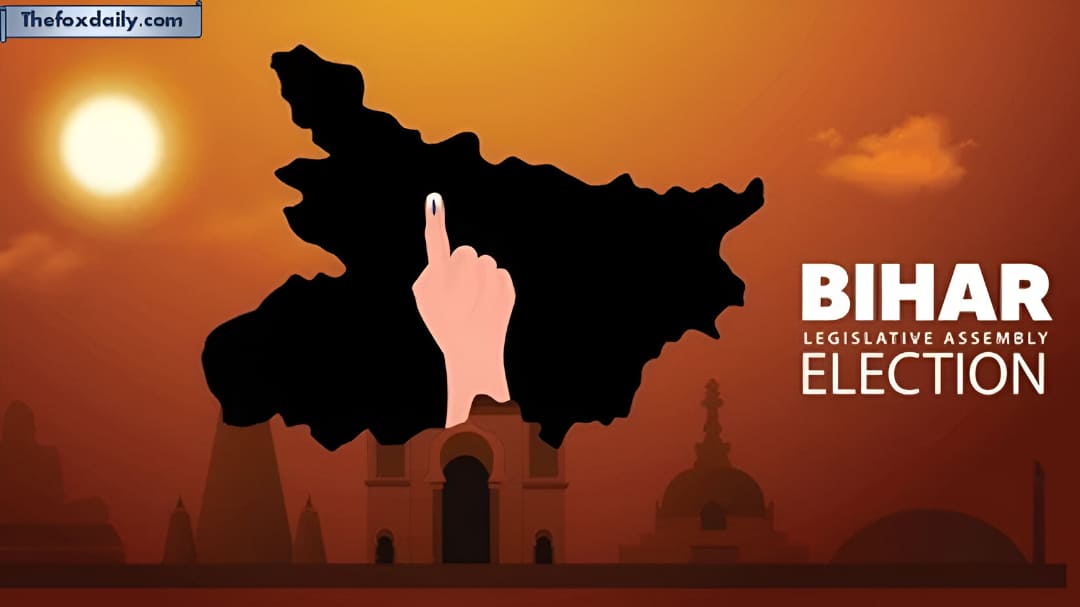
The upcoming Bihar Assembly elections 2025 will be conducted in just two phases on November 6 and November 11, marking the state’s shortest election period in two decades. Previously, the 2005 elections were held in four phases, making this a significant change in Bihar’s electoral process.
Before finalizing any election schedule, the Election Commission of India (ECI) reviews factors such as logistics, climatic conditions, administrative readiness, and other coinciding elections across the country.
Current Situation in Bihar
As mandated by the Constitution, elections for the lok Sabha and State Legislative Assemblies must take place before the completion of their five-year term. Since the term expiry date is known years in advance, the EC begins its preparatory work well ahead of time.
For the Bihar Vidhan Sabha, the term of the current Assembly ends in November 2025. The EC announced the poll schedule on October 6, fixing the voting dates for November 6 and November 11, with counting scheduled on November 14.
In the first phase, polling will be held in 121 constituencies, and in the second phase, in 122 constituencies. For comparison, the 2020 Bihar elections were conducted in three phases, 2015 in five, 2010 in six, and 2005 in four. This time, additional security personnel have also been deployed to ensure smooth polling.
Key Factors the EC Considers While Scheduling Elections
The Election Commission must coordinate multiple state and national polls. It takes into account weather patterns, public holidays, festivals, and school examination schedules, since schools often serve as polling centers and teachers as polling officials.
As former Chief Election Commissioner M. S. Gill explained in his book “The Electoral System of India”, the EC must assess several aspects before fixing election dates—such as snowbound areas in winter, accessibility issues during the monsoon, and agricultural cycles to prevent disruption during sowing or harvesting seasons.
Administrative factors also influence scheduling, including the distribution of Electronic Voting Machines (EVMs), setup of polling booths, and appointment of election staff. Security deployment is another crucial determinant. States affected by insurgency or left-wing extremism often require elections to be spread over multiple phases to ensure law and order.
Chief Election Commissioner Gyanesh Kumar stated during the 2025 Bihar poll announcement: “After considering voter awareness, law and order conditions, availability of CAPFs (Central Armed Police Forces), and administrative improvements, it was deemed appropriate to conduct the elections in two phases.”
How Poll Scheduling Has Evolved Over the Years
India’s first general elections in 1951–52 laid the foundation for detailed poll scheduling. The first CEC, Sukumar Sen, emphasized that polling dates were determined based on geographical and climatic conditions. The earliest election of Independent India was held in October 1951 in Himachal Pradesh’s snow-prone regions of Chini and Pangi, to complete polling before heavy snowfall.
Subsequently, early polling was also conducted in the Travancore-Cochin (now Kerala) constituencies ahead of the rest of the state. Voting in states like Odisha, Madhya Pradesh, Hyderabad, and Punjab began in December 1951, while other states went to polls in January 1952.
The 1995 Bihar Assembly elections became controversial when then CEC T. N. Seshan clashed with Chief Minister Lalu Prasad Yadav over repeated poll delays caused by rampant violence and booth capturing. Seshan, known for his electoral reforms, postponed the polls four times to ensure free and fair voting.
More recently, in 2024, CEC Rajiv Kumar acknowledged that the seven-phase Lok Sabha elections could have been completed earlier to avoid extreme summer heat. He remarked that although logistical constraints limit how much elections can be shortened, efforts are continuously made to make the process more efficient.
For breaking news and live news updates, like us on Facebook or follow us on Twitter and Instagram. Read more on Latest India on thefoxdaily.com.





COMMENTS 0