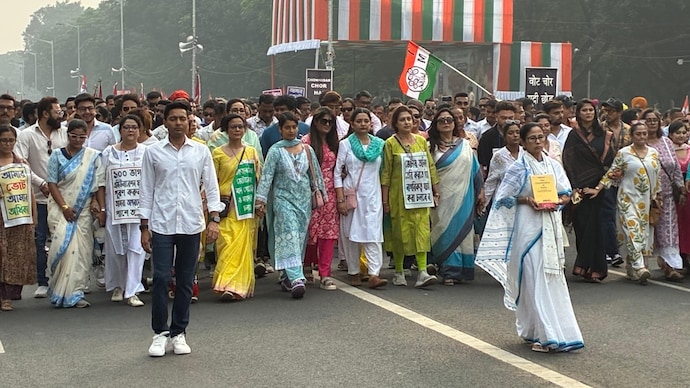
In a powerful show of strength, West Bengal Chief Minister Mamata Banerjee led thousands of Trinamool Congress supporters through the streets of Kolkata on Tuesday, protesting the Special Intensive Revision (SIR) of electoral rolls. She was accompanied by her nephew and the party’s national general secretary, Abhishek Banerjee.
The TMC has accused the BJP-led central government and the Election Commission of orchestrating what it calls a “silent, invisible rigging” through the SIR process. According to the party, this move aims to selectively remove names of legitimate voters, especially from communities that have historically supported opposition parties.
Addressing the crowd, Mamata Banerjee lashed out at the BJP, questioning their motives. “Many people from the unorganised sector are worried their names will be deleted. Just as knowing Hindi or Punjabi doesn’t make one Pakistani, speaking Bangla doesn’t make one Bangladeshi,” she asserted. “Anyone speaking Bangla is being targeted. These fools don’t know that before independence, India, Bangladesh, and Pakistan were one country.”
She further accused the BJP of being a “lootera party” (party of looters), claiming they spread fake news through multiple agencies. “You may have power today, but you won’t hold any authority tomorrow,” Banerjee declared amid cheers from her supporters.
The 3.8-kilometer-long march began near the statue of Dr. B. R. Ambedkar on Red Road and concluded at Rabindranath Tagore’s ancestral home, Jorasanko Thakur Bari. Supporters waved TMC flags, chanted slogans, and carried banners condemning the SIR process. Dressed in her signature white cotton saree and slippers, Mamata paused often to greet citizens who lined balconies and streets to show support.
During his address, Abhishek Banerjee directly challenged the BJP leadership. “We won’t bow to the zamindars of Delhi,” he said. “If we can organise such a huge gathering in two days, imagine the turnout when we march to Delhi.”
He also alleged that several citizens had died out of fear that their names would be struck off the electoral rolls. “Families of seven individuals who died from SIR-related anxiety are present here today. All of them feared losing their right to vote,” he stated, warning that TMC would demonstrate the “power of Bengal’s people” in Delhi if even one genuine voter’s name was deleted.
Abhishek accused the BJP of using the SIR and CAA-NRC policies to disenfranchise communities. “Twelve lakh Hindu Bengalis lost their voting rights in Assam due to the NRC,” he warned. “If you fall into their trap, you will lose everything.”
He criticised Prime Minister Narendra Modi for “dictating terms to ordinary citizens,” citing demonetisation and citizenship documentation as examples of authoritarian control. “PM Modi is deciding everything based on his whims and fancies. There will be a massive protest in Delhi if this continues,” Abhishek warned.
BJP Hits Back, Calls It a “Jamaat Rally”
The BJP responded strongly to the TMC’s show of strength. Suvendu Adhikari, Leader of the Opposition in the West Bengal Assembly, labelled the march a “rally of Jamaat” and said it violated the spirit of the Constitution.
Echoing this sentiment, Samik Bhattacharya, President of the West Bengal BJP, said, “If Mamata Banerjee has grievances, she should approach the Supreme Court. West Bengal is now a state without law and order.”
He further alleged that Mamata Banerjee was “inviting Rohingyas” into the state, claiming a “demographic change” was underway. “Does the public want Rohingyas on the voter list?” he questioned.
BJP IT Cell head Amit Malviya dubbed the march “Ghuspathiya Bachao Yatra,” calling it “a desperate attempt to protect her illegal vote bank.” Malviya cited figures showing that while Bengal’s population rose by 31% since 2001, its voter base grew by 67%. “Where did these extra voters come from?” he asked.
He accused Mamata Banerjee of hypocrisy, recalling that she once led protests against “illegal infiltrators” during Left rule but now blocks efforts to secure borders. Malviya further alleged that the TMC is “shielding illegal Bangladeshi infiltrators who have captured crime networks in Bengal and become her captive vote bank.”
“Mamata knows that once the voter list is cleaned, the fake votes that propped her up will vanish,” Malviya said, drawing parallels between her protest and the “Long March of Maulana Bhasani,” one of the founders of Bangladesh’s Awami League.
Background: What Is the SIR Process?
The Special Intensive Revision (SIR) is a large-scale verification exercise of electoral rolls being carried out across 12 states and union territories, including West Bengal. Conducted by booth-level officers, it aims to remove duplicate, deceased, migrated, or ineligible voters from the rolls — a process that hasn’t been undertaken in two decades.
While the Election Commission maintains that SIR ensures “transparency and accuracy,” opposition parties allege that it is being used selectively to suppress votes of minority and disadvantaged communities. The first phase in Bihar saw nearly 68 lakh deletions, sparking widespread controversy and court intervention. The Supreme Court later allowed the exercise to continue with certain safeguards.
With the Trinamool Congress now bringing the fight to the streets of Bengal, political tensions over the SIR are expected to escalate as the revision process expands to more states.
As Mamata Banerjee’s TMC vows to defend every legitimate voter’s right and the BJP doubles down on allegations of illegal infiltration, Bengal once again finds itself at the epicenter of India’s electoral and identity politics.
For breaking news and live news updates, like us on Facebook or follow us on Twitter and Instagram. Read more on Latest India on thefoxdaily.com.






COMMENTS 0