- Who, What, When, Where, Why, How
- Police Statement and Key Findings
- Multi-Layered Terror Module: How the Network Operated
- The Attack: What Happened on April 1
- Extremist Link: Claim of Responsibility
- ISI Connection: A Strategic Pattern
- Analysis: What This Means for Punjab’s Security
- Key Developments at a Glance
- Insight: Why Such Attacks Target Political Offices
- Ongoing Investigation and Next Steps
- Conclusion: A Timely Crackdown with Broader Implications
In a significant breakthrough, punjab Police has solved the April 1 grenade attack outside the Bharatiya Janata Party (BJP) office in Chandigarh, arresting five accused and identifying two key perpetrators who remain at large. Authorities have linked the attack to a wider terror conspiracy allegedly backed by Pakistan’s intelligence agency, the Inter-Services Intelligence (ISI).
The Counter Intelligence wing of Punjab Police, working in coordination with Chandigarh Police, dismantled what officials described as a “multi-layered terror module” with international connections. The investigation has revealed that the attack was not an isolated act, but part of a broader attempt to destabilize peace in Punjab.
Director General of Police (DGP) Gaurav Yadav confirmed the development, stating that the probe has established links between the attackers and foreign-based handlers operating from Europe, specifically Portugal and Germany.
Who, What, When, Where, Why, How
Who: Five accused – Balvinder Lal alias Shami, Jasveer Singh alias Jassi, Charanjit Singh alias Channi, Rubal Chauhan, and Mandeep alias Abhijot Sharma – have been arrested. Two main perpetrators are still absconding.
What: A grenade attack targeting the BJP office in Chandigarh.
When: April 1.
Where: Sector 37, Chandigarh.
Why: Preliminary findings suggest the attack was aimed at disturbing peace and creating fear, allegedly under the influence of ISI-backed handlers and extremist elements.
How: Two attackers arrived on a two-wheeler and hurled an improvised explosive device (IED) before fleeing the scene.
Police Statement and Key Findings
DGP Gaurav Yadav described the operation as a major success for Punjab Police’s counter-intelligence unit.
“The perpetrators have been identified and there have been five arrests. Apart from the five arrests, two main perpetrators have been identified, and police teams are actively pursuing them.”
He further revealed that one grenade and several cartridges have been recovered during the investigation, strengthening the case against the accused.
According to officials, the conspiracy was orchestrated through a network of foreign handlers, with operational links traced to Portugal and Germany. This highlights the increasing use of international bases by anti-India elements to coordinate local attacks.
Multi-Layered Terror Module: How the Network Operated
Investigators have uncovered a complex structure involving multiple “cutouts” and submodules designed to execute and conceal the operation. Such layered networks are often used to ensure that direct links between masterminds and on-ground operatives remain hidden.
The structure typically involves:
- Foreign handlers coordinating strategy and funding
- Local operatives executing the attack
- Intermediaries managing logistics and communication
This compartmentalization makes detection more difficult, but in this case, coordinated intelligence efforts and technical surveillance helped authorities break through the network.
The Attack: What Happened on April 1
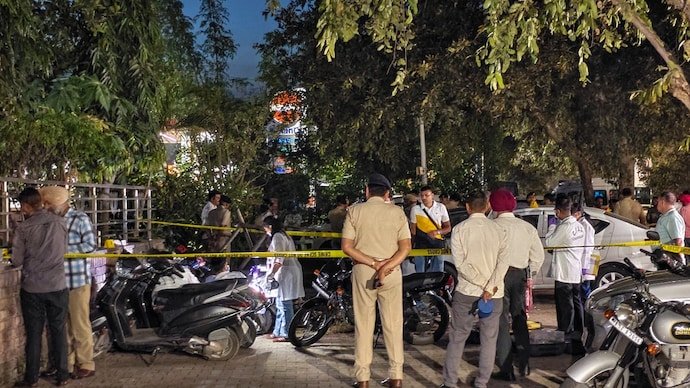
The incident occurred outside the BJP office in Chandigarh’s Sector 37. According to police reports, two individuals arrived on a motorcycle, threw an explosive device, and fled within seconds.
While the blast did not result in casualties, it caused damage to nearby vehicles and triggered panic in the area. The absence of casualties does not diminish the seriousness of the attack, as such incidents are often intended to send a message rather than cause mass destruction.
Forensic teams quickly reached the scene and collected evidence, including shrapnel fragments. CCTV footage from nearby locations played a crucial role in identifying suspects and reconstructing the sequence of events.
Extremist Link: Claim of Responsibility
Shortly after the attack, Khalistani terrorist Sukhjinder Singh Babbar reportedly claimed responsibility, linking the incident to broader extremist objectives.
This claim, combined with evidence gathered by investigators, points toward a convergence of separatist elements and foreign intelligence support-an emerging pattern that security agencies have been closely monitoring.
ISI Connection: A Strategic Pattern
The alleged involvement of ISI-backed handlers is consistent with past cases where cross-border elements have attempted to destabilize Punjab. Security experts note that such operations often aim to revive dormant networks and exploit local vulnerabilities.
The use of handlers based in Europe adds another layer of complexity. It allows conspirators to operate from jurisdictions that are geographically distant, making direct enforcement more challenging.
However, international cooperation and intelligence-sharing mechanisms have improved significantly in recent years, enabling agencies to track such networks more effectively.
Analysis: What This Means for Punjab’s Security
The swift arrests and identification of key suspects indicate a proactive and coordinated response by law enforcement agencies. More importantly, the case highlights the evolving nature of security threats in the region.
Key takeaways include:
- Hybrid Threats: The blending of local operatives with foreign handlers represents a hybrid threat model.
- Use of Technology: CCTV analysis and digital tracking played a critical role in solving the case.
- Rapid Response: Quick action prevented further escalation and possibly larger attacks.
At the same time, the involvement of international networks underscores the need for continuous vigilance and intelligence coordination.
Key Developments at a Glance
| Aspect | Details |
|---|---|
| Date of Attack | April 1 |
| Location | Sector 37, Chandigarh |
| Arrests | Five accused |
| Main Perpetrators | Two identified, still absconding |
| Recovered Items | Grenade and cartridges |
| Foreign Links | Portugal and Germany |
| Alleged Backing | ISI-supported network |
Insight: Why Such Attacks Target Political Offices
Attacks on political offices are rarely random. They are designed to achieve multiple objectives:
- Create fear and uncertainty
- Gain media attention
- Send a symbolic message against governance structures
In many cases, the psychological impact of such attacks outweighs the physical damage. Even a low-intensity explosion can generate widespread panic and dominate headlines.
As one security analyst puts it, “These attacks are less about destruction and more about disruption.”
Ongoing Investigation and Next Steps
Punjab Police has stated that the investigation will be taken “to the top,” indicating a focus on dismantling the entire network rather than just apprehending on-ground operatives.
Multiple teams are currently working to track down the two main perpetrators. Authorities are also expected to expand the probe to identify additional links, funding sources, and potential sleeper cells.
Given the international dimension of the case, further developments may involve coordination with foreign agencies.
Conclusion: A Timely Crackdown with Broader Implications
The successful busting of the network behind the Chandigarh grenade attack marks a critical win for security agencies. It not only prevents potential future attacks but also sends a strong message to those attempting to destabilize the region.
However, the case also serves as a reminder that security threats are becoming increasingly complex, often involving cross-border coordination and decentralized networks.
While the immediate threat has been contained, the broader challenge remains: staying ahead of evolving tactics in an interconnected world.
Because in modern security dynamics, the real battle isn’t just stopping an attack-it’s preventing the next one before it even begins.
For breaking news and live news updates, like us on Facebook or follow us on Twitter and Instagram. Read more on Latest India on thefoxdaily.com.






COMMENTS 0