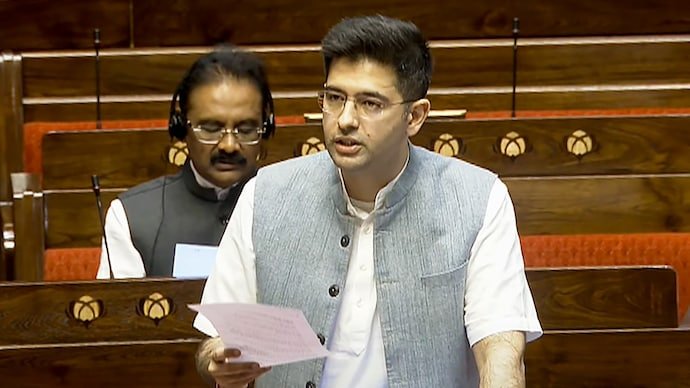
The sudden demotion of Aam Aadmi Party (AAP) leader Raghav Chadha from his position as Deputy Leader in the Rajya Sabha has sparked intense political debate. Within just 24 hours, what initially appeared as a routine reshuffle turned into a public fallout, with Chadha alleging he had been “silenced” by his own party and AAP leaders accusing him of prioritising personal image over party interests.
Chadha, once seen as one of AAP’s most articulate and telegenic faces in Parliament, now finds himself sidelined amid accusations of political timidity, selective activism, and lack of solidarity during crucial moments for the party. The episode highlights not just an internal disagreement, but a broader ideological and strategic divide within AAP.
What Exactly Happened?
Raghav Chadha was removed as Deputy Leader of AAP in the Rajya Sabha and, more significantly, the party reportedly asked that he not be allotted speaking time under its quota in the Upper House. In response, Chadha released a video titled “Silenced, Not Defeated”, claiming that he was being prevented from raising issues that affect ordinary citizens.
He defended his parliamentary record, citing issues like airport food prices, gig worker rights, toll taxes, and financial burdens on the middle class. According to Chadha, these were genuine public concerns that deserved attention.
“The river may be stopped for a while, but it will eventually become a flood,” Chadha said, framing his removal as a temporary setback rather than a political defeat.
AAP’s Counterattack: “You Avoided the Real Fight”
The AAP leadership responded swiftly—and sharply. Senior leaders including Saurabh Bharadwaj and Sanjay Singh publicly criticised Chadha, accusing him of avoiding critical political battles and failing to stand with the party during challenging times.
“Jo dar gaya, samjho mar gaya,” Bharadwaj remarked, suggesting that fear has no place in Politics.
The core of AAP’s argument is simple: while Chadha raised relatable, everyday issues, he allegedly stayed silent on politically sensitive matters that required confronting the ruling government.
Key accusations against Chadha include:
- Skipping opposition walkouts in Parliament
- Not supporting key motions against institutions like the Election Commission
- Remaining silent when AAP leaders faced legal and political challenges
- Failing to raise issues concerning Punjab, the state he represents in Rajya Sabha
For AAP, these actions—or lack thereof—signalled a disconnect between Chadha’s priorities and the party’s expectations.
Personal Brand vs Party Politics
At the heart of the controversy lies a fundamental question: should a politician focus on popular, everyday issues or take strong stands on politically risky topics?
Chadha’s style of politics has been centred around accessible, relatable issues—like pricing, taxes, and consumer concerns. These topics resonate widely and often attract media attention without inviting direct confrontation with powerful political opponents.
However, AAP appears to view this approach as insufficient in the current political climate. The party, which has faced significant legal and political pressure in recent years, expects its leaders to demonstrate visible solidarity and take firm positions—even when it comes at a personal or political cost.
In simple terms, AAP seems to be saying: raising safe issues may win applause, but it doesn’t win political battles.
The Timing: Why Now?
The timing of Chadha’s demotion is particularly significant. It comes after a period when AAP’s top leadership, including Arvind Kejriwal and Manish Sisodia, faced legal scrutiny and political challenges.
Party leaders pointed out that Chadha was notably absent during key moments, including:
- Public protests and demonstrations
- Press conferences following legal developments
- Major party mobilisation events
Atishi, a senior AAP Leader, even highlighted Chadha’s absence during Kejriwal’s arrest, noting that while party workers were on the streets, he was abroad for medical treatment.
In a party that thrives on activism and visible resistance, such absences were seen as politically costly.
Chadha’s Parliamentary Record: Strong but Selective?
To be fair, Chadha’s performance in Parliament has not been weak. He has raised several policy-oriented and economically relevant issues, including:
- Concerns about tariff disadvantages for Indian exporters
- Tax burdens on middle-class families
- Food adulteration as a public health issue
- Regulation of cryptocurrency
- Use of blockchain in land records
These are substantive topics that reflect policy engagement. However, AAP’s leadership appears to have evaluated his performance using a different metric—political alignment and party loyalty during high-stakes moments.
| Aspect | Chadha’s Approach | AAP’s Expectation |
|---|---|---|
| Issues Raised | Public-friendly, low-risk topics | High-impact, politically charged issues |
| Parliament Strategy | Independent articulation | Collective opposition stance |
| Party Loyalty | Perceived as inconsistent | Visible and active solidarity |
A Pattern in Indian Politics
What is happening within AAP is not entirely new. Indian political history is filled with instances where rising leaders face pushback when their individual popularity begins to diverge from party strategy.
When parties publicly criticise their own members—especially through coordinated statements—it often signals deeper organisational decisions rather than spontaneous reactions.
In many cases, such public confrontations precede either a reconciliation on stricter terms or a complete political separation.
What This Means for AAP
For AAP, the episode sends a strong internal message: party discipline and alignment matter more than individual visibility. The leadership appears keen to maintain a unified political stance, especially at a time when it is navigating legal challenges and preparing for future Elections.
By acting decisively against a high-profile leader like Chadha, AAP is reinforcing its expectation that leaders must not only speak well—but also stand firmly with the party when it matters most.
What Lies Ahead for Raghav Chadha?
Chadha’s future within AAP remains uncertain. While he has positioned himself as a leader focused on public issues, the party’s response suggests that this alone may not be enough to retain influence within its structure.
His statement, “Silenced, not defeated,” indicates that he is unlikely to step back quietly. Whether this leads to reconciliation, continued marginalisation, or a larger political shift remains to be seen.
Conclusion: A Clash of Political Styles
The Raghav Chadha episode is more than just an internal party dispute—it reflects a broader clash between two styles of politics. One focuses on public-friendly, issue-based engagement; the other prioritises ideological battles and organisational loyalty.
In today’s high-stakes political environment, balancing both is not easy. Chadha’s demotion suggests that, at least for now, AAP has chosen clarity over compromise.
And in politics, as this episode shows, sometimes the real battle isn’t with opponents—it’s within.
For breaking news and live news updates, like us on Facebook or follow us on Twitter and Instagram. Read more on Latest India on thefoxdaily.com.





COMMENTS 0