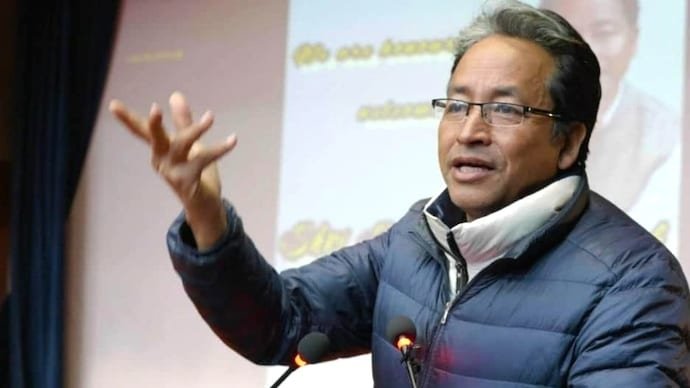
The Union government on Monday strongly defended the preventive detention of Ladakh-based social activist Sonam Wangchuk before the Supreme Court, arguing that his speeches amounted to incitement, separatist messaging, and posed a serious threat to national security in a strategically sensitive border region.
Appearing for the Centre, Solicitor General Tushar Mehta submitted that Wangchuk’s public statements were not merely critical of governance but were designed to provoke unrest, particularly among Ladakh’s youth.
The government alleged that Wangchuk sought to push Ladakh toward a situation similar to Nepal, Bangladesh, and Sri Lanka, referencing political instability and violent uprisings in those countries as cautionary examples.
The matter came up before a bench comprising Justice Aravind Kumar and Justice P. V. Varale, hearing a plea filed by Gitanjali J. Angmo, Wangchuk’s wife, challenging his detention under the National Security Act (NSA).
Plebiscite Calls in a Fragile Border Region: ‘Them vs Us’ Narrative
Addressing the court, Mehta argued that Wangchuk repeatedly used divisive language, portraying the Central government as “them” while referring to the people of Ladakh as “US.”
He told the bench that Wangchuk had gone further by advocating ideas such as a plebiscite or referendum—terminology historically associated with Jammu and Kashmir and viewed by the government as dangerous in the context of Ladakh.
“We are all Indians; there is neither ‘them’ nor ‘us’,” Mehta submitted, stressing that Ladakh shares borders with Pakistan and china and plays a critical role in India’s defence infrastructure.
“This region is extremely fragile and vital for the Army’s supply lines,” he emphasized, warning that provocative rhetoric could destabilize a strategically crucial area.
Mehta further accused Wangchuk of selectively invoking Mahatma Gandhi to mask what the Centre described as his real intentions.
“He even referred to Arab Spring–like movements that led to the overthrow of governments,” Mehta told the court, adding, “Gandhi ji never incited people against their own government.”
The Solicitor General argued that Wangchuk’s speeches must be read as a whole, not in isolation, particularly because they allegedly misled young people under the cover of non-violence.
Centre Says Preventive Detention Is Justified
Defending the incarceration, Mehta informed the court that the district magistrate had issued the detention order only after carefully examining relevant materials, including video recordings of Wangchuk’s speeches.
He stated that the detention order was executed within four hours and that Wangchuk was shown the video clips forming the basis of the decision.
According to Mehta, a DIG-rank officer personally explained the grounds of detention to Wangchuk, ensuring procedural compliance.
Responding to allegations of reliance on “borrowed material,” Mehta said the district magistrate was not required to be physically present at every public address.
“Officials who attended the speeches recorded them and placed the material before the district magistrate, who then applied his independent mind,” he submitted.
Detention Challenged as Arbitrary and Unlawful
Senior advocate Kapil Sibal, appearing for Angmo, strongly contested the Centre’s arguments, asserting that the detention was unlawful and arbitrary.
Sibal argued that the police had misled the detaining authority by relying on selective recordings and so-called “borrowed material,” thereby vitiating the detention order.
The plea contends that the order is based on stale FIRs, vague allegations, and speculative assertions, with no live or proximate link to the grounds required under the NSA.
It further alleges that the detention represents a gross abuse of preventive powers, lacking proportionality and legal justification.
The petition described it as “preposterous” that Wangchuk—widely known for over three decades of work in education, innovation, and environmental conservation—was suddenly portrayed as a national security threat.
Angmo also argued that the violence in Leh on September 24 last year, which resulted in four deaths and more than 90 injuries, could not be attributed to Wangchuk.
She pointed out that Wangchuk had publicly condemned the violence, calling it the darkest day of his life, and had appealed for peace.
Supreme Court to Continue Hearing
The Supreme Court has heard preliminary submissions from both sides and is expected to continue examining the matter.
The bench will further consider arguments from Wangchuk’s counsel challenging the grounds, legality, and proportionality of the detention under the National Security Act.
The case is being closely watched, as it raises significant questions about free speech, preventive detention, and national security in one of India’s most strategically sensitive regions.
For breaking news and live news updates, like us on Facebook or follow us on Twitter and Instagram. Read more on Latest India on thefoxdaily.com.





COMMENTS 0