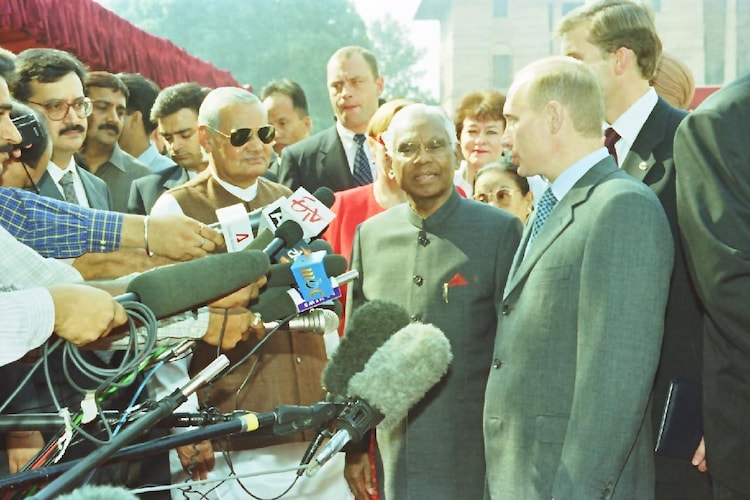
Russian President Vladimir Putin’s arrival in New Delhi on Thursday revived memories of his first visit to India exactly 25 years ago. In the winter of 2000, a newly elected 47-year-old Russian president travelled to India with a clear mission: to breathe new life into the India–Russia relationship, which had lost momentum after the collapse of the USSR.
That landmark visit saw Putin make symbolic gestures – a respectful namaste in Parliament, a widely photographed walk through the Taj Mahal, and a subtle nuclear signal during his stop at India’s atomic hub – all aimed at repositioning Russia as India’s most reliable strategic partner.
India Today’s December 2000 issue summed it up succinctly: “The Central Hall once again came alive to exchange vows with an old flame: Russia.”
Cold Winds, Warm Ties
The geopolitical context of 2000 shaped the significance of Putin’s visit. India was still battling the stigma of being labelled a “nuclear pariah” after the Pokhran-II tests. Russia, meanwhile, was trying to stabilize itself after the Soviet collapse, struggling with economic and political turbulence.
Putin’s task was straightforward but formidable – restore Russia’s role as India’s most trusted partner. His trip achieved exactly that. During the visit, India and Russia signed key agreements on T-90 tanks, Su-30 fighter jets, and new trade mechanisms, while officially declaring a “strategic partnership.”
Putin also flew to Mumbai, toured the Bhabha Atomic Research Centre (BARC), and offered a quiet but unmistakable acknowledgment of India’s nuclear capabilities – a gesture that resonated deeply at a time when global pressure on India was intense.
That 2000 trip paved the way for two and a half decades of consistent engagement. As Putin prepares for what is likely to be his tenth state visit to India in 2025, the symbolism of his first journey remains as relevant as ever.
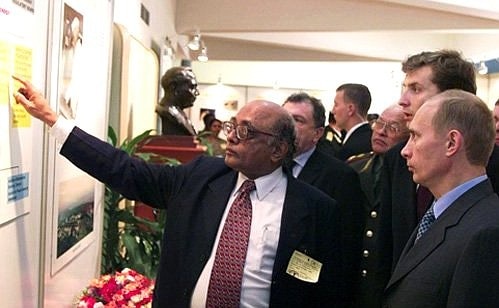
PUTIN’S FIRST ITINERARY IN INDIA: FROM RAJ GHAT TO THE TAJ
Putin and his then-wife Lyudmila received a ceremonial welcome at Rashtrapati Bhavan. He paid homage at Raj Ghat, met business leaders, held talks with senior officials and Prime Minister Atal Bihari Vajpayee, and addressed the Indian Parliament – where his namaste drew applause.
The India Today report noted how Putin “bowled over the gathering with a namaste, flattering references to India’s magic and charm, and the right noises about Kashmir.”
At Rashtrapati Bhavan, President KR Narayanan – who had earlier pardoned five Russians convicted in the Purulia arms drop case – hosted Putin and emphasized the historic importance of the relationship. “For us, Russia has been a friend in need, and we see in you the greatest friend of India,” Narayanan remarked.
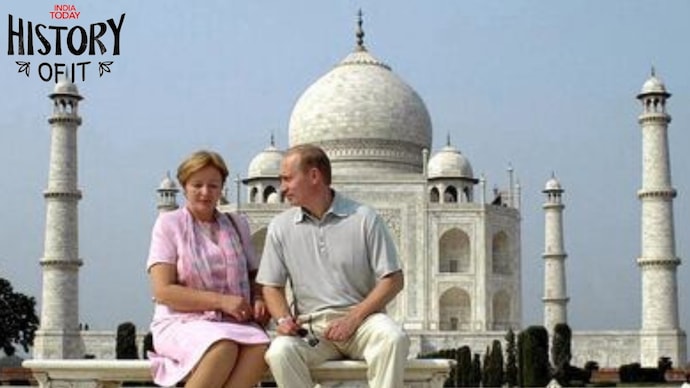
The highlight for photographers came during Putin and Lyudmila’s visit to the Taj Mahal. Landing in Agra on a special Ilyushin-96 aircraft, Putin spent nearly an hour at the monument and described it simply: “It’s lovely… It’s good to be here.”
THE NUCLEAR NUDGE: PUTIN’S STATEMENT WITHOUT WORDS
The most symbolic moment of the 2000 visit came in Mumbai. As Putin nudged India to sign the Comprehensive Test Ban Treaty (CTBT) and the Nuclear Non-Proliferation Treaty (NPT), he simultaneously sent a reassuring message by visiting BARC – “India’s leading nuclear research centre, where reactors and bombs were designed,” as noted by The New York Times.
According to former BARC chief Anil Kakodkar, Putin’s first request at BARC was to take a photograph with him and R. Chidambaram in front of the Dhruva reactor – the very reactor associated with the Pokhran-II tests.
“Putin expressed his support for the N-tests through this picture,” Kakodkar recalled.
The Dhruva reactor, still operational today, has been central to India’s strategic program and continues to produce key radioisotopes for medicine, industry, and research.
TRANSFORMING A VISIT INTO A PARTNERSHIP
Beyond symbolism, the 2000 trip produced outcomes that defined Indo-Russian ties for decades. India signed contracts for 310 T-90 tanks, finalized licensed production of Su-30MKIs, and revived dormant trade mechanisms. Russia also offered the aircraft carrier Admiral Gorshkov, later commissioned as INS Vikramaditya.
Just two years after Pokhran-II, Putin’s outreach sent a clear signal: Russia backed India’s strategic choices and would not allow New Delhi to remain isolated on the global stage.
For Russia, rebuilding ties with India meant consolidating a reliable partner in Asia. For India, it reaffirmed a friendship rooted in trust, defence cooperation, and geopolitical alignment.
A VISIT THAT STILL ECHOES
Putin’s 2000 visit remains one of the most symbolically charged trips by any foreign leader to India. It revived defence cooperation, rebuilt political trust, and reaffirmed a steady partnership that has endured global shifts, from US policy swings to India’s growing multi-alignment strategy.
Twenty-five years later, the essence of that visit still holds true: in a turbulent world, Russia continues to be seen in New Delhi as a stable and long-term partner – a perception shaped in no small part by the winter of 2000, when Vladimir Putin first landed on Indian soil.
For breaking news and live news updates, like us on Facebook or follow us on Twitter and Instagram. Read more on Latest India on thefoxdaily.com.




COMMENTS 0