- Introduction: A High-Stakes Political Gamble
- BJP’s Position: Equality, Governance, and Uniformity
- TMC’s Counter: Protecting Diversity and Religious Freedom
- Electoral Arithmetic: Consolidation vs Counter-Consolidation
- Beyond UCC: A Broader Political Strategy
- Law and Order and Cultural Messaging
- Economic Promises and Development Focus
- Will UCC Be a Rallying Point or a Flashpoint?
- Conclusion: A Defining Issue in Bengal’s Political Landscape
The Bharatiya Janata Party (BJP) has placed the Uniform Civil Code (UCC) at the center of its West Bengal election strategy, raising a critical question: will the proposal unite voters under a common legal framework or deepen existing social and political divides? With Union Home Minister Amit Shah positioning UCC as a matter of equality and governance, and the Trinamool congress (TMC) framing it as a threat to cultural and religious diversity, the issue is quickly becoming one of the most debated topics in the state’s political landscape.
Introduction: A High-Stakes Political Gamble
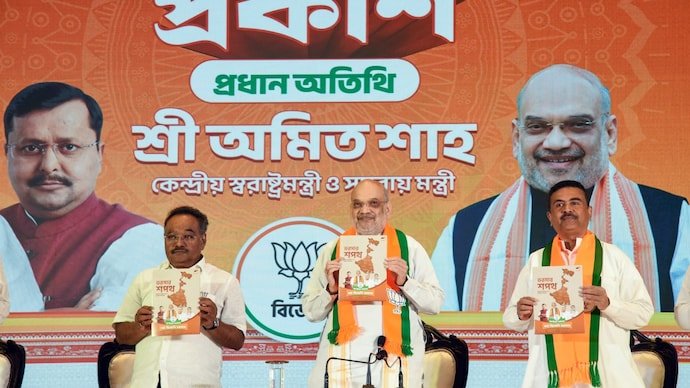
As West Bengal heads toward crucial elections, the BJP has introduced the Uniform Civil Code as a major manifesto promise, pledging to implement it if voted to power. Announced by Amit Shah during the release of the party’s manifesto ‘Bhoroshar Shopoth’, the proposal aims to establish a common set of civil laws governing marriage, inheritance, and family matters across all communities.
The move comes at a time when Bengal’s electorate remains deeply diverse, with significant minority populations and strong regional identities. While the BJP presents UCC as a step toward legal equality, opposition parties—especially the ruling TMC—view it as politically charged, potentially reshaping voter alignments across communities.
BJP’s Position: Equality, Governance, and Uniformity
The BJP has framed the Uniform Civil Code as a constitutional and governance reform designed to ensure equal rights for all citizens, regardless of religion. Amit Shah emphasized that the policy would be implemented strictly within constitutional boundaries.
“We will implement UCC in accordance with the Constitution to ensure equal rights for all citizens,” Shah stated while unveiling the manifesto.
The party argues that a unified legal framework would eliminate disparities in personal laws and strengthen the principle of equality before the law. By highlighting its implementation in BJP-ruled states, the party is attempting to position itself as consistent and decisive on the issue.
Beyond ideology, the BJP also sees UCC as a tool to consolidate a broader voter base, particularly among communities that support uniform governance policies.
TMC’s Counter: Protecting Diversity and Religious Freedom
The Trinamool Congress has strongly opposed the UCC proposal, portraying it as a potential infringement on religious freedom and cultural diversity. In a state where minorities make up roughly 30 percent of the population, this framing could have significant electoral implications.
TMC leaders are expected to argue that personal laws are deeply tied to religious identity and that imposing uniformity could disrupt long-standing traditions.
This narrative may resonate particularly with:
- Muslim voters, who may view UCC as an encroachment on personal law
- Tribal communities, whose customary practices differ from codified systems
- Sections of Scheduled Castes, with localized cultural traditions
By positioning itself as a defender of diversity, the TMC is likely aiming to consolidate these groups into a cohesive electoral bloc.
Electoral Arithmetic: Consolidation vs Counter-Consolidation
The introduction of UCC into Bengal’s political discourse creates the possibility of dual voter consolidation.
On one hand, the BJP may seek to unify segments of the Hindu electorate across caste lines by promoting a common legal identity. On the other, the TMC could benefit from a counter-consolidation of minority and culturally distinct groups.
This dynamic makes the issue particularly potent in Bengal, where electoral outcomes often hinge on coalition-building among diverse communities.
| Political Party | Position on UCC | Target Voter Impact |
|---|---|---|
| BJP | Supports UCC as equality and governance reform | Attempts consolidation of broader Hindu vote |
| TMC | Opposes UCC as threat to diversity | Aims to consolidate minorities and cultural groups |
Beyond UCC: A Broader Political Strategy
While UCC has captured headlines, the BJP’s manifesto reflects a dual strategy that combines ideological messaging with welfare promises.
Key commitments include:
- Monthly financial assistance of Rs 3,000 for women
- Implementation of the Seventh Pay Commission
- Creation of 10 million jobs and self-employment opportunities
- Financial support for unemployed youth
- Time-bound filling of government vacancies
These promises are designed to directly compete with existing welfare schemes introduced by the TMC government, indicating that the BJP is not relying solely on ideological issues.
Law and Order and Cultural Messaging
The BJP has also emphasized law and order as a key campaign plank, promising stricter measures against infiltration, improved Border Security, and action against illegal activities such as cattle smuggling.
At the same time, the manifesto includes cultural initiatives such as establishing a Vande Mataram museum and recognizing additional languages. Interestingly, these cultural commitments are presented alongside assurances of “freedom of religious practices,” creating a careful balance with the UCC proposal.
This dual messaging reflects an attempt to appeal to both ideological and moderate voters.
Economic Promises and Development Focus
On the economic front, the BJP has outlined plans to revive Bengal’s industrial base, focusing on sectors such as tea, MSMEs, and logistics. Infrastructure development, particularly in north Bengal, and improved connectivity are also key priorities.
By combining economic promises with governance reforms, the party is attempting to broaden its appeal beyond traditional political lines.
Will UCC Be a Rallying Point or a Flashpoint?
The central question remains whether the Uniform Civil Code will act as a unifying policy or a polarizing issue in Bengal’s elections.
The answer largely depends on how it is perceived by voters on the ground.
- If seen as a step toward equality, it could strengthen the BJP’s position
- If viewed as a threat to identity and traditions, it could benefit the TMC
In a state known for its complex social fabric, perception may matter as much as policy.
Conclusion: A Defining Issue in Bengal’s Political Landscape
The BJP’s push for a Uniform Civil Code has introduced a powerful and potentially divisive element into West Bengal’s election landscape. While the party frames it as a necessary reform for equality and governance, the opposition views it as a challenge to diversity and cultural rights.
As both sides sharpen their narratives, the ultimate impact of UCC will depend on voter interpretation and ground-level mobilisation. In Bengal’s intricate electoral equation, this single issue could either consolidate support or deepen divisions—possibly shaping not just the outcome of the election, but the future direction of the state’s politics.
For breaking news and live news updates, like us on Facebook or follow us on Twitter and Instagram. Read more on Latest India on thefoxdaily.com.





COMMENTS 0