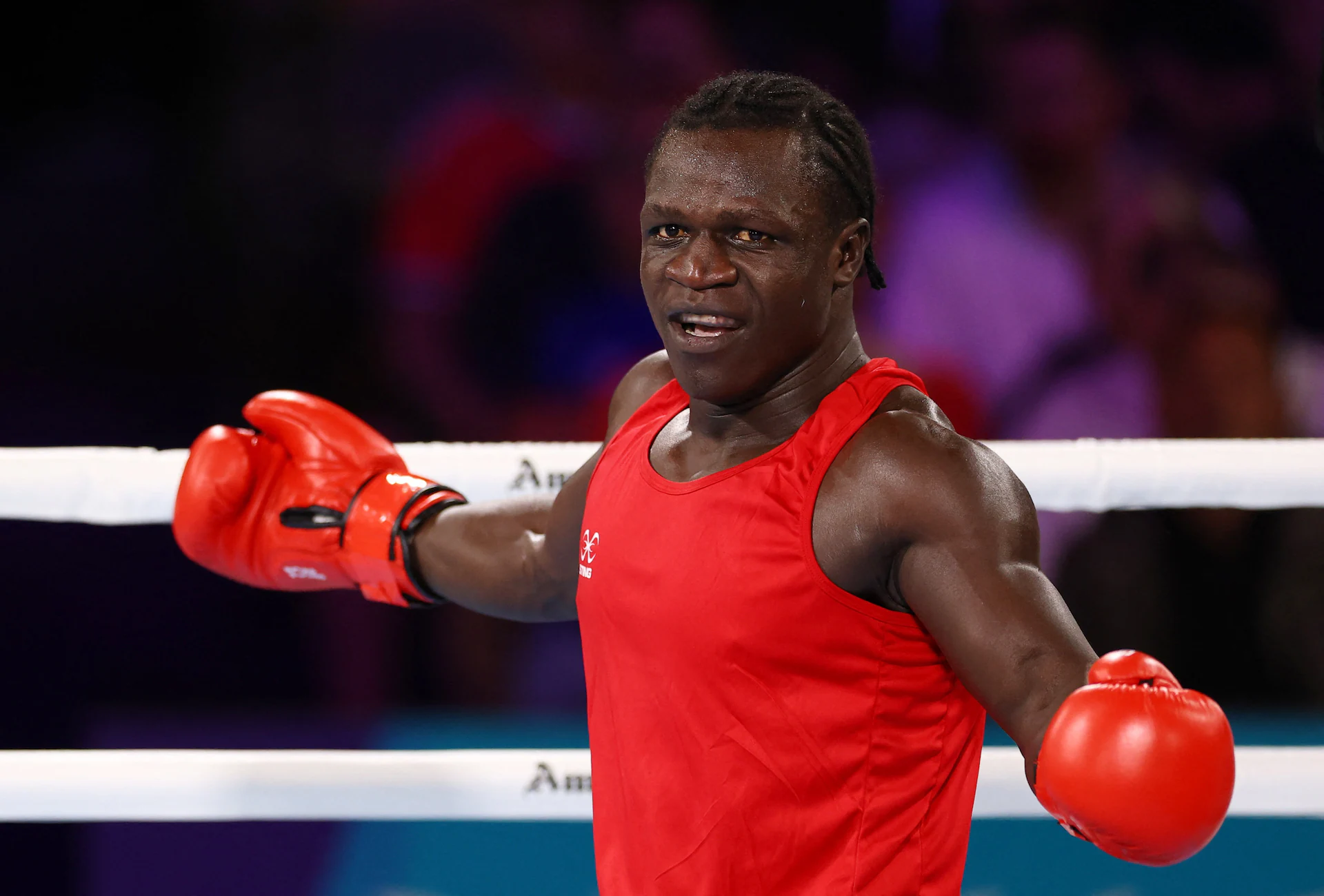
Ugandan boxer Aziz Abdul has been disqualified from another major international tournament after throwing a punch at an opponent after the bell, marking his second high-profile disqualification in a matter of months. The 25-year-old, who is known as Ringo and is the grandson of former Ugandan ruler Idi Amin, lost his silver medal following the incident at the African Boxing Championships in Nairobi.
Abdul was competing against Egypt’s Mohamed Hossen in the men’s 90-kilogramme final when he swung at his opponent after the end of the contest. The blow struck Hossen on the back of the head as the Egyptian boxer turned away. Hossen was not injured, but the incident prompted an immediate disqualification for Abdul.
The decision ended Abdul’s participation in the final and removed the silver medal he had been awarded. It also brought renewed attention to a boxer whose previous disciplinary incident at the Commonwealth Games had already placed his behaviour under the spotlight.
Although Abdul’s family background has attracted considerable public interest, the latest incident centres on conduct inside the boxing ring. His disqualification raises questions about the consequences of striking an opponent after a contest has ended, the importance of protecting competitors and the responsibilities athletes face when representing their countries at international events.
What Happened in the African Boxing Championships Final?
The incident occurred during the men’s 90kg final at the African Boxing Championships in Nairobi, where Abdul faced Egypt’s Mohamed Hossen. The contest ended with Abdul throwing a punch at Hossen after the bell had sounded.
According to the reported account, the blow landed on the back of Hossen’s head as the Egyptian turned away from his opponent. Hossen escaped injury, but the absence of physical harm did not prevent disciplinary action against Abdul.
Officials disqualified the Ugandan boxer and stripped him of his silver medal. The immediate decision reflected the seriousness of an attack delivered after the end of the contest, when the opponent may no longer be preparing to defend himself against an incoming punch.
The distinction between a punch during a contest and one thrown after the bell is fundamental to understanding the incident. Boxing is a regulated combat sport in which competitors are permitted to strike one another within defined rules. That permission does not extend without limits to conduct outside the active contest.
Once a round or bout has ended, fighters are expected to stop attacking and follow the referee’s instructions. A late punch can create a particular risk because an opponent may already have relaxed their guard or turned away in response to the bell.
In Hossen’s case, the reported outcome was that he was uninjured. However, the potential consequences of a blow to the back of the head can be serious, making the timing and location of the punch important details in assessing why the incident attracted immediate disciplinary action.
Second Major Disqualification Raises Questions About Abdul’s Conduct
The Nairobi incident was not Abdul’s first disqualification at a prominent international competition. He was also disqualified from the Commonwealth Games in Glasgow after headbutting England’s Damar Thomas during their opening-round contest.
The two incidents involved different actions, but both resulted in Abdul being removed from competition for conduct that went beyond the permitted use of force in boxing.
The recurrence is significant because international boxing tournaments depend on athletes respecting the rules even when a contest becomes emotionally charged. Competitors must control their actions, respond to referees and accept the outcome of exchanges without resorting to prohibited behaviour.
A single incident may occur under unusual circumstances, but a second high-profile disqualification can lead to greater scrutiny of an athlete’s conduct. It also creates uncertainty about whether the boxer will be able to complete future tournaments without similar disciplinary problems.
However, the available information does not establish whether Abdul has received a longer suspension, whether additional sanctions have been imposed beyond the loss of his silver medal, or whether a formal disciplinary review will follow. Those outcomes should not be assumed without confirmation from the relevant boxing authorities.
For Abdul, the immediate sporting consequence is clear: the disqualification prevented him from retaining the medal associated with his performance in the final. Any longer-term effect on his eligibility or career will depend on decisions by the governing bodies responsible for the competitions in which he participates.
Why Punching After the Bell Is a Serious Boxing Offence
Boxing involves controlled physical confrontation, but the rules are designed to distinguish legitimate competition from dangerous or unsporting conduct. Referees are responsible for managing the bout, enforcing the rules and intervening when necessary to protect the fighters.
The bell provides an audible signal that a round or contest has ended. Boxers are expected to stop attacking rather than continue throwing punches once the signal has sounded.
A punch after the bell can be especially dangerous because the opponent may have already stopped defending themselves. During an active exchange, both fighters generally anticipate incoming attacks. At the end of a contest, that expectation changes, potentially leaving one boxer exposed.
The risk increases when a blow lands on the back of the head. The head and neck contain vulnerable structures, and an impact in this area can cause serious injury. Although Hossen was reported to be uninjured, the outcome in one incident does not remove the potential danger associated with such conduct.
Disqualification is one of the disciplinary measures available in boxing when a competitor commits a serious rule violation. Depending on the applicable competition rules and the circumstances, officials may also have other options, including warnings or further disciplinary procedures.
The precise sanctions available in Abdul’s case depend on the rules governing the African Boxing Championships and any subsequent decisions by the responsible authorities. Nevertheless, the immediate disqualification demonstrates that the incident was treated as a breach serious enough to end his participation in the final.
Aziz Abdul’s Previous Controversy at the Commonwealth Games
Abdul attracted attention before the latest incident because of his participation in the Commonwealth Games in Glasgow. During the tournament, he was disqualified after headbutting England’s Damar Thomas in the opening round.
The incident established a previous record of disciplinary trouble at a major competition. The subsequent disqualification in Nairobi has therefore renewed interest in the boxer and the circumstances surrounding his behaviour inside the ring.
Before the Commonwealth Games, Abdul had also made a provocative declaration that he would become the “new King of Scotland”. The remark referred to a film made about his grandfather, Idi Amin, whose rule over Uganda remains associated with severe political repression and widespread killings.
Such a statement may have helped attract attention to Abdul before his fights, but pre-competition bravado and conduct during a bout are separate matters. A boxer’s public persona does not change the rules that apply once the contest begins.
In elite sport, athletes can build public profiles through confidence, personality and memorable statements. However, those qualities must coexist with respect for opponents and officials. When an athlete is repeatedly disqualified, the disciplinary incidents can become more prominent than the sporting achievements that might otherwise define their career.
Abdul’s latest disqualification is likely to renew that discussion. Whether he can move beyond the controversies will depend in part on his future performances and his ability to compete within the rules.
Who Was Idi Amin, and Why Does Abdul’s Family Background Attract Attention?
Aziz Abdul’s connection to Idi Amin has been a recurring element of media coverage. Amin ruled Uganda for eight years after taking power in a 1971 coup. His government became notorious for repression, killings and human rights abuses.
Estimates of the number of people killed during Amin’s rule vary, but his regime is widely associated with mass violence and a period of profound suffering in Uganda. The historical record has made his name internationally recognisable long after his removal from power.
Amin was also known for his large family. The supplied report states that he is said to have fathered around 60 children, although the exact number is unknown.
Abdul was a toddler when Amin died in exile in 2003 and never met his grandfather. Despite that lack of personal contact, the family relationship has shaped the way Abdul is introduced in media reports about his boxing career.
His connection to Amin is relevant to understanding the attention surrounding his public statements, but it does not establish anything about his own conduct or beliefs. Abdul must be assessed as an athlete on the basis of his actions, performances and decisions rather than treated as responsible for the actions of a relative.
This distinction is particularly important when covering the descendants of controversial historical figures. Family relationships can explain why someone attracts public interest, but they cannot substitute for evidence about that individual’s behaviour.
What Abdul Has Said About His Grandfather
In a July interview with the BBC, Abdul discussed the mixed reactions he encounters because of his family background. He acknowledged that some people speak positively about Amin while others focus on the negative aspects of his legacy.
Abdul said he did not want to discuss his grandfather extensively, explaining that he did not consider it appropriate to speak negatively about someone who was no longer alive.
His comments illustrated the difficulty of navigating a family connection to a figure whose historical reputation is closely tied to political violence. They also showed that Abdul preferred to avoid an extended public debate about Amin.
That position does not resolve the historical questions surrounding Amin’s rule, nor does it require the public to overlook the documented abuses associated with his government. Historical assessment and an individual’s personal relationship with a deceased relative are separate issues.
For Abdul, the challenge is that the family connection can continue to attract attention even when the immediate story concerns his own actions in sport. The latest disqualification has brought those two subjects together again, but the disciplinary decision itself concerns what happened in the boxing ring.
Why the Disqualification Matters for Ugandan Boxing
International boxing competitions provide athletes with opportunities to represent their countries, compete against opponents from different sporting systems and establish themselves on a wider stage. Disqualification can remove those opportunities in an instant.
For an individual boxer, the consequences may extend beyond the result of a single contest. Repeated disciplinary incidents can affect public perception and raise questions about an athlete’s ability to meet the standards required for international competition.
For national boxing programmes, such incidents can also draw attention away from training, preparation and sporting achievement. Athletes who represent their countries are highly visible, and their behaviour can influence how their teams are perceived by audiences unfamiliar with the wider squad.
That does not mean Abdul’s actions should be treated as representative of Ugandan boxing as a whole. One athlete’s conduct cannot fairly establish the behaviour or standards of an entire national programme.
Instead, the incident highlights the importance of effective preparation, clear understanding of competition rules and the ability to maintain control under pressure. Those qualities are relevant to every boxer, regardless of nationality or family background.
What Happens Next for Aziz Abdul?
Abdul’s immediate position is clear: he was disqualified from the African Boxing Championships final and stripped of his silver medal after striking Hossen following the bell. The Egyptian boxer was reported to be uninjured.
The longer-term consequences remain less certain. The available report does not specify whether Abdul faces a suspension, additional disciplinary measures or restrictions on entering future tournaments.
Any further action would depend on the applicable competition regulations and decisions by the relevant governing authorities. Until those details are confirmed, it would be premature to predict the length or severity of any additional punishment.
Abdul’s future in competitive boxing will also depend on his ability to return to competition and avoid further disciplinary incidents. His previous disqualification in Glasgow means that the Nairobi episode is now part of a wider pattern of controversy around his participation in major tournaments.
The latest incident offers a straightforward lesson about the boundaries of combat sport. Boxing permits competitors to use physical force within carefully defined rules, but those rules also establish when an attack must stop. A punch thrown after the bell can end a fighter’s participation regardless of the contest’s competitive circumstances.
For Abdul, the focus now shifts from the final in Nairobi to whatever decisions follow from his disqualification. For boxing officials and competitors more broadly, the incident reinforces the importance of respecting the bell, protecting opponents and ensuring that sporting competition remains governed by clear standards of conduct.
For breaking news and live news updates, like us on Facebook or follow us on Twitter and Instagram. Read more on Latest Sports on thefoxdaily.com.






COMMENTS 0