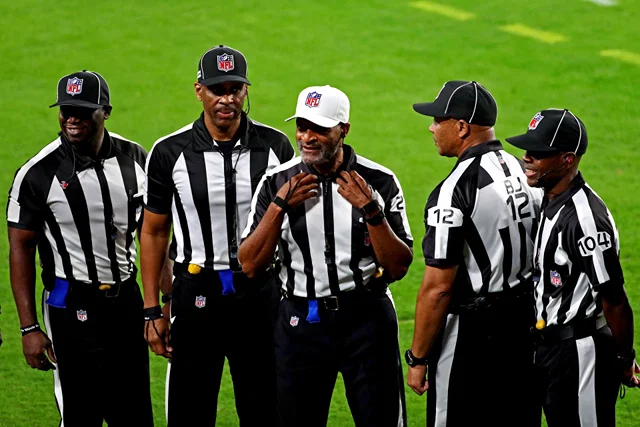
Former NFL defensive tackle Breiden Fehoko has sparked a debate over officiating in professional football after accusing referees of influencing game outcomes through questionable penalty calls. During an appearance on Jason Whitlock’s Fearless podcast, Fehoko claimed that the Kansas City Chiefs repeatedly benefited from questionable pass interference calls when they were trailing late in games.
Fehoko, who previously played for the Los Angeles Chargers, recalled facing Kansas City and suggested that his team expected the officials to make a controversial call in the Chiefs’ favor when the circumstances were right. His comments went beyond the usual complaints about individual penalties, raising broader concerns about how much influence officials have over the outcome of NFL games.
The former defensive tackle also criticized what he described as an increase in penalties, arguing that referees have become too involved in deciding games. His remarks come amid renewed scrutiny of NFL officiating following several controversial decisions, including a disputed penalty during the Arizona Cardinals’ game against the Los Angeles Rams.
Although Fehoko made serious allegations about the way games are officiated, his comments reflect his personal assessment and do not establish that NFL games are being deliberately rigged. Nevertheless, the interview has added to the ongoing debate about consistency, accountability and the use of replay technology in professional football.
Breiden Fehoko Claims Chiefs Regularly Benefited From Questionable Calls
During his appearance on Whitlock’s Fearless podcast on Monday, Fehoko discussed his experiences playing against the Chiefs while he was with the Chargers. He claimed that Kansas City appeared to receive questionable pass interference calls when trailing by double digits in the fourth quarter.
“When I was with the Chargers, we played in Kansas City, and there was always a ghost pass interference call when the Chiefs were down ten in the fourth quarter. It didn’t matter how you played it if you had good coverage, bad coverage. We always knew the Chiefs were going to get a ghost call.”
Fehoko’s use of the phrase “ghost pass interference call” suggests that he believed some penalties were unwarranted or difficult to justify based on the defensive coverage. He portrayed the alleged pattern as something his team anticipated when facing Kansas City in a close or challenging situation.
Pass interference penalties can have a significant impact on an NFL game. Depending on the circumstances, a defensive pass interference call can result in the offense receiving the ball at the spot of the foul, potentially providing a substantial gain and extending a drive.
That impact can become particularly important late in the fourth quarter, when a team trailing by 10 points needs to score quickly. A controversial penalty can change field position, extend a possession and create an opportunity for a comeback.
However, Fehoko’s recollection does not independently demonstrate that officials deliberately favored the Chiefs. His comments reflect his perspective as a former player, and no supporting evidence was presented in the supplied interview excerpt to establish that the alleged calls were part of a coordinated effort to influence results.
Former Chargers Defensive Tackle Says NFL Officials Have Too Much Influence
Fehoko expanded his criticism beyond his experiences against Kansas City, arguing that officiating has become an increasingly disruptive part of the NFL. He pointed to the number of penalties being called and suggested that referees are exercising too much control over the flow and outcome of games.
“To me, it’s become a mockery, and you can look at the stats. This year, officials are averaging double-digit penalties a game, compared to years prior when it was single-digit. … These officials are controlling the game more than what it needs to be, and I’m sick of it.”
Fehoko’s comments highlight a longstanding frustration among players, coaches and fans: penalties can determine the outcome of a game even when the teams’ performances appear closely matched. A holding call, defensive pass interference penalty or roughing-the-passer decision can erase a major play, extend a drive or put a team in scoring position.
At the same time, a high penalty count does not automatically mean that officiating is unfair or that games are being manipulated. Penalty totals can vary with playing style, rule enforcement priorities, game situations and the specific conduct officials observe on the field.
Fehoko cited an alleged increase in average penalties per game, but the figures in his remarks were not independently substantiated in the supplied material. A meaningful comparison would require verified league-wide statistics from the relevant seasons, using the same definition of penalties and accounting for differences in the number of games played.
His broader concern, however, is clear: Fehoko believes the officials’ decisions have become too central to the NFL experience. In his view, games should be determined primarily by the players’ performance rather than a series of disputed rulings.
Fehoko Questions Officials’ Football Backgrounds
The former defensive tackle also questioned whether NFL officials have sufficient football experience to make decisions that can determine the results of games played by professional athletes.
“These guys aren’t football guys. They have their own jobs throughout the week accountants, right? And then they get to come and determine a game with guys who have put their blood, sweat, and tears week in and week out, and that’s what it’s become.”
Fehoko’s comments reflect his frustration with the difference between the physical demands placed on NFL players and the authority officials have over the game. Players dedicate much of their professional lives to preparation, training and competition, while referees are responsible for applying a complex set of rules under intense pressure.
His criticism also raises questions about how the NFL trains and evaluates its officials. Consistency is crucial in a sport where a single penalty can change possession, erase a touchdown or extend a game-winning drive.
However, the assertion that officials are not qualified to make such decisions is Fehoko’s opinion. NFL officiating requires specialized training, knowledge of league rules and the ability to make rapid judgments in fast-moving situations. The fact that an official may have another occupation does not, by itself, establish a lack of competence.
Still, the criticism illustrates the level of distrust that can develop when players and fans believe similar plays are being judged differently. Greater transparency around controversial decisions and clearer explanations of rule enforcement could help address some of those concerns.
Jon Gruden Criticizes Penalty During Rams-Cardinals Game
Fehoko was not the only prominent football figure to criticize NFL officiating on Monday. Former Las Vegas Raiders head coach Jon Gruden also questioned a controversial penalty from the Arizona Cardinals’ game against the Los Angeles Rams.
During the final drive of Sunday’s matchup, Cardinals wide receiver Jalen Brooks made a 21-yard catch before being hit in the helmet by Rams cornerback Josh Wallace. Officials called a defensive penalty on the play, moving Arizona into field-goal range and creating an opportunity for a dramatic finish.
Cardinals kicker Chad Ryland subsequently converted a 43-yard field goal as time expired, giving Arizona a walk-off victory. The penalty therefore became a major talking point because it helped extend the drive that led to the game-winning kick.
Gruden discussed the decision during an appearance on Wake Up Barstool the following day. His criticism focused on the NFL’s replay and communication systems, questioning why a replay official could not intervene if a call was believed to be incorrect.
“We have a guy in the booth; he’s called the replay official. And his job is to look at the game and see calls that are screwed up. He has communication with the white hat. And I should just say, ‘Hey, Dave, you really screwed up that call, pick up the flag.’”
Gruden argued that modern technology should make it easier to correct obvious officiating mistakes before they affect the outcome of a game. He questioned the value of having a replay official communicate with the referee if that communication could not be used to address a potentially incorrect ruling.
“Now, for that not to happen, it makes me sick. I don’t understand what we’re doing! We have all this technology; look at these super high-speed, Emmy Award-winning shots you’re showing. What’s the point in having a guy up there communicating?”
His remarks reflected a broader frustration with the limits of replay review. While video technology allows officials and broadcasters to examine plays from multiple angles, not every on-field decision can be reviewed or overturned under the league’s rules.
Gruden’s criticism centered on whether the NFL’s existing procedures give replay officials enough authority to correct mistakes. His comments did not establish that the penalty was intentionally awarded or that officials were attempting to influence the result.
Why Replay Technology Remains a Point of Debate
The disagreement surrounding the Rams-Cardinals game illustrates the challenge of balancing the speed of live officiating with the accuracy offered by video review. Officials must make decisions in real time, often while players are moving at full speed and contact occurs in a fraction of a second.
Replay technology can help clarify what happened, but its effectiveness depends on the rules governing when reviews are permitted and what kinds of decisions can be changed. If a particular penalty is not reviewable under the applicable procedures, even multiple camera angles may not give officials a way to overturn the original ruling.
That limitation can frustrate fans and coaches when a controversial decision has a direct impact on a game’s final moments. In the Cardinals’ case, the penalty helped place the team within field-goal range, making the ruling especially significant because Arizona converted the opportunity as time expired.
Supporters of greater replay authority argue that the league should use available technology to reduce obvious errors. Critics of expanded reviews, however, can point to the risk of longer games, additional stoppages and difficult questions about how much contact should qualify as a penalty.
The challenge for the NFL is to improve accuracy without turning every close decision into an extended review. Consistent rule enforcement, effective communication between officials and clear explanations of controversial calls remain important elements of maintaining confidence in the game.
Cardinals and Rams Both Move to 2-4
The result of the Rams-Cardinals game left both teams with 2-4 records, according to the supplied report, with Arizona holding the head-to-head tiebreaker following its victory.
For the Cardinals, Ryland’s walk-off field goal provided a dramatic finish and an important win. The game-winning kick followed Brooks’ 21-yard reception and the defensive penalty involving Wallace, which moved Arizona closer to a potential field goal.
For the Rams, the ending was frustrating because the defense had an opportunity to prevent the Cardinals from reaching scoring range. The penalty proved costly in the final moments, though the ruling itself became the focus of criticism from Gruden and others discussing the game.
When teams have similar records, individual results can carry additional importance in the standings. The head-to-head tiebreaker gives Arizona an advantage over Los Angeles in that comparison, although both teams still have the remainder of the season to improve their positions.
The controversy surrounding the finish also demonstrates how officiating discussions can overshadow the performances that led to a game’s decisive moment. Instead of focusing solely on the players’ execution, attention can shift to whether a penalty was justified and whether replay procedures should have produced a different result.
Officiating Controversies Renew Questions About NFL Accountability
Fehoko’s allegations and Gruden’s criticism have brought renewed attention to the role of referees in the NFL. Their comments differ in focus: Fehoko alleged a recurring pattern of questionable calls benefiting Kansas City, while Gruden challenged the league’s ability to correct a disputed penalty during a decisive moment.
Neither set of comments, on its own, establishes that NFL games are being rigged. Allegations of deliberate manipulation are serious and would require credible evidence beyond a former player’s recollection or a coach’s disagreement with a particular ruling.
Nevertheless, controversial calls can have a significant effect on how fans perceive the fairness of the competition. When a penalty changes field position or extends a game-winning drive, supporters naturally want to understand why the ruling was made and whether the same standard would be applied in another game.
Improving confidence in officiating requires more than defending individual decisions. Clear explanations, consistent enforcement, effective use of replay technology and appropriate evaluation of officials can help the league demonstrate that rules are being applied fairly.
The NFL must also balance accountability with the reality that officiating involves difficult judgments under pressure. Even experienced officials can make mistakes, and not every disagreement indicates bias or intentional misconduct.
Breiden Fehoko’s Comments Add to the NFL Referee Debate
Breiden Fehoko’s appearance on Jason Whitlock’s Fearless podcast has added another strong voice to the ongoing debate over NFL officiating. His claim that the Chiefs were expected to receive a questionable pass interference call when trailing late in games has attracted attention because it alleges more than a simple mistake by an individual referee.
Fehoko also argued that officials are becoming too influential in determining outcomes and questioned whether their football backgrounds adequately prepare them for the responsibility. Meanwhile, Jon Gruden’s criticism of the Rams-Cardinals penalty has renewed discussion about whether replay officials should have greater authority to correct potentially incorrect calls.
The controversy highlights the fine line between criticizing officiating and making unsupported claims about deliberate manipulation. Disputed penalties deserve scrutiny, but allegations that officials are controlling or rigging games require evidence before they can be treated as established facts.
For the NFL, the challenge remains ensuring that games are decided as fairly as possible while maintaining the speed and flow of competition. As debates over penalties and replay continue, consistency and transparency will be essential to preserving trust among players, coaches and fans.
For breaking news and live news updates, like us on Facebook or follow us on Twitter and Instagram. Read more on Latest NFL on thefoxdaily.com.






COMMENTS 0