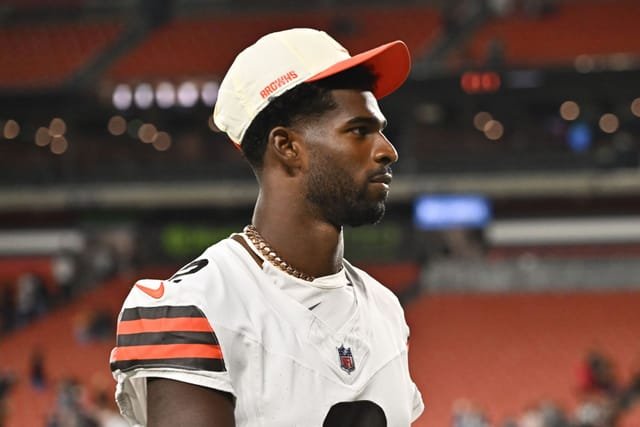
Cleveland Browns 2027 NFL Draft speculation has taken an intriguing turn after ESPN analyst Field Yates projected Notre Dame quarterback CJ Carr to Cleveland with the No. 3 overall pick. The prediction is significant because the Browns already have Deshaun Watson and Shedeur Sanders competing for quarterback duties.
Yates’ projection goes beyond a simple mock-draft selection. His reasoning centers on how Cleveland has handled its quarterback room entering the 2026 season, particularly the decision to name Watson the starter for Week 1.
According to Yates, that decision could indicate that the Browns are not yet convinced Sanders is their long-term answer at quarterback. If Cleveland eventually ends up selecting third overall in the 2027 NFL Draft, the quarterback position could once again become the focus of the franchise.
The situation also creates an interesting dilemma for Cleveland. The Browns could potentially have three very different quarterback options: an experienced veteran in Watson, a young passer in Sanders who has already received NFL starting experience, and a highly regarded college prospect in Carr.
Why Field Yates has CJ Carr going to Cleveland
Field Yates made his prediction while appearing with Mel Kiper on ESPN’s “First Draft.” His argument was based largely on the Browns’ current quarterback hierarchy.
Yates suggested that if Cleveland believes Sanders can become its franchise quarterback, the organization would presumably have given the younger passer the opportunity to start immediately.
Instead, Watson was named the starting quarterback for Week 1.
That decision does not automatically mean Cleveland has given up on Sanders. Quarterback development can take time, and teams often prefer to avoid placing unnecessary pressure on young players.
However, Yates sees the situation differently. His projection assumes that if the Browns struggle badly enough to land the third overall selection, the organization could decide that another quarterback reset is necessary.
Shedeur Sanders’ position has become complicated
Shedeur Sanders entered Cleveland with considerable attention after beginning his professional career as a developmental quarterback. His path during his rookie season was not straightforward.
He started the season as the Browns’ third-string quarterback but eventually moved up the depth chart and started the final seven games of the regular season.
That experience is important because Sanders has already shown that he can handle the demands of starting NFL games.
At the same time, starting seven games does not necessarily guarantee a long-term future. Young quarterbacks are evaluated over a much larger sample, and organizations must determine whether a player’s performances demonstrate sustainable franchise-level potential.
That is where the 2026 season becomes particularly important for Sanders.
If he receives opportunities and performs well, Cleveland could quickly change the narrative surrounding its quarterback future. If he struggles or remains behind Watson for an extended period, the Browns could have a stronger reason to explore alternatives.
Why Deshaun Watson remains central to the discussion
Watson’s presence makes the Browns’ quarterback situation more complicated.
The veteran was named Cleveland’s starter for Week 1, meaning Sanders begins the season behind him despite having started the final seven games of the previous regular season.
That decision can be interpreted in several ways.
From a developmental perspective, it gives Sanders additional time to learn and improve without immediately carrying the full responsibility of the offense.
From a competitive perspective, it gives Cleveland an experienced option at the most important position on the roster.
And from a draft perspective, it creates an evaluation period.
If Watson performs well, Cleveland may have less reason to make an early quarterback selection. If Watson struggles, Sanders could receive another opportunity. If neither player establishes himself as the long-term answer, the Browns could enter the 2027 draft searching for a new solution.
Mel Kiper explains why he preferred Watson as QB1
Mel Kiper offered a different perspective on the decision to start Watson over Sanders.
Kiper has previously been a strong supporter of Sanders and once viewed him as a potential No. 1 overall selection during the draft evaluation process.
Nevertheless, Kiper argued that making Watson the starter could actually benefit Sanders.
The logic is straightforward: starting Sanders immediately would expose a young quarterback to pressure and could force Cleveland to evaluate him before he was fully prepared.
If Watson starts and performs well, Cleveland benefits from having a functioning veteran quarterback. If Watson struggles, the Browns can turn to Sanders without having already committed to him as the unquestioned starter.
That creates what Kiper described as a potential “win-win” situation.
The Browns have multiple possible quarterback paths
| Quarterback | Current Situation | Potential 2026 Outcome | Impact on 2027 Draft |
|---|---|---|---|
| Deshaun Watson | Named Week 1 starter | Could strengthen his position with strong performances | Success could reduce the need for an early QB pick |
| Shedeur Sanders | Young quarterback with previous starting experience | Could earn a larger role during the season | Strong play could convince Cleveland to stay with him |
| CJ Carr | Projected early 2027 prospect | Continues developing at Notre Dame | Could become an option if Browns pick near the top |
CJ Carr’s development makes the projection interesting
CJ Carr is entering his second season as Notre Dame’s starter after an impressive 2025 campaign.
For NFL teams, experience is particularly valuable when evaluating young quarterbacks. A prospect who has already faced high-level college competition and managed the responsibilities of being a starter can be viewed as having a stronger developmental foundation.
That does not mean Carr is guaranteed to become a top-three selection.
Quarterback evaluations can change dramatically during a college season. Performance against stronger opponents, decision-making under pressure, accuracy, mobility and consistency all influence how scouts view a prospect.
That is why Yates’ prediction should be treated as an early projection rather than a forecast of what will definitely happen in April 2027.
Why the No. 3 pick would be crucial for Cleveland
If the Browns actually finish the 2026 season with the No. 3 overall selection, the quarterback decision would become one of the biggest choices in the franchise’s recent history.
A top-three selection provides access to the most highly regarded prospects in a draft class. Using such a pick on a quarterback means the organization believes the player can become the centrepiece of its future.
But Cleveland would need to evaluate its existing quarterbacks carefully before making that decision.
Drafting Carr would effectively signal that the team is willing to move forward with a new long-term plan rather than relying on Sanders or Watson.
That makes the 2026 season crucial even though the 2027 draft is still months away.
The most important variable is Shedeur Sanders’ performance
The simplest way for Sanders to change this conversation is to play well when given the opportunity.
Draft projections are constantly revised because players change perceptions through their performances. If Sanders develops into a reliable starter during the 2026 season, the Browns may have little reason to spend a top-three selection on another quarterback.
His previous experience as a starter gives him a foundation that many young quarterbacks do not have.
However, he must turn that experience into consistent production.
The Browns will ultimately need answers to several questions: Can Sanders read NFL defenses consistently? Can he make good decisions under pressure? Can he protect the football? Can he lead the offense against strong opponents? And perhaps most importantly, can he give the organization confidence that it has found its long-term starter?
Why Cleveland’s quarterback strategy matters
The Browns have spent significant time searching for stability at quarterback. That makes the possibility of selecting another passer near the top of the draft particularly important.
A franchise cannot afford to repeatedly reset its quarterback plan without a clear evaluation process.
The next year should therefore be about collecting evidence.
Watson needs to demonstrate whether he can provide dependable production. Sanders needs to show whether his potential translates into sustained NFL success. Meanwhile, Carr needs to continue developing at Notre Dame and prove that he deserves to be considered among the best quarterbacks in the 2027 class.
Only after those questions are answered will Cleveland have enough information to make an intelligent decision.
A top-three quarterback pick could change the Browns’ timeline
If Cleveland selects Carr third overall, the organization would be making more than a positional choice.
It would be choosing a new timeline.
A rookie quarterback selected that high would likely become a major part of the franchise’s future planning. The Browns would need to build the offense around his development while managing the transition from their current quarterback options.
That could mean difficult decisions involving roster construction, contracts and playing time.
On the other hand, if Sanders performs well enough during the 2026 season, Cleveland could use a top draft pick to address another position of need.
That is why the current debate is less about Carr versus Sanders today and more about what evidence Cleveland collects over the next several months.
What could happen next?
Three scenarios stand out for the Browns.
Scenario 1: Watson succeeds
If Watson performs well throughout the season, Cleveland could decide that it does not need an immediate quarterback replacement. Sanders could remain part of the longer-term plan or continue developing behind an experienced starter.
Scenario 2: Sanders takes over and excels
If Watson struggles and Sanders gets another opportunity, strong performances from the younger quarterback could completely change the team’s draft strategy.
In that situation, the Browns could enter the 2027 draft with Sanders as their preferred long-term option.
Scenario 3: Neither quarterback provides certainty
This is the scenario that makes Yates’ CJ Carr projection particularly interesting.
If Watson fails to establish himself and Sanders cannot convince the organization that he is the answer, Cleveland could decide that a top-three draft selection is too valuable to pass up.
That would make Carr a realistic option if he continues his development and remains one of the leading prospects in the class.
Conclusion
Cleveland Browns 2027 NFL Draft speculation has already produced a major quarterback storyline, with ESPN analyst Field Yates projecting Notre Dame’s CJ Carr to Cleveland at No. 3 overall.
The prediction is especially significant because Shedeur Sanders remains part of the Browns’ quarterback plans after starting the final seven games of his rookie season, while Deshaun Watson has been named the Week 1 starter for 2026.
Mel Kiper believes starting Watson could actually help Sanders by reducing the pressure on the young quarterback and giving Cleveland more information before making a long-term decision.
Ultimately, the 2027 quarterback question will probably be decided by what happens during the 2026 season. If Sanders develops into a dependable starter, the Browns may have no reason to select Carr. If the existing quarterback situation remains uncertain and Cleveland lands near the top of the draft, however, a highly rated college quarterback could become extremely difficult to ignore.
For now, CJ Carr to Cleveland remains an early projection—not a certainty. But it highlights just how important the Browns’ quarterback decisions in 2026 could become.
For breaking news and live news updates, like us on Facebook or follow us on Twitter and Instagram. Read more on Latest NFL on thefoxdaily.com.






COMMENTS 0