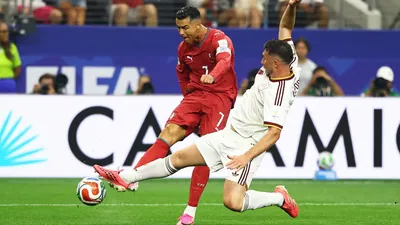
Cristiano Ronaldo’s final FIFA World Cup campaign was supposed to be a celebration of longevity, greatness, and one last pursuit of football’s most coveted prize. Instead, Portugal’s heartbreaking Round of 16 defeat to Spain ended not only their 2026 World Cup dream but also produced an unexpected statistic that has sparked debate across the football world.
The 41-year-old Portuguese icon finished the tournament with 17 shots without creating a single chance for a teammate, the highest such total recorded at a FIFA World Cup since detailed tracking began in 1966. While records have defined much of Ronaldo’s extraordinary career, this particular milestone highlights the complex reality of aging superstars, changing team dynamics, and the evolution of modern football.
More importantly, the statistic tells a deeper story than numbers alone. It reflects how Portugal approached the tournament, how opponents defended against Ronaldo, and how one of football’s greatest careers reached its final World Cup chapter.
Portugal vs Spain: The Match That Ended a Dream
Portugal entered the knockout clash against Spain knowing they faced one of the tournament favorites. The rivalry between the Iberian neighbors has produced memorable World Cup moments in the past, and expectations were high for another classic encounter.
For much of the match, both sides created opportunities without finding a breakthrough. Spain controlled possession in long stretches, while Portugal relied on quick transitions and moments of individual brilliance from players such as Bruno Fernandes, Bernardo Silva, João Félix, and Ronaldo.
The contest appeared destined for extra time until the dramatic 91st minute. Mikel Merino combined effectively with Ferran Torres before finding the decisive goal that sent Spain into the quarterfinals and ended Portugal’s campaign.
The result left Portuguese players devastated, particularly Ronaldo, who knew this would almost certainly be his final opportunity to compete on football’s biggest stage.
The FIFA World Cup Record Nobody Wants
Football statistics often celebrate greatness, but occasionally they reveal uncomfortable truths.
Ronaldo’s record of 17 shots without creating a chance for a teammate illustrates a tournament in which he struggled to influence matches in the manner fans had become accustomed to throughout his career.
The previous mark belonged to Mexico’s Alberto García Aspe, who registered 15 shots during the 1998 FIFA World Cup without producing a chance for a teammate. Ronaldo surpassed that figure during Portugal’s 2026 campaign.
| Statistic | Cristiano Ronaldo (2026) | Previous Record |
|---|---|---|
| Shots Without Creating a Chance | 17 | 15 |
| Record Holder Before 2026 | — | Alberto García Aspe |
| Tracking Era | Since 1966 | Since 1966 |
While critics may view the number negatively, context matters. The statistic does not necessarily indicate poor performance. Instead, it reflects how Ronaldo was used tactically and how opponents focused defensive attention on him throughout the tournament.
Why This Record Does Not Tell the Full Story
Modern football analysis increasingly warns against judging players solely through isolated statistics.
Ronaldo’s 17-shot record is noteworthy, but it fails to capture several important realities.
- He consistently occupied defenders and created space for teammates.
- Portugal often structured attacks around getting him into scoring positions.
- Opposing teams dedicated significant defensive resources to limiting his influence.
- His leadership remained important despite reduced physical output.
Football’s tactical complexity means some contributions never appear on a stat sheet. A striker’s movement can open passing lanes, force defensive adjustments, and create opportunities indirectly.
That does not erase the significance of the record, but it does provide necessary context.
How Age Changed Ronaldo’s World Cup Role
One of the defining stories of the 2026 FIFA World Cup was Ronaldo’s transformation from explosive attacker to experienced veteran.
At his peak, Ronaldo combined extraordinary pace, elite dribbling, aerial dominance, and ruthless finishing. Defenders struggled to contain his complete attacking arsenal.
By 2026, his game had naturally evolved.
Rather than leading counterattacks from deep positions, Ronaldo operated closer to goal. His movement became more calculated, conserving energy for decisive moments inside the penalty area.
This tactical shift is common among elite athletes who extend their careers into their late thirties and forties.
However, it also increases dependence on service from teammates. When opponents successfully disrupt supply lines, forwards can appear isolated and less influential.
Spain’s Defensive Blueprint Against Ronaldo
Spain deserves significant credit for limiting Portugal’s biggest threat.
Throughout the match, the Spanish defense maintained compact positioning and minimized opportunities for Ronaldo to receive dangerous passes in central areas.
Whenever Portugal advanced into attacking zones, Spain compressed space quickly and prevented Ronaldo from turning toward goal.
The strategy reflected a broader trend seen throughout the tournament. Opponents understood that allowing Ronaldo even a small opening remained dangerous despite his age.
As a result, Portugal often found themselves searching for alternative routes to goal.
The Evolution of Portugal Beyond Ronaldo
For nearly two decades, Portugal’s identity was closely linked to Ronaldo.
His goals, leadership, and star power became synonymous with the national team. Yet the 2026 World Cup demonstrated that Portugal is increasingly transitioning toward a new generation.
Players such as Bruno Fernandes, Bernardo Silva, João Félix, Rafael Leão, and others have assumed larger responsibilities.
This evolution is both necessary and inevitable.
Every great national team eventually faces the challenge of moving beyond a transformational figure. The most successful transitions occur when younger stars develop before the legend departs entirely.
Portugal appears positioned to remain competitive, but replacing Ronaldo’s influence will remain one of the biggest tasks in international football.
Comparing Ronaldo’s Final World Cup to Previous Campaigns
The contrast between Ronaldo’s final World Cup and earlier tournaments is striking.
| World Cup | Career Stage | Primary Role |
|---|---|---|
| 2006 | Emerging Superstar | Dynamic attacker |
| 2010 | Prime Years | Main offensive threat |
| 2014 | Peak Leadership | Captain and focal point |
| 2018 | Veteran Superstar | Elite goalscorer |
| 2022 | Experienced Leader | Mentor and attacker |
| 2026 | Football Icon | Senior leader and striker |
The progression highlights one of the most remarkable aspects of Ronaldo’s career: adaptation.
Few athletes remain effective across such dramatically different phases of their professional lives.
What Bruno Fernandes’ Comments Reveal
After the defeat, Bruno Fernandes emphasized that Portugal failed to maintain the level shown during the first half.
His comments reflected a broader sentiment within the squad.
Portugal believed they had opportunities to challenge Spain but ultimately could not sustain the intensity required to defeat one of the tournament’s strongest teams.
Fernandes also acknowledged Spain’s quality, demonstrating the respect Portugal held for a side widely regarded as one of the favorites to lift the trophy.
The remarks suggest that Portugal viewed the loss not as a collapse but as a missed opportunity against elite opposition.
Why Spain Look Like Genuine World Cup Contenders
While much attention has focused on Ronaldo and Portugal, Spain’s performance deserves equal analysis.
The Spanish squad combines experienced leaders with some of the most exciting young talents in world football.
Their ability to remain patient under pressure, control possession, and produce decisive moments in critical situations has become a hallmark of their tournament run.
Mikel Merino’s winning goal demonstrated the depth and composure that championship-winning teams often possess.
Rather than relying solely on star players, Spain continues to benefit from a collective structure that maximizes contributions throughout the squad.
The Bigger Story Behind Ronaldo’s Tears
Statistics may dominate headlines, but emotions often reveal the true significance of sporting moments.
Ronaldo’s tears after the final whistle were not simply about a single defeat.
They represented the end of a dream that began two decades earlier.
Since making his World Cup debut in 2006, Ronaldo chased the one trophy capable of completing an already extraordinary career. Despite countless records and achievements, the FIFA World Cup remained elusive.
That emotional response resonated with fans because it highlighted the human side of greatness.
Even the most accomplished athletes experience disappointment, heartbreak, and unfulfilled ambitions.
A Unique Insight: Why This Record May Eventually Be Forgotten
Football history tends to remember defining achievements more than isolated statistics.
Years from now, most supporters will likely remember Ronaldo as:
- One of football’s greatest goalscorers.
- An international icon.
- A European champion.
- A player who competed at the highest level for over twenty years.
- A leader who transformed Portuguese football.
The unwanted World Cup record will remain part of the historical record, but it is unlikely to define his legacy.
Instead, it will serve as a footnote in a career filled with far more significant accomplishments.
What Comes Next for Cristiano Ronaldo and Portugal?
Although Ronaldo has confirmed that his World Cup journey is over, he has not yet made a final decision regarding his broader international future.
Portugal, meanwhile, enters a critical transition period.
The team possesses enough talent to remain competitive in major tournaments, but leadership responsibilities will increasingly shift toward the next generation.
How successfully Portugal manages that transition could determine whether the nation remains among football’s elite over the coming decade.
For Ronaldo, the next chapter may involve mentoring younger players, expanding his influence beyond the pitch, and reflecting on one of the most remarkable careers the sport has ever witnessed.
Conclusion: An Unwanted Record Cannot Overshadow a Historic Legacy
Cristiano Ronaldo’s final FIFA World Cup ended with disappointment, elimination, and an unwanted statistical record. Yet focusing solely on those elements risks missing the larger story.
The 2026 tournament marked the conclusion of a World Cup journey that spanned six editions, multiple football generations, and countless unforgettable moments.
While the World Cup trophy remained beyond reach, Ronaldo’s impact on football is undeniable. He inspired millions, elevated Portugal’s international standing, and redefined expectations for longevity and professionalism in modern sport.
The record books may show 17 shots without creating a chance, but history will remember something much bigger: a player whose pursuit of greatness lasted longer than almost anyone thought possible and whose influence will endure long after his final World Cup appearance.
For breaking news and live news updates, like us on Facebook or follow us on Twitter and Instagram. Read more on Latest Sports on thefoxdaily.com.






COMMENTS 0