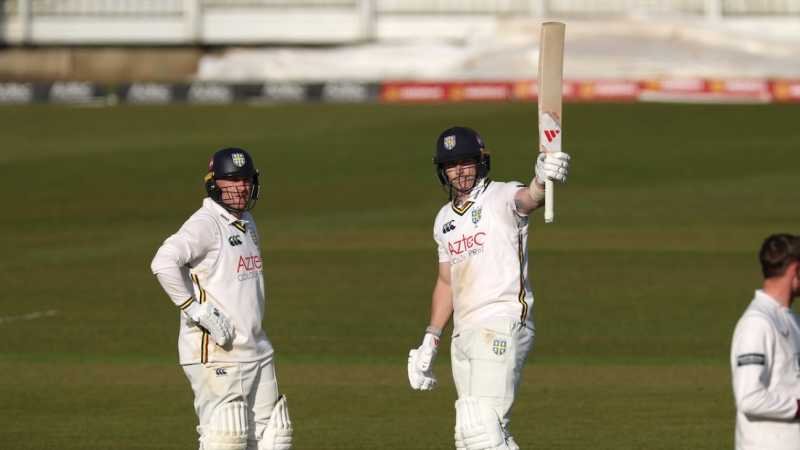
Durham’s ten-wicket victory over Gloucestershire further strengthened their grip on the Rothesay County Championship Division Two table, as the league leaders completed their latest win in just six deliveries on the fourth morning at BANKS Homes Riverside.
Chasing only four runs after Gloucestershire’s second innings ended on 250, Durham sent Matthew Potts and Ollie Robinson out to finish the job. Potts struck the winning boundary from the final delivery of Ollie Price’s first over, bringing an emphatic conclusion to a match dominated by the hosts.
The result was Durham’s seventh victory of the season and came at a crucial stage of the Division Two campaign, with only four matches remaining. Gloucestershire, meanwhile, suffered their ninth defeat in their last ten matches and remain at the bottom of the table.
Although the winning margin was only ten wickets, the manner of Durham’s success tells the bigger story. They controlled almost every major phase of the match, building a huge first-innings advantage before their bowlers finished the job and their openers completed the chase without losing a wicket.
How Durham sealed victory in just six balls
The final equation could hardly have been simpler. Durham needed four runs to win after Gloucestershire reached 250 in their second innings.
Play had been delayed from the previous evening because of bad light, meaning Durham had to return on the fourth morning for what was effectively a four-run chase.
Potts and Robinson were selected to open the innings, and the job was completed immediately. Potts took responsibility for the finish, hitting a boundary from the last ball of the first over bowled by offspinner Ollie Price.
That meant Durham faced only six deliveries before the match was officially over.
It was a fitting ending to a game in which Durham had established control early and never allowed Gloucestershire to build enough pressure to threaten the result.
David Bedingham sets the foundation with another century
The standout batting performance belonged to David Bedingham, whose 122 provided Durham with the platform for their huge first-innings advantage.
The South African overseas batter produced his fifth Championship century of the year, underlining his importance to Durham’s promotion campaign and consistency throughout the season.
His latest hundred also took him within 57 runs of reaching 1,000 Championship runs for the season. That milestone underlines the scale of his contribution, particularly because Durham have been able to convert strong individual performances into victories.
Bedingham’s role goes beyond simply accumulating runs. A major first-innings score in a Championship match can change the entire tactical picture by giving a team time to attack with the ball and forcing the opposition to bat under scoreboard pressure.
Durham’s first-innings lead changed the match
Gloucestershire were dismissed for just 137 in their first innings, giving Durham an enormous opportunity to dictate the match.
Durham responded by scoring 384, establishing a 247-run first-innings lead.
That lead was arguably the decisive moment of the contest. Gloucestershire were immediately placed in a position where they had to bat for a long period simply to make Durham bat again.
Instead of having to chase a substantial target, Durham could focus on taking wickets and controlling the tempo. Their bowlers were therefore able to attack from a position of considerable strength.
| Team | First Innings | Second Innings | Match Result |
|---|---|---|---|
| Durham | 384 | 4 for 0 | Won by 10 wickets |
| Gloucestershire | 137 | 250 | Lost by 10 wickets |
Kasey Aldridge provides Gloucestershire’s biggest threat
Despite Gloucestershire’s defeat, Kasey Aldridge delivered an outstanding individual bowling performance.
Aldridge claimed five wickets for only 16 runs in Durham’s first innings, helping to restrict the hosts after Gloucestershire had been dismissed for 137.
He then returned in the second innings to take another four wickets for 47 runs. His match figures of nine wickets for 63 runs were exceptional and represented the most significant positive for the visitors.
His performance also demonstrates an important feature of Championship cricket: individual brilliance does not always guarantee a team result.
Aldridge repeatedly created opportunities, but Gloucestershire’s first-innings collapse meant that Durham had already established too large an advantage.
Gloucestershire’s first innings proved too costly
Gloucestershire’s total of 137 put them on the back foot almost immediately.
James Bracey’s 60 provided the principal resistance, but the rest of the batting order could not produce enough runs to prevent Durham from taking control.
The difference between the two first-innings totals was enormous. Durham’s 384 gave them 247 runs of breathing room, while Gloucestershire were forced to spend their second innings trying to repair the damage.
In a four-day Championship match, a first-innings deficit of that size is extremely difficult to overcome because it affects both the scoreboard and the tactical options available to the team trailing.
Miles Hammond delays Durham’s final push
Gloucestershire showed considerably more resistance in their second innings.
Miles Hammond scored 58, helping the visitors reach 250 and avoid an innings defeat. His contribution was particularly important because Gloucestershire needed to extend the match deep into the third day after their poor first-innings total.
The second innings also gave Aldridge another opportunity to make an impact, with his four wickets helping Gloucestershire remove Durham’s remaining resistance.
However, 250 was still nowhere near enough to make Durham’s task difficult. The hosts needed only four runs, and bad light prevented them from completing the chase on the third evening.
Brydon Carse adds another dimension to Durham’s attack
Durham’s bowling strength was also illustrated by Brydon Carse, who contributed four important wickets during the match.
The presence of Carse, Ben Stokes and Matthew Potts highlighted the depth and quality available to Durham.
That combination is particularly valuable in Championship cricket. A team competing for promotion needs more than one dominant bowler because four-day matches can place significant demands on the attack.
Durham’s ability to combine established international-quality players with performers capable of making decisive contributions gives them a strong platform as the season reaches its final stage.
Why Durham’s promotion push looks increasingly convincing
The victory has significant consequences for the Division Two standings.
Durham entered the round as leaders, while Kent occupied second place and Northamptonshire were third. Those two teams were facing each other in the same round, meaning Durham’s victory had the potential to create additional separation at the top.
With seven wins now recorded and only four matches remaining, Durham have placed themselves in an excellent position to challenge for the Division Two title and promotion.
The important factor is not simply the number of victories but the consistency with which Durham have turned strong starts into match-winning positions.
This Gloucestershire match followed that pattern almost perfectly: early wickets, a substantial first-innings score, sustained pressure and a straightforward final chase.
Durham’s season can be viewed through three strengths
1. Top-order run production
Bedingham’s century is the clearest example, but Durham’s success has not depended on one isolated innings. Their ability to build substantial first-innings totals gives their bowlers a significant advantage.
2. Quality pace bowling
Carse and Potts provide international experience and the ability to take wickets. That becomes particularly important when opposition batting line-ups need to survive long periods under pressure.
3. Match control
Perhaps the most impressive aspect of Durham’s campaign is their ability to put themselves in positions where the opposition must play from behind. The 247-run first-innings advantage against Gloucestershire was a perfect example.
What Gloucestershire need to fix
Gloucestershire’s ninth defeat in ten matches highlights a more serious problem than one bad innings.
The immediate concern is batting. Being dismissed for 137 against a strong Durham attack meant that the team had almost no margin for error during the remainder of the match.
The second innings showed greater resilience, with Hammond scoring 58 and the team reaching 250. But improvement in the second innings cannot completely compensate for repeated early collapses.
Gloucestershire will need greater consistency from their top order if they are to reverse their position at the bottom of Division Two.
The bowling department did provide encouragement through Aldridge’s nine-wicket match, but Championship matches are rarely won by one department alone.
Aldridge’s performance offers Gloucestershire something to build on
There is a clear positive for Gloucestershire to take from the defeat.
Aldridge’s nine wickets demonstrate that the team has a bowler capable of creating sustained pressure against a strong batting line-up.
The challenge is converting those individual performances into collective results.
If Gloucestershire can support that bowling effort with bigger first-innings totals, the balance of future matches could look very different.
Why the six-ball finish is more significant than it looks
At first glance, finishing a four-run chase in six balls might appear almost trivial. In reality, it reflects the position Durham had created over the previous three days.
They did not need to take risks. They did not need a major batting performance on the final morning. They simply needed four runs.
That is the ultimate advantage of building a dominant first-innings lead: the final task becomes almost administrative.
Potts’ winning boundary was therefore not just a quick finish. It was the final result of Durham’s earlier batting and bowling dominance.
Durham’s next challenge: Northamptonshire
Durham will travel to Northampton for their next Championship fixture, where they will face Northamptonshire.
The match could carry additional significance because Northamptonshire are among the teams competing near the top of Division Two.
For Durham, the objective will be straightforward: maintain the consistency that has taken them to the top and avoid allowing the pressure of the promotion race to affect their approach.
Another strong result against a direct contender could make the closing stages of the season even more favourable for the leaders.
Gloucestershire face Derbyshire test
Gloucestershire will return to Bristol to face Derbyshire in their next fixture, beginning on Wednesday.
The matchup offers Gloucestershire an immediate chance to respond to another heavy defeat.
Interestingly, Gloucestershire defeated Derbyshire by ten wickets back in April, providing a reminder that their current position does not necessarily reflect their ability to produce strong individual performances.
The key will be consistency. One convincing result is not enough to change the direction of a Championship season, but a win could provide the confidence required for a late improvement.
What the result tells us about the promotion race
Durham’s victory provides a useful lesson about the difference between competing and controlling a Championship division.
Promotion races are often decided by teams that consistently collect wins while avoiding prolonged periods of poor form. Durham are currently doing exactly that.
The remaining four matches will still matter, but the leaders have created a valuable cushion through repeated victories.
The upcoming contests involving Kent and Northamptonshire could also reshape the chasing group, making every remaining point increasingly important.
Final verdict: Durham are setting the pace
Durham’s ten-wicket victory over Gloucestershire was one of the clearest demonstrations yet of why they sit at the top of Division Two.
David Bedingham’s 122 provided the batting headline, while Kasey Aldridge produced an outstanding nine-wicket performance for Gloucestershire. Brydon Carse also played a major role with four wickets as Durham controlled the contest.
The hosts’ 384 created a massive 247-run lead after Gloucestershire’s first-innings 137. Although the visitors fought harder in their second innings and reached 250, Durham needed only four runs to win.
Bad light delayed the inevitable on the third evening, but the fourth morning lasted just six deliveries. Potts hit the winning boundary from Ollie Price’s final ball of the opening over to complete the ten-wicket victory.
With seven wins secured and only four matches remaining, Durham are increasingly well placed in the Division Two promotion race. Their next challenge against Northamptonshire could provide another major test of their credentials.
For Gloucestershire, the priority is very different. Their ninth defeat in ten matches leaves them needing a rapid turnaround, and the upcoming meeting with Derbyshire provides an immediate opportunity to begin it.
Durham are now setting the standard at the top. Gloucestershire, meanwhile, have little time left to find an answer.
For breaking news and live news updates, like us on Facebook or follow us on Twitter and Instagram. Read more on Latest Cricket on thefoxdaily.com.






COMMENTS 0