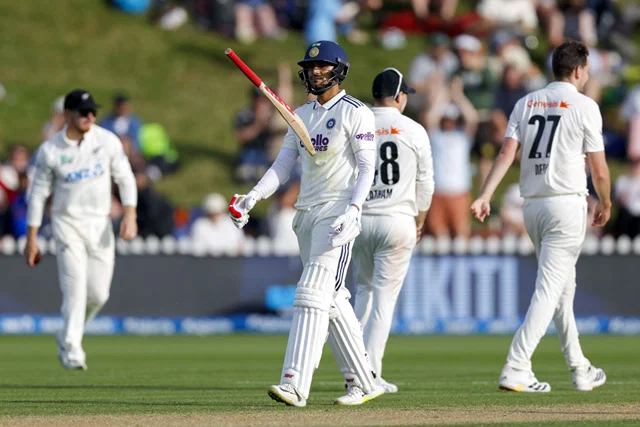
India captain Shubman Gill survived a controversial DRS decision on 67 during Day 3 of the first Test against New zealand at the Basin Reserve in Wellington. Gill was initially given out lbw by on-field umpire Richard Illingworth after Nathan Smith struck his pads, but third umpire Paul Reiffel overturned the decision after detecting a spike on UltraEdge.
The decision left New Zealand’s players unconvinced, with several fielders questioning the verdict and seeking an explanation from the on-field umpire. The Basin Reserve crowd also responded with boos as Gill was allowed to continue batting.
The incident became one of the major talking points of the day, particularly because Gill had only a few seconds remaining on the DRS review clock when he decided to challenge the original decision. His survival proved important for India, as the captain continued his innings and built valuable partnerships with KL Rahul and Rishabh Pant.
Shubman Gill survives controversial DRS review on 67
The incident occurred during the 108th over of India’s innings when New Zealand fast bowler Nathan Smith delivered a ball that moved back into Gill’s pads. On-field umpire Richard Illingworth immediately raised his finger, ruling the Indian captain out lbw.
Gill initially appeared ready to walk back to the pavilion. However, he checked with non-striker Rishabh Pant before making his final decision. With approximately three seconds remaining on the review clock, the India captain signalled for a Decision Review System (DRS) challenge.
Third umpire Paul Reiffel then began examining the available replays. The review took several minutes as the officials studied different camera angles and checked the UltraEdge technology to determine whether the ball had made contact with Gill’s bat before hitting his pad.
The side-on replay appeared to show a thin inside edge, with the ball making contact with the bat before reaching the pad. UltraEdge also displayed a spike, leading Reiffel to overturn Illingworth’s original decision and rule Gill not out.
However, New Zealand’s players were not convinced by the decision. Their fielders believed there was a visible gap between the bat and pad and questioned whether the ball had actually made contact with the bat.
New Zealand players question umpire after DRS verdict
As the decision was reversed, Nathan Smith approached Illingworth to seek clarification. Rachin Ravindra and Daryl Mitchell also joined the discussion, showing their disagreement with the third umpire’s verdict.
The broadcast audio captured parts of the exchange between the players and the officials. One New Zealand player could be heard questioning the decision by pointing towards what he believed was a gap between the bat and pad.
“Yeah, that’s out. There’s a little gap over there,” one New Zealand player said.
Another player then asked whether the gap was visible to the umpire, saying:
“Kumar, can you see the gap?”
Pant responded confidently to the comment, defending the official’s ability to assess the replay.
“Yeah, Kumar is not blind. Don’t worry.”
Gill also later discussed the incident with New Zealand wicketkeeper Tom Blundell. The Indian captain explained that he had checked whether his bat was close to his pad before deciding to review the original decision.
“I asked him if my bat was close to the pad or not,” Gill told Blundell.
The exchange reflected the frustration among New Zealand’s players, who believed the original lbw decision should have stood. Nevertheless, the third umpire’s decision was final, allowing Gill to continue his innings.
Gill makes New Zealand pay after controversial reprieve
Gill’s survival was particularly significant because he was batting confidently and had already become one of India’s most important contributors. He had arrived at the crease when India were 295 for 2 and immediately looked comfortable against the New Zealand bowling attack.
The India captain showed positive intent throughout his innings, finding gaps in the field and playing attractive strokes against the pace attack. He also brought up his half-century in style, pulling Jacob Duffy for a six and moving past New Zealand’s first-innings total.
Gill’s innings was built around controlled aggression and his ability to rotate the strike. While other Indian batters had also made important contributions, the captain continued to put pressure on the bowlers with his stroke-making.
After reaching his fifty, Gill continued to build partnerships that strengthened India’s position in the match. He first added 91 runs with KL Rahul before combining with Pant for another century stand.
His contribution helped India move into a commanding position during the third day. However, despite surviving the controversial review, Gill ultimately missed out on a deserved century by just two runs.
Jacob Duffy dismisses Gill on 98 in final over
Gill’s impressive innings came to an end in the 125th over when New Zealand pacer Jacob Duffy found a way through his defence. Duffy delivered a ball that clipped Gill’s pad before going on to hit the off stump, dismissing the Indian captain for 98.
Gill walked back after scoring 98, just two runs short of what would have been his 12th Test century. His dismissal was a significant moment for New Zealand, as the hosts finally managed to break a partnership that had helped India establish a substantial lead.
The dismissal also placed Gill among the Indian captains who have fallen in the 90s against New Zealand in Test Cricket. He became the second India captain to suffer such a fate, following MS Dhoni, who scored 98 against New Zealand in Nagpur in 2010.
Although Gill missed the milestone, his innings remained one of the defining contributions of India’s batting performance. His partnerships with Rahul and Pant helped the visitors take control of the contest.
KL Rahul’s gritty 136 leads India’s batting charge
KL Rahul was the leading run-scorer for India on Day 3, producing a determined innings of 136 from 290 deliveries. His knock marked his 13th Test century and represented another major achievement in his international career.
Rahul also became the first Indian opener to score Test centuries in all four SENA countries: South Africa, England, New Zealand and Australia. The milestone highlighted his ability to perform in challenging overseas conditions.
His innings was built on patience, concentration and an understanding of the conditions at the Basin Reserve. While the New Zealand bowlers attempted to apply pressure, Rahul remained disciplined and continued to collect runs through well-timed shots.
His partnership with Gill was particularly important, adding 91 runs and helping India maintain momentum after losing their second wicket. Rahul’s century also provided the foundation for the contributions that followed from the middle order.
Rahul eventually departed after making 136 from 290 balls, but his effort had already placed India in a strong position in the match.
Devdutt Padikkal contributes 80 in Wellington
Devdutt Padikkal also played an important role in India’s batting performance, scoring 80 runs from 175 deliveries. The left-handed batter showed patience and composure, supporting Rahul during a crucial phase of the innings.
Padikkal’s innings helped India maintain pressure on New Zealand and build a strong platform for the middle order. His partnership with the senior batters ensured that the visitors continued to add runs without allowing the hosts to take control.
New Zealand pacer Kyle Jamieson eventually dismissed Padikkal, ending his valuable contribution. However, his 80-run effort further strengthened India’s position and added to the workload of the home bowling attack.
Rishabh Pant returns with an aggressive unbeaten fifty
Rishabh Pant also made a significant contribution after returning from a side strain. The wicketkeeper-batter produced an aggressive unbeaten 55 from just 62 deliveries, providing India with further momentum during the closing stages of the day.
Pant’s approach was noticeably positive, with the left-hander looking to put pressure on the New Zealand bowlers. His innings included attacking strokes and quick scoring, allowing India to continue extending its advantage.
His partnership with Gill added 100 runs, giving India another substantial stand after the earlier contributions from Rahul and Padikkal. Pant remained unbeaten at stumps, ensuring that India finished the day with a strong batting position.
India finish Day 3 on 486/4 with a commanding lead
India ended the third day at 486 for 4, having established a lead of 118 runs over New Zealand. The visitors’ batting performance was built around centuries and major contributions from Rahul and Gill, along with valuable half-centuries from Padikkal and Pant.
Jacob Duffy was among the New Zealand bowlers who worked hard throughout the innings, finishing with figures of 1 for 181. Despite taking an important wicket by dismissing Gill on 98, he had conceded a significant number of runs during India’s long batting effort.
New Zealand had earlier been bowled out for 368 in their first innings. India’s response of 486 for 4 gave them a substantial advantage heading into the next stage of the Test match.
The day featured several important moments, including Rahul’s historic century, Padikkal’s composed 80, Pant’s attacking return and Gill’s controversial DRS reprieve. Although the decision involving Gill created frustration among the New Zealand players, the Indian captain continued to make a major contribution before falling just short of his century.
DRS controversy adds another talking point to NZ vs India Test
The review involving Gill became one of the most discussed incidents of Day 3 because of the disagreement between the two teams. While the third umpire identified a spike on UltraEdge and overturned the original decision, New Zealand’s players remained convinced that the evidence did not support the reprieve.
For India, the decision allowed their captain to continue an innings that helped strengthen the team’s position. For New Zealand, it was a frustrating moment during a day in which their bowlers struggled to contain the visitors’ batting lineup.
With India closing on 486 for 4 and holding a 118-run lead, the pressure had shifted towards the hosts. Rahul’s century, Gill’s 98 and Pant’s unbeaten fifty had given India a strong platform, while the controversy ensured that the DRS decision would remain a major talking point from the Wellington Test.
For breaking news and live news updates, like us on Facebook or follow us on Twitter and Instagram. Read more on Latest Cricket on thefoxdaily.com.






COMMENTS 0