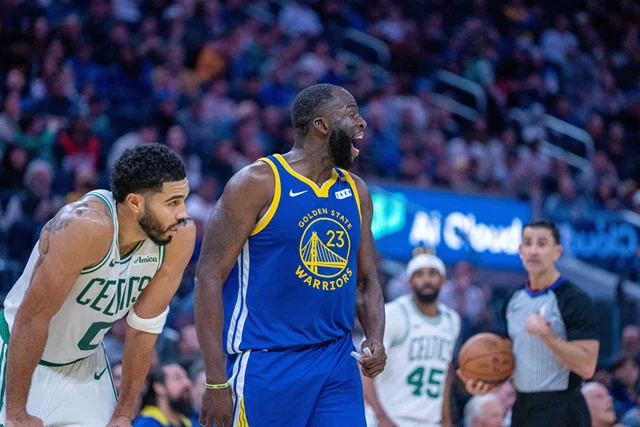
Golden State Warriors forward Draymond Green has become the subject of criticism following his online feud with former NBA player and commentator Eddie A. Johnson. The exchange has also attracted attention from sports media personalities, including former NFL player Emmanuel Acho, who delivered a blunt assessment of Green’s public behaviour during a discussion on his show, Speakeasy.
Acho disagreed with the defence offered by his co-host, Shady McCoy, and used a sharp comparison to question Green’s position within the Warriors organisation. He described the veteran forward as a “janitor” acting like a “CEO”, arguing that Stephen Curry remains the central figure in Golden State’s leadership structure.
The comments have added another layer to the discussion surrounding Green’s role, influence and tendency to engage with critics publicly. The Warriors star has continued to defend himself against Johnson, including after Golden State’s victory over the Boston Celtics.
Emmanuel Acho criticises Draymond Green during Speakeasy debate
The discussion took place on Speakeasy, where Acho appeared alongside co-host Shady McCoy to examine the disagreement between Green and Johnson. A clip from the programme was subsequently shared on X by NBA Hoop, bringing the debate to a wider basketball audience.
McCoy defended Green during the conversation, arguing that the Warriors forward should be recognised as a winner rather than dismissed as an ordinary role player. He also compared Green favourably with Shawn Marion, bringing up the way players are evaluated in modern basketball.
McCoy’s argument focused on the importance of winning and the contributions of players whose value cannot always be measured through scoring statistics. He also questioned the tendency to praise high-scoring players such as Tracy McGrady while overlooking the achievements of players who contribute to championship-winning teams.
Acho, however, rejected the direction of McCoy’s argument. He suggested that the issue was not whether Green had played an important role in Golden State’s success, but whether the forward was behaving as though he held a position above his actual standing within the team.
To explain his point, Acho compared Green to a janitor who acts like the chief executive of an organisation. The remark was deliberately provocative and quickly became the central moment of the discussion.
“Draymond’s the janitor that acts like the CEO”
Acho acknowledged that his comparison could sound offensive but insisted that it reflected his view of Green’s place within the Warriors organisation. He argued that janitors perform valuable work and that their contribution becomes obvious when a building is not properly maintained. However, he maintained that their importance does not make them the chief executive.
“(This) is going to sound offensive but it is just what it is. Draymond’s the janitor that acts like the CEO,” Acho said. “You know how valuable a janitor is if you ever walk into a place and it ain’t been cleaned … but at the end of the day, the janitor is not the CEO.”
The comparison was aimed at Green’s public behaviour and his ongoing disagreements with basketball personalities. Acho’s argument was that a player can be extremely important to a successful organisation without being its primary leader or most influential figure.
By using the CEO comparison, Acho placed Stephen Curry at the centre of his assessment. Curry is widely regarded as the defining player of the Warriors’ modern era, while Green has played a significant supporting role in the team’s success through his defence, playmaking, intensity and leadership.
The comments also highlighted a familiar debate in basketball: how should a player’s value be measured when their biggest contributions do not necessarily appear in traditional scoring statistics? Green’s supporters often point to his defensive impact and ability to influence the game in several ways. Critics, meanwhile, question his approach when his on-court intensity turns into public confrontation.
Shady McCoy defends Green’s value and winning record
McCoy’s defence of Green reflected a different way of evaluating the Warriors star. Rather than focusing primarily on his public disagreements, McCoy emphasised the importance of winning and the contributions made by players who do not always lead their teams in scoring.
His comparison with Shawn Marion also brought attention to the wider discussion about the value of players who contribute through defence, versatility and their ability to fit into championship teams. In the modern NBA, the label of a role player can sometimes be used too broadly, particularly when it overlooks the responsibilities and influence of players who are not the leading scorers.
Green’s role with Golden State has often involved doing the work that allows other players to operate more effectively. His defensive communication, ability to guard multiple positions and passing from the frontcourt have made him an important part of the Warriors’ system.
However, Acho’s response suggested that those contributions should not automatically justify every public action or statement. His criticism focused on the distinction between being valuable to a team and behaving as though one has authority over the organisation.
The disagreement between Acho and McCoy therefore extended beyond Green’s argument with Johnson. It became a debate about how much influence a successful supporting star should have and whether his achievements on the court should affect how his public behaviour is judged.
Draymond Green continues his exchange with Eddie Johnson
While the discussion on Speakeasy was attracting attention, Green was continuing his own disagreement with Johnson. The Warriors forward addressed the situation on Sunday after Golden State defeated the Boston Celtics.
The exchange had developed online ahead of the matchup, with Green and Johnson trading comments. Given the attention surrounding the disagreement, there was considerable interest in whether Green would discuss it when speaking to reporters after the game.
Green did not avoid the subject. During his postgame interview, he explained that he generally responds to criticism when he has time but prefers to make his point once and then allow the other person to continue speaking.
“People gonna say what they’re gonna say,” Green said. “If I have time, I’ll usually respond just once and then just kind of let them talk to their microphone or their laptop or, in Eddie Johnson’s case, whoever he has typing for him. Because we know he don’t know how to use those things.”
Green’s response included a personal jab at Johnson’s ability to use technology, suggesting that someone else was responsible for typing his online comments. The remark continued the back-and-forth between the two basketball personalities rather than bringing the disagreement to an immediate conclusion.
His comments also reflected his familiar approach to criticism. Green has frequently responded directly to comments about his performances, personality and place in the NBA. While some supporters view that willingness to speak openly as part of his competitive character, critics believe it can create unnecessary distractions.
Why the Warriors star remains a divisive figure
Green has built a reputation as one of the most outspoken players in the NBA. His intensity and willingness to challenge opponents have been central to his identity as a competitor. Those qualities have also made him a prominent personality beyond the basketball court.
His importance to the Warriors cannot be understood through scoring numbers alone. Green’s defensive awareness, communication and ability to organise teammates have been important elements of Golden State’s approach. He has also developed a close basketball partnership with Curry, helping the team maintain its style of play through different stages of its success.
At the same time, Green’s public confrontations frequently attract attention and can shift discussions away from basketball. His latest feud with Johnson is another example of how disagreements involving the forward can become major talking points.
Acho’s comments have added to that conversation by questioning whether Green’s influence sometimes leads him to act as though he occupies a position comparable to the Warriors’ leading figure. McCoy’s defence, on the other hand, highlighted the value of players whose contributions are essential to winning even when they are not the primary offensive stars.
Could Acho’s remarks trigger another backlash?
Acho’s comments about Green arrive after another public disagreement involving the former NFL player and basketball personality Nick Young earlier in the month. His latest remarks could therefore attract further reactions from NBA fans and personalities who disagree with his assessment.
The comparison between Green and a janitor acting like a CEO is particularly likely to generate debate because it touches on the difference between a player’s contribution and his position within a team. Supporters of Green may consider the remark dismissive of the work he has done for Golden State, while those who agree with Acho may see it as criticism of the forward’s public conduct rather than his basketball ability.
For now, the discussion remains centred on opinions expressed by the three personalities. McCoy has defended Green’s importance as a winner, while Acho has questioned the way the Warriors star handles disagreements. Green, meanwhile, has continued responding to Johnson and has shown little indication that he intends to remain silent when criticised.
Johnson’s next response could determine whether the online exchange continues to grow. Until then, the disagreement has provided another reminder of Green’s ability to attract attention both for his contributions on the court and for his outspoken personality away from it.
Green’s role and Curry’s leadership remain central to the debate
The argument ultimately reflects two different ways of looking at the Warriors’ structure. Curry remains the central figure in the franchise’s modern success, while Green has been an influential teammate whose defensive and organisational contributions have helped shape the team’s identity.
Both roles can be important without being identical. Green’s value as a player does not necessarily depend on being considered the team’s chief leader, just as Curry’s position does not diminish the contributions of the players around him.
Acho’s blunt analogy and McCoy’s defence have brought that distinction into the spotlight. Whether Green responds to the criticism or allows the debate to continue without further comment remains to be seen, but his ongoing feud with Johnson has already made him one of the latest talking points across the NBA community.
For breaking news and live news updates, like us on Facebook or follow us on Twitter and Instagram. Read more on Latest Basketball on thefoxdaily.com.






COMMENTS 0