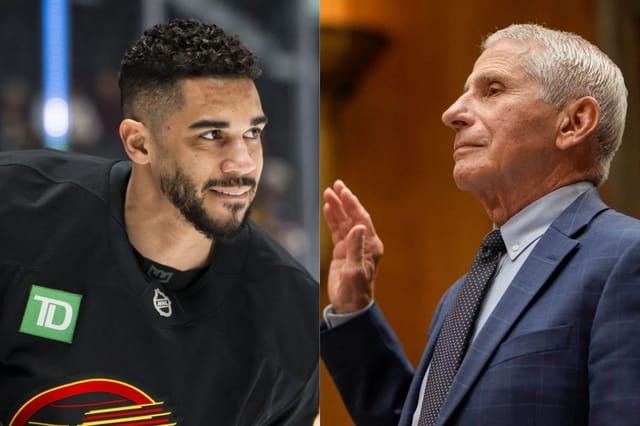
Evander Kane has once again found himself at the center of a heated online debate, this time after weighing in on the latest controversy surrounding former U.S. infectious-disease adviser Anthony Fauci. Kane’s comments about vaccination, public-health messaging and Fauci’s appearance before a U.S. Senate committee drew a sharp response from NHL analyst Mark Spector on August 6, 2026.
The exchange quickly moved beyond a disagreement over Fauci. Kane responded directly to Spector, calling the analyst’s criticism an “idiotic take” and referring to what appeared to be a previous confrontation between the two men. That personal reference transformed what could have been a routine social-media disagreement into a bigger story for hockey fans.
The timing is also significant because Kane’s comments arrive nearly five years after he received a 21-game unpaid suspension from the NHL for violating the league’s COVID-19 protocols. That history gives the latest discussion an additional layer that other reactions to the controversy may overlook.
What happened between Evander Kane and Mark Spector?
The dispute began after Kane reacted on X to the Senate Homeland Security and Governmental Affairs Committee’s decision to hold Anthony Fauci in contempt of Congress. Fauci had invoked his Fifth Amendment right more than 100 times during a hearing concerning questions surrounding the COVID-19 pandemic.
Kane used the development to criticize an idea he believed had been promoted during the pandemic: that vaccinated people had a responsibility to protect those who remained unvaccinated. He also questioned the role of media outlets in amplifying what he viewed as an overly simplistic public-health message.
Mark Spector, an NHL analyst known for covering the Edmonton Oilers, responded critically to Kane’s position. His reply characterized Kane’s stance as selfish, turning the discussion from Fauci and COVID-19 policy into a direct exchange between two recognizable hockey figures.
Kane did not leave the criticism unanswered. He quote-tweeted Spector and dismissed the analyst’s response as an “idiotic take.” He then referenced an earlier incident involving the two, writing that he could say more but suggested Spector might react emotionally, before adding: “Don’t tell me you forgot.”
That final line quickly became one of the most attention-grabbing elements of the exchange because it suggested that the disagreement was not simply about Fauci or COVID-19 policy. Kane’s response indicated that there was already personal history between the two men, giving the social-media argument a hockey-specific backstory.
Why Kane’s Fauci comments are attracting so much attention
The reaction to Kane is not solely about his opinion on Anthony Fauci. It is also about the unusual intersection of sports, politics and a player’s personal experience with pandemic-era rules.
Professional athletes were among the most visible groups affected by COVID-19 restrictions because leagues had to balance competition with health and safety protocols. Hockey was particularly complicated because players operated in close-contact environments, traveled frequently and shared locker rooms.
For Kane, those issues were not theoretical. His career was directly affected by the NHL’s COVID-19 rules in 2021, when he was suspended for 21 games after the league determined that he had violated its COVID-19 protocol.
That history means Kane’s latest comments inevitably invite comparisons between his past experience and his current criticism of pandemic-era messaging. However, the two situations should not be treated as identical. His 2021 suspension concerned compliance with NHL rules, while his 2026 comments are an expression of his views about public-health policy and political accountability.
Evander Kane’s 2021 COVID-19 suspension explained
In October 2021, the NHL announced that Kane had been suspended for 21 games without pay for violating the league’s COVID-19 protocol. The league’s investigation established a violation and lack of compliance with the COVID-19 rules agreed upon by the NHL and NHL Players’ Association.
The issue became widely associated with allegations that Kane had submitted a fraudulent COVID-19 vaccination card. However, the key point from the league’s disciplinary action was that Kane was suspended for violating the NHL/NHLPA COVID-19 protocol.
The suspension came during a particularly complicated period for Kane and the San Jose Sharks. He had already been the subject of multiple investigations, creating an unusually intense level of scrutiny around the veteran forward.
Kane subsequently apologized to his teammates, the Sharks organization and the team’s supporters. He acknowledged that he had made a mistake and said he accepted responsibility for violating the NHL’s COVID protocols.
He also said he intended to use the suspension period to work on making better decisions before returning to the ice. That response was important because it showed that Kane publicly accepted responsibility for the specific league violation, even though his views on pandemic policy have continued to attract debate years later.
Did the NHL require every player to get vaccinated?
This distinction is important when discussing Kane’s history.
The NHL’s 2021-22 COVID-19 protocols created different requirements and consequences for vaccinated and unvaccinated players, but the league did not simply frame the issue as a universal vaccination mandate for every player.
Unvaccinated players faced significantly more restrictive protocols, including limitations designed to reduce potential exposure and transmission. Players who tested positive could also face financial consequences depending on their circumstances and the applicable league rules.
For professional sports leagues, the objective was not only individual protection. The broader challenge was keeping teams functioning while reducing disruptions caused by outbreaks, player absences and travel restrictions.
This context matters because debates about vaccination during the pandemic often collapse several different questions into one: individual choice, workplace rules, public-health policy and responsibility toward others.
Kane’s current position is different from his 2021 situation
One of the most important angles in the current controversy is the difference between expressing an opinion and violating a league policy.
Kane is now commenting on a political and public-health dispute as a private individual. His statements about Fauci and vaccination represent his interpretation of events and should not automatically be presented as an official NHL position or as a medical conclusion.
That distinction is especially relevant because Kane is a professional athlete rather than a public-health specialist. His experience gives him a perspective on how pandemic restrictions affected athletes, but it does not make his interpretation of medical policy equivalent to expert scientific analysis.
At the same time, dismissing his comments solely because of his history would also oversimplify the debate. People can disagree with Kane’s conclusions while still examining the broader questions he is raising about pandemic communication, institutional accountability and the relationship between public policy and individual freedom.
Why the Mark Spector response changed the story
Had Kane simply posted his opinion about Fauci, the discussion might have remained another political argument on social media. Spector’s response changed that dynamic because it introduced a direct NHL connection.
Instead of debating only the substance of Kane’s argument, the conversation became about whether a hockey analyst should criticize an NHL player so personally and how Kane would respond.
Kane’s decision to bring up their alleged previous confrontation made the exchange even more personal. His wording suggested that the two had experienced an earlier incident away from the immediate political discussion.
That is why the dispute has attracted attention beyond people interested in Fauci or pandemic policy. For hockey followers, it has become another chapter in the long-running public fascination with Kane’s willingness to confront critics rather than quietly move on.
Evander Kane has long been a polarizing NHL figure
Kane’s public profile has never been limited to his performance on the ice. Throughout his NHL career, controversy has frequently followed him, sometimes overshadowing his production as a player.
That makes his latest exchange particularly predictable from a media perspective. Kane is a player whose statements can generate attention quickly because fans and critics already have established opinions about him.
Yet there is another side to that story. Kane has also remained a productive NHL forward across multiple stops in his career, including time with the Atlanta Thrashers, Winnipeg Jets, Buffalo Sabres, San Jose Sharks and Edmonton Oilers.
His ability to remain relevant on the ice while repeatedly becoming part of off-ice controversies is one reason his social-media posts tend to attract significant attention.
A comparison that explains the latest controversy
| Issue | Kane’s 2021 situation | Kane’s 2026 comments |
|---|---|---|
| Central issue | NHL COVID-19 protocol compliance | Public-health policy and Fauci controversy |
| Setting | Professional hockey | Political and social-media debate |
| Consequence | 21-game unpaid NHL suspension | Public criticism and online debate |
| Kane’s role | NHL player subject to league rules | Individual expressing a personal opinion |
The comparison illustrates why the latest story has gained traction. The subject matter overlaps, but the circumstances are fundamentally different. In 2021, Kane was dealing with a workplace policy enforced by a professional sports league. In 2026, he is participating in a political conversation that has no direct connection to an NHL disciplinary process.
What the Fauci controversy means for the broader debate
The Senate committee’s action against Fauci has reopened arguments about accountability for decisions made during the COVID-19 pandemic. Fauci invoked the Fifth Amendment during questioning, and the committee subsequently voted to hold him in contempt.
The legal and political implications are separate from Kane’s comments, but they explain why the topic has become so combustible online.
For some critics, the hearing represents an opportunity to scrutinize decisions made by public-health officials during the pandemic. For Fauci’s defenders, the proceedings raise concerns about the politicization of scientific expertise and the use of congressional investigations as a political weapon.
Kane’s contribution to that discussion is therefore less about providing a definitive answer and more about showing how deeply pandemic-era arguments continue to resonate outside politics and medicine.
The bigger lesson for sports and social media
The Kane-Spector dispute highlights a broader reality of modern professional sports: athletes are no longer expected to speak only about games.
Social media has eliminated much of the distance between athletes, journalists and fans. A player can comment on politics, respond to criticism and create a headline within minutes. That direct access can make athletes feel more authentic to supporters, but it also increases the risk that a personal argument becomes a national story.
For journalists and analysts, the same environment creates a difficult balance. Criticizing an athlete is part of sports media, but personal exchanges can quickly become more important than the original subject.
In Kane’s case, that transformation happened almost instantly. A discussion about Fauci became a debate about vaccination, then a confrontation with Spector, and finally a reminder of Kane’s own COVID-related history.
What happens next for Kane and Spector?
The most likely outcome is that the dispute remains largely confined to social media unless either Kane or Spector chooses to provide additional details about the previous incident referenced in Kane’s response.
That is where the story could become more significant. Kane’s “Don’t tell me you forgot” comment creates an obvious opening for further discussion, but without additional verified information, it would be irresponsible to speculate about what happened between the two men.
For now, the central takeaway is simple: Kane has publicly challenged Spector, Spector has criticized Kane’s position, and the exchange has revived discussion of Kane’s complicated relationship with the legacy of pandemic-era NHL rules.
Conclusion: Kane’s latest controversy is about more than Fauci
Evander Kane’s Anthony Fauci comments have become a talking point not because the NHL forward is an authority on public health, but because his personal history gives the debate an unusual sports angle.
His 2021 suspension for violating NHL COVID-19 protocols remains an important part of the context, while his latest comments show that the political and social arguments surrounding the pandemic have not disappeared.
The clash with Mark Spector adds another layer. What began as Kane’s reaction to a Senate committee’s treatment of Fauci quickly became a personal exchange between two hockey personalities, with Kane invoking an earlier confrontation between them.
The bigger story may therefore be less about who won the argument online and more about how quickly modern sports conversations can cross into politics, public health and personal history. In an era when an athlete’s social-media post can become a headline within minutes, Kane’s latest exchange is a clear example of how the line between the sports world and the wider public debate continues to disappear.
For breaking news and live news updates, like us on Facebook or follow us on Twitter and Instagram. Read more on Latest NHL on thefoxdaily.com.






COMMENTS 0