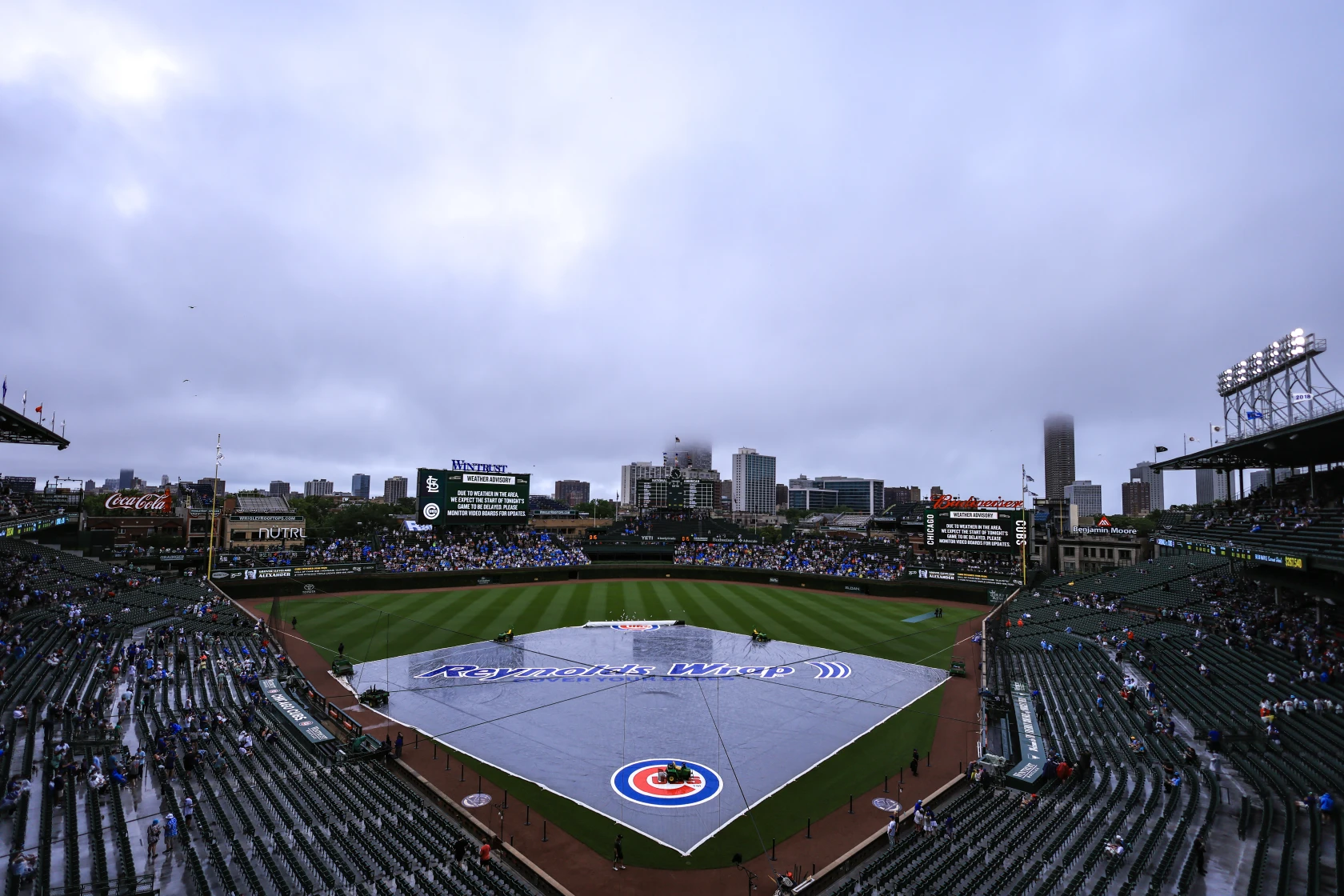
Rain, Tarps, and a Ballpark That Has Seen It All
If you have ever been to Wrigley Field on a gray Chicago afternoon, you already know the particular brand of anticipation that comes with watching the grounds crew roll out the tarp. There is something almost theatrical about it the way the ivy-covered brick walls hold the stillness of a rain delay, the video board cycling through updates, the smell of wet grass and old wood drifting through the concourse. Wrigley does not simply host rain delays. It performs them.
On Friday, the Chicago Cubs officially announced at 12:40 p.m. that the scheduled 1:20 p.m. first pitch against the San Francisco Giants would be pushed back due to weather in the area. The team set a revised target of 2:20 p.m. and asked fans inside Wrigley Field to keep an eye on the video board for further updates. As of that announcement, the tarp was down, the grounds crew was at work, and both teams were waiting along with a Wrigley crowd that has historically treated rain delays as an intermission rather than an inconvenience.
What makes this delay more than just a weather blip is the context surrounding it. The Giants are making their only visit to Wrigley Field this season, opening a three game series that carries genuine implications for both teams. Edward Cabrera is making what amounts to a statement start for the Cubs after coming off the injured list. And San Francisco is arriving in Chicago riding one of the more statistically contradictory road trips in recent memory swinging the bat at an elite level while their pitching staff quietly falls apart.
This is not just a rained-out Friday afternoon at the ballpark. It is a fascinating baseball story with a weather delay attached.
Wrigley Field and Weather: A Relationship as Old as Baseball Itself
To understand why weather is always a factor at Wrigley Field, you have to understand the ballpark itself. Opened in 1914 as Weeghman Park and renamed Wrigley Field in 1926, the stadium is one of only two remaining ballparks in Major League Baseball that predate the 1960s, along with Fenway Park in Boston. It sits in the Lakeview neighborhood on Chicago’s North Side, just miles from the shore of Lake Michigan a geographic reality that shapes the weather inside the stadium on a daily basis.
Lake Michigan is not a passive neighbor. It generates its own microclimate, pushing cold fronts and storm systems across the city with a regularity that has frustrated and fascinated Cubs fans for over a century. June in Chicago can deliver temperatures in the 80s and brilliant sunshine one afternoon and a cold, rain-soaked gray sky the next. The lake doesn’t check the calendar. More importantly for baseball, the wind at Wrigley is famous for a reason: on some days it blows in from left field, suppressing home runs and rewarding pitchers; on others it blows out toward Waveland Avenue, turning routine fly balls into souvenirs. Both the Cubs and their opponents have to factor this into their preparation in ways that no indoor ballpark demands.
Rain delays at Wrigley are not rare events. They are a feature of the experience part of the texture of what makes the ballpark feel like a living place rather than a sterile modern stadium. The grounds crew, the tarp procedure, the communal waiting it has all been choreographed by decades of repetition. Today’s delay is simply the latest chapter in that ongoing relationship between a historic ballpark and the city’s mercurial sky.
Edward Cabrera’s Return: A Blister, a Layoff, and a High-Stakes Start
The pitching matchup for this series opener adds a layer of genuine intrigue to what might otherwise be a straightforward regular season contest. For the Cubs, Edward Cabrera takes the mound
For breaking news and live news updates, like us on Facebook or follow us on Twitter and Instagram. Read more on Latest Sports on thefoxdaily.com.


COMMENTS 0