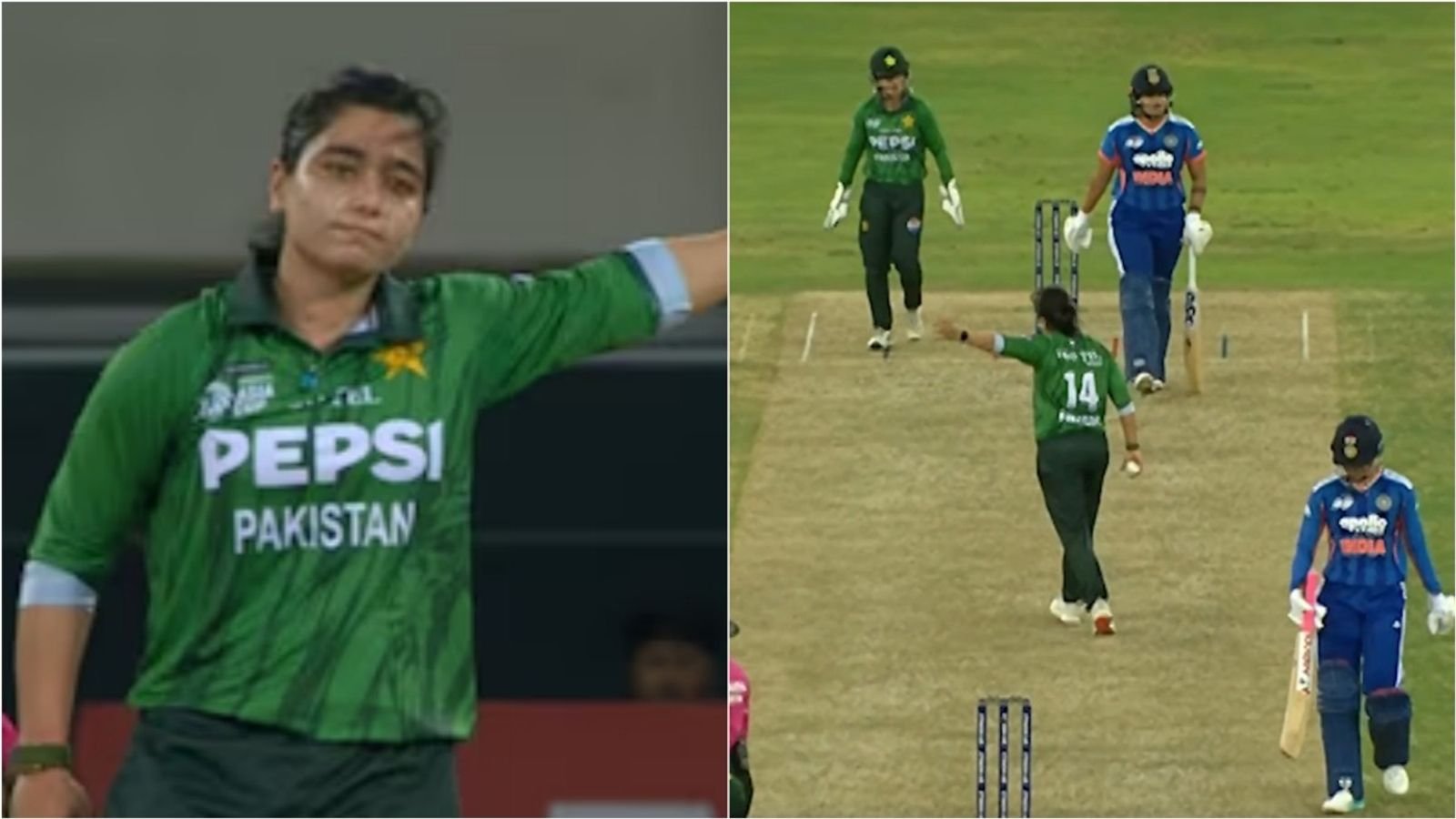
Fatima Sana has been punished by the ICC following her aggressive send-off to India opener Shafali Verma during the Women’s T20 Asia Cup 2026 clash between India and Pakistan. The Pakistan captain was fined 10 per cent of her match fee after being found guilty of breaching Level 1 of the ICC Code of Conduct.
The incident occurred on September 5 at the Dubai International Cricket Stadium after Fatima dismissed Shafali. Following the catch, the Pakistan captain pointed towards the dressing-room area in a gesture that the ICC determined could provoke an aggressive reaction from the dismissed batter.
Fatima admitted the offence, meaning a formal hearing was not required. Match referee Supriya Das imposed the financial penalty and added one demerit point to Fatima’s disciplinary record.
The punishment came after a match in which Pakistan endured a difficult evening with the bat. Pakistan were bowled out for just 55 in 18.1 overs before India chased down the target comfortably, winning by seven wickets with 11.2 overs remaining. Fatima’s three-wicket haul was one of the few positives from Pakistan’s performance.
Why was Fatima Sana punished by the ICC?
The ICC action against Fatima was linked specifically to her conduct after dismissing Shafali Verma. The Pakistan captain breached Article 2.5 of the ICC Code of Conduct, which covers language, actions or gestures that disparage a batter or could provoke an aggressive reaction following a dismissal.
Fatima dismissed Shafali caught and bowled. After completing the catch, she pointed towards the dressing-room direction before Shafali walked away without responding to the gesture.
While competitive emotion is a normal part of international cricket, the ICC rules draw a line between passionate celebration and conduct that can be interpreted as provocative or personal.
That distinction is particularly important in high-profile matches involving India and Pakistan, where moments between players can attract enormous attention.
What exactly is Fatima Sana’s punishment?
| Disciplinary detail | Outcome |
|---|---|
| Player | Fatima Sana |
| Offence | Level 1 breach of ICC Code of Conduct |
| Article | Article 2.5 |
| Financial penalty | 10 per cent of match fee |
| Demerit points | 1 |
| Formal hearing | Not required after admission of offence |
| Match referee | Supriya Das |
The ICC’s decision means Fatima receives a financial penalty while also moving one step closer to a potential suspension if further disciplinary offences occur within the relevant period.
Fatima already had a demerit point
The latest sanction is more significant because this was not Fatima’s first disciplinary offence within the 24-month period.
Her previous demerit point came during a T20I against Ireland in 2025. The latest incident therefore adds another point to her disciplinary record.
Under the ICC disciplinary system, players who accumulate demerit points can eventually face suspension points. If a player receives two suspension points, the consequence can be a ban covering one Test, two ODIs or two T20Is, depending on which format comes next.
That makes discipline particularly important for Fatima going forward. A further offence could increase the pressure on the Pakistan captain and potentially affect her availability.
Why Fatima escaped the maximum Level 1 penalty
The ICC Code of Conduct allows a range of sanctions for Level 1 breaches. The maximum penalty for this type of offence can reach a 50 per cent match-fee fine along with up to two demerit points.
Fatima received a considerably lighter punishment: a 10 per cent match-fee fine and one demerit point.
Her admission of the offence helped avoid the need for a formal hearing. The match referee also chose not to impose the maximum penalty.
The decision demonstrates that disciplinary sanctions are not necessarily identical for every breach. The circumstances surrounding an incident, the nature of the offence and the player’s acceptance of responsibility can all form part of the disciplinary process.
The Shafali Verma dismissal happened during a difficult match for Pakistan
The controversy surrounding the send-off came during a match that Pakistan would rather forget for cricketing reasons.
Pakistan’s batting collapsed dramatically, with the team dismissed for only 55 runs in 18.1 overs. India’s bowlers maintained pressure throughout the innings and prevented Pakistan from building any meaningful partnership.
India then chased the target with 11.2 overs still remaining, losing only three wickets in the process. Harmanpreet Kaur and Deepti Sharma ensured that India completed a comfortable seven-wicket victory.
Fatima’s individual bowling performance offered some consolation. She claimed three wickets, including the dismissal of Shafali, but her effort could not prevent Pakistan from suffering a heavy defeat.
Shafali chose not to react to the send-off
One of the interesting aspects of the incident was Shafali’s response—or lack of one.
After Fatima’s gesture, Shafali did not engage in a confrontation and instead continued towards the dressing-room area. That kept the incident from escalating on the field.
In international cricket, such restraint can be important. A provocative moment can quickly become a distraction, particularly when the match is already emotionally charged.
From India’s perspective, the best response ultimately came through the result. The team completed a comfortable victory and secured its place in the semifinals.
India’s dominance made the send-off even more noticeable
The timing of Fatima’s celebration is an important part of the broader story. Pakistan had just been bowled out for 55, meaning the match was already moving heavily in India’s favour.
Although Fatima’s dismissal of Shafali represented a personal success, the overall contest remained firmly under India’s control.
That contrast explains why the gesture attracted attention. The Pakistan captain produced an excellent individual bowling moment during an otherwise disappointing team performance, but the ICC subsequently determined that the manner of the celebration crossed the line set by its conduct regulations.
What the punishment means for Fatima’s captaincy
Fatima Sana is not only a player but also Pakistan’s captain, which makes disciplinary issues more consequential.
Captains are expected to lead by example, particularly in high-pressure matches. Passion and aggression are valuable qualities in competitive sport, but leadership also involves controlling emotions when a contest becomes heated.
The latest ICC sanction does not prevent Fatima from continuing to lead Pakistan, but it serves as a clear warning. Another breach could increase her demerit total and potentially create availability concerns if suspension points are accumulated.
For Pakistan, avoiding unnecessary disciplinary distractions will be especially important as the team attempts to progress further in the tournament.
Pakistan now face a must-win match against Hong Kong, China
The disciplinary issue comes at a crucial stage of Pakistan’s Women’s T20 Asia Cup campaign. Pakistan are scheduled to face Hong Kong, China on September 7 in a must-win contest.
The stakes are straightforward: Pakistan need a victory to keep their campaign alive and improve their chances of reaching the next stage.
India have already qualified for the semifinals, while Pakistan’s position means there is little room for another disappointing performance.
A strong response on the field would therefore be more valuable to Fatima and her team than allowing the controversy surrounding the send-off to dominate attention.
Pakistan’s challenge is bigger than one disciplinary incident
It would be easy to make the send-off the entire story, but Pakistan’s bigger concern is their performance with the bat.
Scoring only 55 in a major tournament match puts enormous pressure on the bowling unit. Even an excellent bowling spell becomes difficult to convert into victory when the batting side has produced such a small total.
Fatima’s three wickets demonstrated that Pakistan still possess match-winning bowling ability. The challenge is creating a complete performance in which the batting unit provides enough support for the bowlers.
Against stronger opposition, Pakistan cannot consistently expect individual bowling brilliance to compensate for major batting collapses.
India’s approach was the complete opposite
India’s performance highlighted the difference between the two sides on the day.
India’s bowlers restricted Pakistan to 55 before the batting unit completed the chase with plenty of time remaining. Harmanpreet Kaur and Deepti Sharma ensured there was no late drama.
The result also underlined an important feature of successful T20 cricket: controlling multiple phases of the match.
India dominated Pakistan’s batting innings and then handled the chase without allowing the target to become a serious threat. Pakistan, by contrast, struggled to establish momentum with the bat.
The larger lesson about on-field celebrations
The Fatima-Shafali incident provides another reminder that modern international cricket places significant emphasis on player conduct.
Celebrations are an important part of sport, and players are naturally expected to show emotion after taking important wickets. However, celebrations that are perceived as directly targeting or provoking an opponent can attract disciplinary attention.
The ICC’s rules exist partly to prevent individual confrontations from escalating into larger disputes. In a sport watched by millions, the behaviour of international players also sets an example for younger cricketers.
For captains in particular, the standard can feel even higher because their actions are naturally scrutinised more closely.
What Fatima and Pakistan need to focus on now
The immediate priority should be cricket rather than controversy.
Pakistan need to respond against Hong Kong, China, and the team’s batting department must show significant improvement. Fatima will also need to ensure that her latest disciplinary issue does not become a distraction while she leads the side through a crucial stage of the tournament.
The bowling performance against India showed that Pakistan can still create pressure with the ball. The next step is to produce a more competitive total and maintain composure throughout the match.
Final verdict: ICC warning arrives at a crucial moment
Fatima Sana’s 10 per cent match-fee fine and one demerit point bring a disciplinary consequence to an already difficult night for Pakistan. The Pakistan captain was punished for an aggressive send-off directed towards Shafali Verma after dismissing the India opener.
The incident was classified as a Level 1 breach under Article 2.5 of the ICC Code of Conduct. Fatima admitted the offence, avoiding a formal hearing, while match referee Supriya Das opted against the maximum available penalty.
For Fatima, the one demerit point matters because she already had a previous point from a 2025 T20I against Ireland. Further disciplinary action could eventually result in suspension points.
But the bigger issue for Pakistan remains their cricket. After being dismissed for 55 and losing to India by seven wickets, the team must quickly shift its attention towards Hong Kong, China.
The best response to the controversy will be a disciplined and complete performance on the field. With their tournament hopes at stake, Pakistan need their captain to lead not only with the ball but also through composure and decision-making.
For breaking news and live news updates, like us on Facebook or follow us on Twitter and Instagram. Read more on Latest Cricket on thefoxdaily.com.

COMMENTS 0