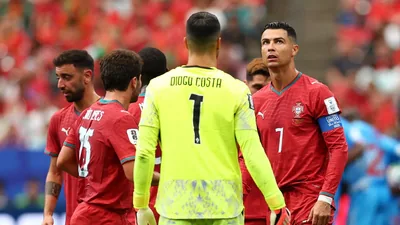
Cristiano Ronaldo has spent more than two decades defying expectations. He has broken records, won titles across multiple leagues, and redefined what elite longevity looks like in modern football.
Yet the 2026 FIFA World Cup has reopened a question that many believed would eventually arrive: can Portugal still build their attack around a 41-year-old Ronaldo?
Portugal’s 1-1 draw against DR Congo in their Group E opener was more than an unexpected result. It exposed structural issues that have lingered beneath the surface for several years.
While Ronaldo made history by appearing in his sixth FIFA World Cup, the landmark achievement was overshadowed by an underwhelming performance that highlighted the growing gap between his legendary reputation and his current on-field influence.
The challenge for Portugal is not whether Ronaldo remains a great player. That debate was settled long ago. The real question is whether the team’s tactical setup still maximizes its collective strengths.
Portugal’s World Cup Opener: Possession Without Purpose
Portugal entered the match as overwhelming favorites against DR Congo, but they struggled to convert possession into meaningful attacking opportunities.
Despite boasting a technically gifted midfield featuring Bruno Fernandes, Vitinha, and Joao Neves, Portugal produced only seven shots throughout the game and managed just one effort on target.
For long periods, the team controlled possession comfortably but lacked urgency and creativity in the final third.
DR Congo remained compact defensively, denying space between the lines and forcing Portugal into predictable passing patterns.
The result was a frustrating evening for a team expected to challenge for the latter stages of the tournament.
Ronaldo’s Numbers Paint a Concerning Picture
Elite forwards are often judged by goals, but modern football demands more than finishing ability alone.
Against DR Congo, Ronaldo completed the full match but recorded just 25 touches—the fewest among Portugal’s outfield players who played all 90 minutes.
He finished without a goal or assist and extended his scoring drought in major international tournaments.
These numbers are significant because they highlight how Ronaldo’s role has evolved.
Earlier in his career, he could influence games through dribbling, pressing, and carrying the ball over long distances. Today, he operates primarily as a penalty-box striker whose effectiveness depends heavily on service from teammates.
When that supply line breaks down, his overall impact naturally declines.
| Metric | Cristiano Ronaldo vs DR Congo |
|---|---|
| Minutes Played | 90 |
| Goals | 0 |
| Assists | 0 |
| Total Touches | 25 |
| Portugal Shots | 7 |
| Portugal Shots on Target | 1 |
The Messi Comparison Is Becoming Impossible to Ignore
Comparisons between Ronaldo and Lionel Messi have defined football’s modern era, but the opening week of the 2026 FIFA World Cup highlighted how differently the two legends have adapted to aging.
Messi’s hat-trick against Algeria demonstrated that he remains capable of controlling matches through creativity, positioning, and playmaking.
Ronaldo’s influence, by contrast, has become increasingly dependent on finishing chances created by others.
Neither approach is inherently better, but one offers greater tactical flexibility.
When Portugal struggle to create opportunities, Ronaldo’s ability to affect the game diminishes significantly. Messi, meanwhile, can still shape matches even when he is not scoring.
This contrast has amplified scrutiny around Portugal’s current approach.
Has Portugal Become Too Dependent on Ronaldo?
One of the biggest challenges for teams built around iconic players is avoiding overreliance.
Ronaldo’s status within Portuguese football is unmatched. His leadership, experience, and achievements command enormous respect from teammates and supporters alike.
However, there is a risk that Portugal’s attacking play becomes overly focused on finding their captain instead of exploiting other options.
Players may hesitate to take responsibility or alter their natural instincts when sharing the pitch with one of football’s greatest-ever goalscorers.
This dynamic can reduce unpredictability and make Portugal easier to defend against.
The issue is not Ronaldo’s presence itself—it is ensuring that his presence does not limit the team’s attacking variety.
Can Roberto Martinez Make the Difficult Decision?
Every great national team coach eventually faces a defining moment: choosing between loyalty to a legend and the tactical needs of the team.
Former Portugal coach Fernando Santos made that decision during the 2022 World Cup when he left Ronaldo on the bench for key matches.
The move generated intense debate, but it demonstrated a willingness to prioritize team balance over individual status.
Roberto Martinez now faces a similar challenge.
Could Ronaldo become more effective as an impact substitute against tiring defenses?
Introducing him in the final 30 minutes could maximize his movement inside the penalty area while reducing the physical demands of leading the line for an entire match.
Such a decision would undoubtedly attract headlines, but tournament football often rewards bold choices.
How Playing in Saudi Arabia Has Influenced the Debate
Since joining Al-Nassr in 2023, Ronaldo has maintained impressive scoring numbers at club level.
However, critics argue that competing outside Europe’s top leagues may affect a player’s readiness for elite international tournaments.
The intensity, tactical complexity, and defensive quality at the FIFA World Cup are significantly higher than most domestic competitions.
While Ronaldo’s commitment to fitness remains extraordinary, maintaining sharpness against the world’s best defenders requires consistent exposure to the highest level of competition.
It is an uncomfortable conversation, but one that inevitably surrounds aging superstars.
Portugal’s Bigger Problem Extends Beyond Ronaldo
Focusing exclusively on Ronaldo risks overlooking Portugal’s broader tactical shortcomings.
Bruno Fernandes struggled to influence the game creatively. Vitinha enjoyed plenty of possession but rarely broke defensive lines. Portugal’s wide players failed to stretch DR Congo consistently.
The lack of movement, urgency, and vertical passing affected the entire team.
Even the most prolific goalscorers depend on collective structure and chance creation.
Portugal’s disappointing performance was not the result of one player underperforming—it reflected a wider issue with attacking cohesion.
What Happens Next?
Portugal’s upcoming fixtures will offer a clearer indication of whether the draw against DR Congo was an isolated setback or a sign of deeper concerns.
Martinez must decide whether to maintain his current system or make adjustments that place greater emphasis on mobility and creativity.
Ronaldo still possesses qualities that can change matches. His movement inside the box, aerial ability, and finishing instincts remain among the best in football.
But the reality of elite sport is unforgiving: past achievements cannot guarantee future success.
Portugal’s challenge is to find a balance between honoring a legend and building a team capable of competing with the world’s best.
Conclusion
Cristiano Ronaldo’s legacy as one of football’s greatest players is secure regardless of what happens at the 2026 FIFA World Cup.
However, legacies do not win matches—performances do.
Portugal’s draw against DR Congo highlighted the growing tension between sentiment and strategy. The team still values Ronaldo’s experience and leadership, but it must also adapt to the realities of his evolving role.
The question is no longer whether Ronaldo belongs at the World Cup. It is whether Portugal can create a system that allows him to thrive without limiting the collective potential of the team.
How Roberto Martinez answers that question could define Portugal’s entire tournament.
For breaking news and live news updates, like us on Facebook or follow us on Twitter and Instagram. Read more on Latest Sports on thefoxdaily.com.





COMMENTS 0