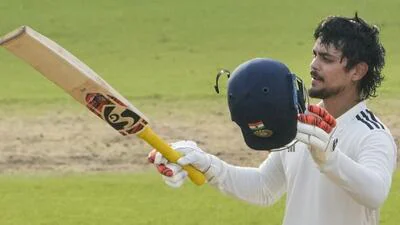
Ishan Kishan Duleep Trophy century became the defining story of the opening day of the 2026 Duleep Trophy final as East Zone captain Kishan produced an unbeaten 111 to put his team in a commanding position against South Zone at the MA Chidambaram Stadium in Chennai.
East Zone closed Day 1 on 385/4 after choosing to bat first, with Kishan remaining unbeaten deep into the evening alongside Kumar Kushagra. The innings was significant not only because of the score but also because of the manner in which Kishan constructed it. Instead of relying entirely on his naturally aggressive style, the left-hander spent considerable time defending, absorbing pressure and waiting for scoring opportunities.
His century also carried wider significance for Indian Cricket. Kishan has previously faced questions over his commitment to first-class cricket, but performances such as this strengthen the argument that he can still develop into a serious red-ball option. The final therefore became more than a domestic tournament match; it was another opportunity for Kishan to demonstrate that he can build long innings under pressure.
Why Ishan Kishan’s Duleep Trophy Century Matters
Kishan’s 111 not out came from 135 deliveries and included 14 fours and a six. The century took his first-class tally beyond 4,000 runs, adding another statistical milestone to an innings that already had considerable selection relevance.
The most encouraging aspect was the progression of his innings. Kishan did not attempt to dominate every bowler immediately. Against spin, he was prepared to defend for extended periods. When South’s fast bowlers used shorter deliveries, he initially focused on judging the bounce rather than attacking every ball.
That approach matters for a wicketkeeper-batter seeking opportunities in Test cricket. Red-ball success requires the ability to change gears according to the match situation. A batter who can survive difficult spells and then attack when the field or bowler offers an opening becomes significantly more valuable over a long innings.
Kishan demonstrated exactly that progression. Once he became comfortable, his strokeplay became increasingly forceful. His attack against spin and short bowling suggested that the aggression remains intact, but it was supported by greater patience.
A Century Built on Patience Before Aggression
The innings was particularly notable because Kishan appeared willing to let the game come to him. That is an important change in perception for a batter who has traditionally been associated with attacking cricket.
South Zone used different methods to disrupt his rhythm. Shreyas Gopal operated with leg spin, while Mohammed Siraj and Chama Milind tested the batter with short deliveries. Kishan responded by staying compact and waiting for balls that could be attacked safely.
As his score moved towards fifty, the tempo changed. When Gopal tossed the ball up, Kishan advanced down the pitch and struck it over deep midwicket. Short deliveries from Milind were pulled with increasing confidence, while loose deliveries from spin were punished through the leg side.
The important distinction was between aggression and impatience. Kishan’s attacking shots appeared to come after he had established control over the conditions. That is precisely the type of batting progression that can make a red-ball innings more sustainable.
How Ishan Kishan Reached His 111
Kishan’s century was completed with a controlled drive against Gopal. The bowler delivered the ball outside off stump, and Kishan leaned forward to drive it on the rise through the off side.
After reaching three figures, he removed his helmet and acknowledged the applause. The moment represented another important step in his return to serious first-class cricket.
More importantly, Kishan remained unbeaten. A hundred is valuable, but an unbeaten hundred gives a batter an opportunity to convert the platform into an even larger score on the following day.
That possibility could make Day 2 especially important. If Kishan can turn 111 into a substantial double-century opportunity or continue to bat for a long period, the innings would provide even stronger evidence of his ability to handle sustained red-ball demands.
East Zone’s Strong Start Was More Than a Kishan Show
Although Kishan was the headline performer, East Zone’s dominance came from contributions throughout the top order. The team lost only four wickets during 79 overs and consistently maintained pressure on the South Zone bowling attack.
Abhimanyu Easwaran provided the early foundation with 72 from 86 balls. The East Zone opener scored freely and helped establish a 100-run opening partnership with Vaibhav Sooryavanshi.
Sooryavanshi contributed 44 from 37 deliveries, continuing his reputation for positive strokeplay. His innings ended when Milind found an edge in execution on a short delivery, with the resulting catch being taken in the deep.
Easwaran later departed through a run-out after a mix-up while attempting a run. His dismissal prevented him from converting another promising start into a century, but by then East had already established an excellent platform.
Shikhar Mohan Adds Another Major Contribution
Shikhar Mohan continued East Zone’s strong batting performance with 85 from 120 balls. His innings was built around accumulation rather than constant attacking, helping ensure that the pressure remained on South Zone.
His dismissal eventually brought Kishan and Kumar Kushagra together. Instead of allowing South to regain control, the pair continued the momentum.
The partnership between Kishan and Kushagra became one of the most important developments of the day. Kushagra finished unbeaten on 63 from 75 deliveries and struck five sixes, while Kishan remained at the other end on 111.
The unbroken partnership meant South Zone ended the day without a late breakthrough. That could prove costly because East Zone now has the opportunity to dictate the tempo of the second day.
Kumar Kushagra’s Supporting Role Could Become Crucial
Kumar Kushagra’s unbeaten 63 should not be overlooked simply because Kishan dominated the headlines. His aggressive contribution ensured that South Zone could not concentrate entirely on containing the captain.
Five sixes in his innings showed that Kushagra was prepared to attack once the situation allowed it. His ability to score quickly alongside Kishan also gave East the option of accelerating further before declaring or reaching a massive first-innings total.
The partnership presents an interesting tactical challenge for South Zone. If bowlers focus heavily on stopping Kishan, Kushagra can exploit the change in attention. If they attack Kushagra, Kishan’s experience and current rhythm could make him difficult to contain.
What the Innings Says About Kishan’s Red-Ball Development
The most significant takeaway from the Ishan Kishan Duleep Trophy century is not simply that he scored 111. It is that he showed several skills required for successful first-class batting.
- Patience: Kishan was willing to defend and wait rather than manufacture shots.
- Shot selection: He increased his aggression after establishing a base.
- Adaptability: He handled both spin and short bowling without abandoning his natural style.
- Concentration: He remained unbeaten through the entire opening day.
- Game awareness: His batting reflected the needs of a final rather than simply personal scoring ambitions.
These qualities are particularly relevant because Test cricket can expose weaknesses that shorter formats sometimes hide. A player may possess outstanding strokeplay, but converting that talent into long first-class innings requires patience and discipline.
The Bigger Test Selection Question
Kishan’s century does not automatically guarantee a return to India’s Test XI. Selection at the international level depends on team balance, wicketkeeping options, recent performances, fitness and the availability of established players.
However, domestic performances are an important part of rebuilding a selection case. A player who has been outside the Test picture needs sustained evidence rather than one isolated performance.
That makes the Duleep Trophy final particularly valuable for Kishan. A strong finish to this match followed by consistent performances in other first-class fixtures would create a much stronger argument than a single century alone.
Why First-Class Cricket Remains Important for Kishan
Kishan’s career has demonstrated that his attacking ability is not in question. The bigger question has been how effectively he can translate those skills into longer innings.
First-class cricket provides the ideal environment to answer that question because matches require batters to manage changing conditions over several sessions. The pressure is different from T20 cricket, where a player can target a specific scoring rate almost immediately.
In a first-class match, the batter has to think about the new ball, field changes, bowler fatigue, spin, pitch deterioration and the possibility of batting again. Kishan’s unbeaten century therefore provides useful evidence of how he is approaching those challenges.
East Zone’s Advantage Going Into Day 2
At 385/4 after 79 overs, East Zone have established a commanding position. Their top order has already delivered multiple substantial scores, and Kishan and Kushagra remain at the crease.
South Zone now need early wickets. Removing both unbeaten batters quickly would prevent East from turning a strong total into an overwhelming one. If Kishan and Kushagra continue for another extended period, East could push the score towards a total that places enormous pressure on the opposition.
The final’s early pattern also suggests that South’s bowlers will need to improve their consistency. Giving established batters too many scoring opportunities can make recovery extremely difficult once a team has accumulated more than 300 runs.
Key Numbers From Day 1
| Player | Score | Balls | Key Detail |
|---|---|---|---|
| Ishan Kishan | 111* | 135 | 14 fours, 1 six |
| Kumar Kushagra | 63* | 75 | Five sixes |
| Abhimanyu Easwaran | 72 | 86 | 10 fours, 1 six |
| Shikhar Mohan | 85 | 120 | Strong middle-order contribution |
| Vaibhav Sooryavanshi | 44 | 37 | Positive opening approach |
| East Zone | 385/4 | 79 overs | Commanding position |
What Kishan Needs to Do Next
The biggest challenge for Kishan is now consistency. A century can reopen a conversation, but a sequence of substantial first-class performances can change the conversation entirely.
His immediate objective should be to make the most of the position he has created. Remaining at the crease for a significant portion of Day 2 would give him another opportunity to demonstrate concentration and innings management.
Beyond the Duleep Trophy final, continued first-class cricket will remain important. Repeated scores across different conditions would provide selectors with a broader picture of his development.
For a wicketkeeper-batter, there is also another layer to the selection debate: the balance between batting output and wicketkeeping value. Kishan’s aggressive batting makes him an attractive option, but the strongest selection case would come from combining that batting with reliable work behind the stumps.
Can This Century Lead to a Test Return?
It is too early to say that Kishan has secured a Test recall, but it is fair to say that his case has become stronger.
The significance of the innings lies in the combination of result, situation and method. Kishan scored heavily in a major domestic final, remained unbeaten and demonstrated a willingness to play the longer game before unleashing his attacking strokes.
That is the profile selectors want to see from a player attempting to rebuild a red-ball career. The next step is repetition.
If Kishan can follow this performance with more substantial first-class scores, his name will become increasingly difficult to ignore whenever India’s Test wicketkeeping and batting options are assessed.
The Real Winner for Kishan Is the Timing
Domestic performances become especially important when they arrive at a point where future international squads are being shaped. Kishan’s century gives him momentum at precisely the kind of stage when selectors can reassess players based on current evidence.
But the timing should not create unnecessary pressure. His best route forward is simple: keep playing first-class cricket, continue producing runs and allow the performances to build the case.
The 111 not out is therefore better viewed as a new chapter rather than a final answer. Kishan has shown that he can still produce a serious red-ball innings. Now he has to demonstrate that this level can become the standard rather than the exception.
Conclusion: Ishan Kishan Has Given Selectors Something to Think About
Ishan Kishan’s unbeaten 111 was the standout performance as East Zone reached 385/4 on the opening day of the Duleep Trophy final. The score itself was impressive, but the way he built it made the performance more meaningful.
He absorbed pressure, defended patiently, attacked when opportunities appeared and stayed at the crease until the close of play. Alongside Kumar Kushagra’s unbeaten 63, he placed East Zone firmly in control of the final.
For Kishan, however, the most important consequence may come away from the scoreboard. His century strengthens his red-ball credentials and provides fresh evidence that he remains capable of constructing long first-class innings.
A Test return will require more than one performance, but this is exactly the kind of innings that can restart that conversation. If Kishan turns this momentum into sustained first-class form, his path back into India’s red-ball plans could become increasingly realistic.
For breaking news and live news updates, like us on Facebook or follow us on Twitter and Instagram. Read more on Latest Cricket on thefoxdaily.com.






COMMENTS 0