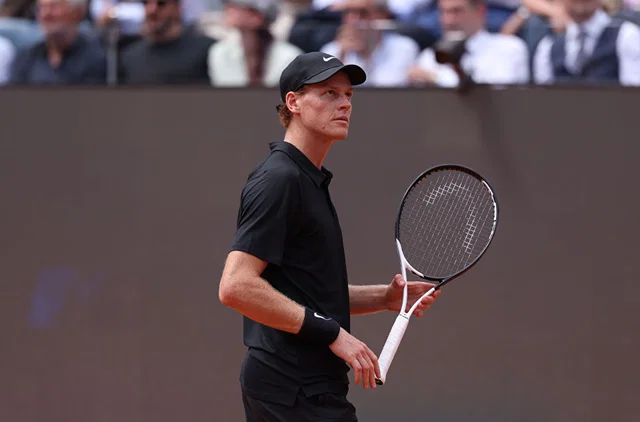
Jannik Sinner‘s doping case has come under renewed scrutiny after American tennis player Jessica Eudovic received a two-year suspension for testing positive for clostebol, the same prohibited substance involved in the Italian star’s case. The International Tennis Integrity Agency (ITIA) announced Eudovic’s sanction on November 19, reigniting debate among tennis fans over how anti-doping penalties are determined and whether players have been treated consistently.
Eudovic’s suspension is scheduled to end on November 20, 2027. Although an independent tribunal accepted that her anti-doping violation was unintentional, it concluded that there was insufficient evidence to establish how clostebol entered her body. The decision has prompted criticism from fans, many of whom have compared her punishment with the three-month suspension Sinner served in 2025.
Reactions on social media have centred on the difference between the two sanctions. Some fans have questioned why Eudovic received two years while Sinner avoided a lengthy absence from competition. However, the cases involved different evidence, and the circumstances surrounding the alleged contamination played a significant role in the respective decisions.
Jessica Eudovic receives two-year suspension for clostebol violation
The ITIA announced Eudovic’s suspension following an independent tribunal hearing that lasted two days in October. The tribunal accepted that the American player had not intentionally committed an anti-doping violation. It considered the very low concentration of clostebol detected in her sample, the circumstances surrounding the case and the evidence she presented.
However, accepting that a violation was unintentional did not automatically mean that the tribunal could reduce the punishment further. Eudovic was unable to establish how the prohibited substance entered her body, which became a decisive factor in the ruling.
She had also used the ITIA’s product-testing fund in an attempt to identify a possible source of contamination. Despite those efforts, she could not establish a credible explanation for the presence of clostebol. Without sufficient evidence supporting a specific contamination route, the tribunal found that the rules did not permit an additional reduction in her sanction.
Under the applicable anti-doping framework, a four-year suspension is the standard period for certain violations involving prohibited substances. A two-year sanction can apply when an athlete establishes that the violation was not intentional. Eudovic received that reduced period, but the tribunal did not find grounds to lower it further.
The decision has nevertheless attracted attention because clostebol was also central to Sinner’s doping case. Fans have used the announcement to revisit the differences between the two outcomes and question whether the system delivers consistent treatment to athletes facing similar allegations.
How Jannik Sinner’s clostebol case ended with a three-month ban
Sinner’s case began in March 2024, when two separate samples revealed trace amounts of clostebol metabolites. The positive tests initially raised questions about the world-class Italian player’s involvement in a doping violation. However, an independent tribunal later cleared him of fault or negligence in August 2024 after considering the explanation provided by his team.
According to the explanation accepted by the tribunal, Sinner’s physiotherapist had used a clostebol-containing spray to treat a cut on his own finger. The physiotherapist subsequently massaged Sinner, resulting in what was determined to be an accidental transfer of the substance. The tribunal accepted this account and concluded that Sinner had not intentionally violated the anti-doping rules.
The World Anti-Doping Agency (WADA) subsequently appealed the original decision. The appeal brought renewed uncertainty over the case, despite the initial finding that Sinner bore no fault or negligence. The matter eventually ended with Sinner accepting a three-month suspension, which he served between February and May 2025.
The difference between the cases largely comes down to the evidence available to establish the source of contamination. Sinner’s team provided a specific explanation involving a product, a physiotherapist and a mechanism through which the substance could have entered his body. The tribunal accepted that explanation. Eudovic, meanwhile, could not identify or prove a comparable source despite using the available testing process.
That distinction is central to understanding why the two players received different sanctions. Both cases involved clostebol, but the presence of the same prohibited substance does not automatically make two anti-doping cases legally identical. The circumstances, evidence and applicable rules can lead to different outcomes.
Tennis fans accuse anti-doping authorities of double standards
Eudovic’s two-year suspension quickly became a topic of discussion on X, where tennis fans compared her punishment with Sinner’s three-month ban. Several users argued that the difference was unfair, while others expressed frustration that Sinner did not miss any Grand Slam tournaments during his suspension period.
Some reactions focused directly on the substance involved, with fans questioning whether Sinner had become the public face of the clostebol controversy. Others argued that the Italian should have received a much longer suspension and that members of his team should also have faced consequences.
One fan questioned the apparent difference between the two cases, writing:
“So Sinner is the face of clostebol now?”
Another user highlighted the difference in the length of the suspensions:
“TWO YEARS Jessica, SINNER 3 months. WHY? wake up,”
One particularly critical reaction called for a much longer punishment for the Italian:
“Jannik Sinner should have been banned until 2029. His team should have been banned for life. Just my opinion,”
Other fans focused on the fact that Sinner’s suspension did not prevent him from competing at a Grand Slam tournament:
“Still angry he missed zero grand slams after testing POSITIVE,”
Additional reactions questioned the fairness of the different outcomes:
“And this is fair how?”
“The differential treatment,”
“Sinner ‘cheated’ and should have been banned too,”
These comments reflect the frustration of some supporters, but they represent social media reactions rather than legal findings. The difference in sanctions cannot be assessed solely by comparing the substance detected or the length of each suspension. The evidence presented in each case and the tribunal’s findings remain important parts of the disciplinary process.
Why the two doping cases resulted in different punishments
The central issue separating the Eudovic and Sinner cases is the ability to establish how the prohibited substance entered the athlete’s body. In Sinner’s case, the tribunal accepted a specific contamination explanation involving his physiotherapist’s use of a clostebol spray. That explanation allowed the tribunal to clear him of fault or negligence at the initial stage.
Eudovic’s situation was different. Although the tribunal accepted that her violation was unintentional, she could not identify the source of the substance. Her efforts to investigate possible contamination did not produce sufficient evidence to support a particular explanation. Consequently, the tribunal applied a two-year suspension without granting an additional reduction.
The distinction demonstrates why an unintentional violation and an established contamination explanation are not necessarily treated as the same thing under anti-doping rules. An athlete may convince a tribunal that there was no intention to dope but still be unable to demonstrate how the prohibited substance entered their system.
For that reason, the two-year sanction imposed on Eudovic was a reduced punishment compared with the standard four-year period described in the applicable rules. Sinner’s case, meanwhile, followed a different legal path after the tribunal accepted the contamination explanation and WADA subsequently appealed the original decision.
Although fans may continue to debate whether the outcomes were fair, the available case details show that the tribunals considered different evidence. The comparison has nevertheless renewed calls among supporters for greater clarity and transparency in how anti-doping cases are assessed.
Jannik Sinner’s Australian Open 2027 participation in doubt
While the doping debate has returned to the spotlight, Sinner is also facing uncertainty over his return to professional tennis. The Italian has not competed since July 12, when he defeated Alexander Zverev in four sets to defend his Wimbledon title and secure his fifth Grand Slam championship.
Following that victory, Sinner was expected to continue his season on the North American hard-court circuit. However, a knee injury forced him to withdraw from the Canadian Open. Many supporters initially expected him to recover in time for the remaining tournaments, including the US Open, but his condition did not improve sufficiently.
He subsequently withdrew from the US Open and eventually decided to end his 2026 season. The extended absence has raised questions about his fitness and whether he will be ready for the opening Grand Slam of the following year.
Sinner has reportedly continued to undergo medical evaluations as he attempts to understand the source and extent of his knee problems. His initial hope was to return in time for the Australian Open 2027, but recent reports from Italian media have raised doubts about that possibility.
According to those reports, the pain has persisted and a possible lateral meniscus problem is suspected. Surgery has reportedly not been ruled out, although no definitive outcome has been established in the supplied information. Whether or not an operation becomes necessary, Sinner is understood to be avoiding unnecessary pressure to accelerate his recovery.
Missing the Australian Open would be a significant setback for the Italian, particularly given his record at the tournament. It would also change the competitive landscape of the men’s singles draw by removing one of the leading contenders for the title.
Sinner’s Australian Open record makes his possible absence significant
The Australian Open holds particular importance in Sinner’s career because it was the venue where he captured his first Grand Slam title. In the 2024 final, he produced a remarkable comeback against Daniil Medvedev after losing the opening two sets.
Medvedev initially took control of the match with 6-3, 6-3 set victories. Sinner responded by raising his level and winning the next three sets 6-4, 6-4, 6-3 to complete an impressive comeback and claim his maiden major championship.
He returned to the final in 2025 and successfully defended his title by defeating Alexander Zverev. The victory established his position as a two-time consecutive Australian Open champion and extended his impressive run at Melbourne Park.
However, his attempt to win a third consecutive title ended in the 2026 tournament. Novak Djokovic defeated Sinner in an epic five-set semifinal, bringing his two-year reign as Australian Open champion to an end.
If Sinner is unable to compete in 2027, the tournament would lose one of its most prominent title contenders. His absence would also create an opportunity for other leading players to strengthen their chances of winning the opening major of the season.
What happens next for Sinner?
For now, Sinner’s immediate priority is recovering from his knee problem rather than setting an aggressive return date. The possibility of a lateral meniscus issue and the reports suggesting that surgery remains an option have added uncertainty to his preparations for the 2027 season.
His medical situation will determine whether he can return in time for the Australian Open. Until there is greater clarity about the injury and his recovery timeline, his participation in Melbourne remains uncertain rather than officially ruled out.
At the same time, the Eudovic suspension has brought renewed attention to the different outcomes in high-profile clostebol cases. While fans continue to question the contrast between the two punishments, the legal distinction rests on the evidence each player provided and the findings reached by the relevant tribunal.
The debate is likely to continue as supporters examine the decisions and their implications for tennis’s anti-doping system. For Sinner, however, the immediate challenge is returning to full fitness and determining whether he can defend his place among the sport’s leading players at the start of the 2027 season.
For breaking news and live news updates, like us on Facebook or follow us on Twitter and Instagram. Read more on Latest Sports on thefoxdaily.com.






COMMENTS 0