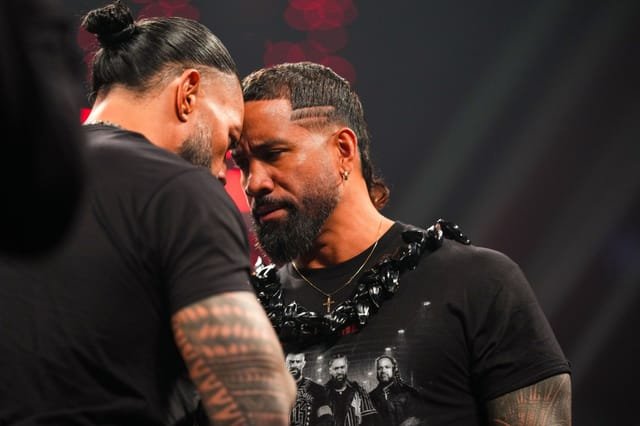
Jey Uso WWE RAW became one of the biggest talking points of the show after WWE heavily edited footage of the former world champion during a shocking opening attack. Jey and Jimmy Uso were targeted before RAW had even properly begun, and the broadcast went further than simply cutting away from the violence.
Jey’s entire face was blurred during the footage, while visible blood was also censored. Jimmy Uso’s portion of the attack was treated differently, with WWE freezing the moment of impact when he was slammed onto the glass of a vehicle and showing him only afterward.
The unusual presentation immediately stood out because WWE has historically used different approaches when broadcasting physical angles involving blood or potentially graphic moments. The latest RAW therefore raised an interesting question about how WWE is adapting its presentation for its Netflix audience.
The Usos were attacked before RAW began
The chaos started before the main RAW broadcast could fully get underway.
Jimmy Uso and Jey Uso arrived at the arena, only to be confronted by the newly formed faction involving Royce Keys and OTM. The attack quickly escalated, leaving both members of The Usos down in the parking area.
Jey appeared to be bleeding after being attacked and shoved against a vehicle. The footage showed blood falling from his face, but WWE subsequently blurred his entire face during the broadcast.
The censorship was so extensive that Jey’s facial features were almost completely hidden. Viewers could identify him through his clothing, build and other recognizable characteristics, but his face itself was deliberately obscured.
Why WWE blurred Jey Uso’s entire face
The most noticeable aspect of the segment was not simply that WWE avoided showing graphic imagery. Instead, the company appeared to remove almost the entire visual identity of Jey’s face.
That made the sequence look dramatically different from a conventional wrestling attack angle.
WWE regularly uses camera cuts, replays and selective framing when a scene becomes particularly intense. In this case, however, the use of digital blurring made the censorship impossible to miss.
The approach also affected the way viewers experienced the angle. Rather than allowing the audience to see the full aftermath of the attack, the broadcast directed attention toward the fact that certain imagery had been deliberately hidden.
That can sometimes create an unintended effect: censorship itself becomes part of the story.
Jimmy Uso’s attack was edited differently
Jey was not the only Uso affected by the broadcast editing.
Jimmy Uso was also attacked during the same sequence. OTM picked him up and slammed him onto the glass of a vehicle in a particularly violent-looking moment.
However, WWE did not show the complete impact in the same way viewers might normally expect from a wrestling replay.
The broadcast froze or avoided the crucial moment and instead showed Jimmy afterward as he lay on the ground.
This created a clear distinction between the two attacks. Jey’s face and blood were digitally obscured, while Jimmy’s impact was largely communicated through editing and aftermath footage.
Jacob Fatu arrived to help the Usos
The attack eventually brought Jacob Fatu into the situation.
Fatu arrived carrying a pipe and attempted to intervene against the attackers. By that point, however, Jey and Jimmy had already taken significant punishment.
The appearance of Fatu added another layer to the angle because it connected the attack to the broader family dynamics surrounding The Usos and the current WWE landscape.
Rather than being a simple backstage confrontation, the segment immediately established a serious conflict that could have consequences for upcoming RAW storylines.
WWE replayed the attack—but kept the censorship
One of the more notable decisions came later when WWE showed a replay of the attack.
Replays are usually used in wrestling to give viewers another look at an important moment. They can also help build a storyline by emphasizing what happened and why a feud has escalated.
In this case, the replay showed more context surrounding the attack, including Jey being dragged from the vehicle and Jimmy being slammed onto it.
However, the censored presentation remained.
The fact that the same moments were presented with similar restrictions suggested that the editing was not simply a one-time camera decision during the live broadcast.
Netflix has changed the way WWE is presented
The incident is also notable because WWE RAW is now part of Netflix’s distribution environment, creating a different viewing experience from the show’s previous television presentation.
Over recent months, viewers have noticed instances in which blood or violent imagery has been treated differently during WWE programming.
This matters because professional wrestling depends heavily on visual storytelling. A major attack is supposed to communicate danger, intensity and consequences without requiring excessive explanation.
When certain visuals are removed, WWE has to find other ways to deliver the same message.
Why censorship can actually change a wrestling storyline
There is an interesting storytelling consequence to WWE’s decision.
Violence in professional wrestling is generally designed to make the audience understand that a character has suffered a serious setback. Blood, visible impact and reactions can reinforce that message.
If those elements are hidden, the performers’ reactions and the surrounding commentary become more important.
In the Usos’ case, WWE still communicated that the attack was serious through the aftermath. Jey was shown injured, Jimmy was left on the ground and Jacob Fatu was motivated to intervene.
The audience therefore received the essential narrative information without seeing every part of the attack.
From a production perspective, this is a useful example of how WWE can maintain the storyline while reducing the amount of graphic imagery shown to viewers.
The new faction immediately gets major attention
The attack also served another purpose: it gave the newly formed faction an immediate impact.
Royce Keys and OTM did not simply appear as another group on RAW. By attacking two established WWE stars before the show even properly started, they instantly positioned themselves as a serious threat.
For a new faction, that kind of introduction can be valuable.
Wrestling audiences quickly judge new groups based on presentation. A dominant debut can establish credibility faster than weeks of promotional material.
Targeting Jey and Jimmy Uso also gives the storyline an emotional element because the Usos are among WWE’s most recognizable tag-team names.
What this could mean for Jey Uso’s RAW storyline
The attack creates several possible directions for Jey Uso.
First, WWE can use the incident to build a revenge storyline. Jey could return to confront the people responsible, potentially leading to singles matches or a larger faction conflict.
Second, the attack could strengthen the relationship between Jey and Jimmy, especially if the angle is designed to reunite or further develop their tag-team story.
Third, Jacob Fatu’s involvement could expand the conflict into a wider storyline involving multiple members of the wrestling family.
At this stage, the most important development is that the attack has established a clear reason for future confrontation.
The bigger WWE production question
The most interesting part of the segment may ultimately be the changing balance between realism and broadcast standards.
WWE wants its major attacks to feel dangerous because that helps audiences become emotionally invested. At the same time, the company has to consider how those moments appear across different platforms and audiences.
Netflix gives WWE a global distribution platform, meaning presentation decisions can receive immediate attention from viewers across different markets.
The Jey Uso segment demonstrates one possible solution: preserve the storyline and aftermath while digitally limiting the most graphic imagery.
Whether viewers prefer this approach is a separate question.
WWE’s approach compared with traditional wrestling broadcasts
| Element | Traditional presentation | Jey Uso RAW segment |
|---|---|---|
| Visible blood | Could remain visible depending on the segment | Blood was censored |
| Facial imagery | Normally shown clearly | Jey’s entire face was blurred |
| Impact moment | Often shown during replays | Jimmy’s impact was heavily edited |
| Replay | Used to emphasize major moments | Replay retained censorship |
| Storytelling | Relies heavily on visual impact | Used aftermath and reactions to communicate severity |
Why the censorship itself became news
There is an ironic element to the entire situation.
WWE attempted to reduce the visibility of the violent imagery, but the unusual editing made the segment more noticeable to viewers.
When an entire face is digitally blurred during a major wrestling segment, fans naturally wonder why that specific presentation was chosen.
That means the censorship can become a talking point separate from the storyline itself.
From a media perspective, this is an important lesson: hiding an image does not necessarily make the moment less memorable. Sometimes the editing draws even more attention to what the audience is not being shown.
What happens next for The Usos?
The next stage of the storyline will determine whether the attack becomes a short-term RAW angle or the beginning of a larger feud.
Jey Uso has enough established credibility to turn the incident into a significant singles storyline, while Jimmy’s involvement creates the possibility of a tag-team response.
Jacob Fatu’s intervention also provides WWE with another potential avenue. His presence could turn a straightforward revenge angle into a larger confrontation involving several wrestlers.
The newly formed faction now has momentum, while the Usos have an obvious reason to fight back.
Conclusion
Jey Uso WWE RAW became a major talking point because of both the attack itself and WWE’s unusual decision to censor the footage.
Jey and Jimmy Uso were targeted in a parking-lot assault involving Royce Keys and OTM, while Jacob Fatu later arrived to help. Jey’s face and visible blood were blurred, while Jimmy’s impact against a vehicle was heavily edited.
The decision highlights how WWE is adapting its presentation in the Netflix era, particularly when it comes to violent or graphic wrestling footage.
From a storyline perspective, the attack successfully established the new faction as a threat and created an obvious path toward a future confrontation with the Usos.
Whether the censorship becomes a regular feature of WWE programming remains to be seen. For now, though, one thing is clear: an attempt to hide the most graphic parts of the attack has made the segment itself impossible for fans to ignore.
For breaking news and live news updates, like us on Facebook or follow us on Twitter and Instagram. Read more on Latest Sports on thefoxdaily.com.






COMMENTS 0