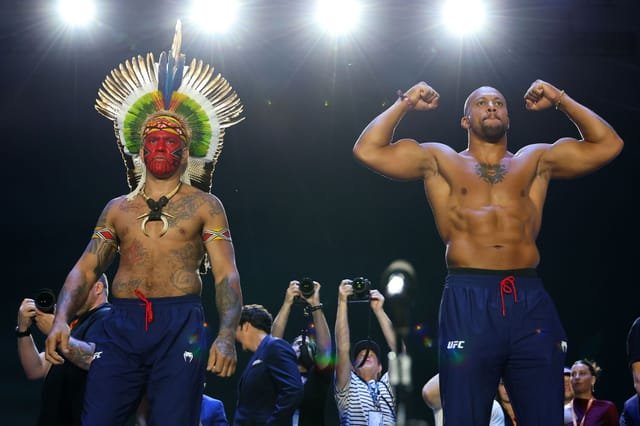
Few results at UFC Freedom 250 generated as much discussion as Ciryl Gane’s second-round TKO win over Alex Pereira in the co-main event. Entering the fight as the betting favorite, Pereira had an opportunity to make history by becoming the first fighter to capture UFC titles in three different weight classes.
Instead, Gane delivered a composed and tactical performance that earned him the interim heavyweight championship for a second time and reshaped the division’s title picture.
While fans and analysts debated what the result means for the future of the heavyweight division, fellow UFC heavyweight Josh Hokit added another layer to the conversation by questioning some of Gane’s tactics and highlighting potential flaws in Pereira’s approach to moving up in weight.
Why Josh Hokit Believes Ciryl Gane Crossed the Line
Watching the fight backstage after securing a victory of his own over Derrick Lewis, Hokit focused on a sequence during which Pereira attempted to return to his feet while Gane maintained pressure on the ground.
According to Hokit, several of Gane’s strikes appeared to land to the back of Pereira’s head—a prohibited target area under the Unified Rules of Mixed Martial Arts.
“Ciryl Gane’s beating Pereira. Elbows to the back of the head. He’s hitting him in the back of the head.”
Strikes to the back of the head are considered illegal because of the increased risk of serious injury. Referees are instructed to warn fighters or intervene if they believe repeated fouls are occurring.
However, distinguishing between legal and illegal strikes during fast-paced grappling exchanges can be challenging. The angle of a fighter’s movement, hand positioning, and body rotation often make such calls difficult in real time.
As of now, no official protest or disciplinary action has been announced regarding Gane’s performance.
Ciryl Gane’s Reputation for Controversial Moments
Hokit also referenced Gane’s previous bout against Tom Aspinall, in which the Frenchman faced criticism from some fans for an accidental eye poke.
While there is no evidence to suggest intentional wrongdoing, repeated incidents can shape public perception.
“Ciryl Gane’s known for his little cheap shots, I guess. His eye pokes. He’s gonna eye poke him in a second.”
Combat sports history shows that fighters can quickly develop reputations—fairly or unfairly—based on isolated incidents. Once a narrative gains momentum among fans, every future exchange tends to be examined more closely.
For Gane, the scrutiny may intensify as he prepares for another high-profile heavyweight title fight.
How Ciryl Gane Neutralized Alex Pereira’s Strengths
Despite the controversy, Gane deserves significant credit for executing an effective game plan.
The former interim champion avoided prolonged striking exchanges, mixed his attacks intelligently, and used his movement to prevent Pereira from establishing rhythm.
Most importantly, Gane forced Pereira to work at a pace and in positions unfamiliar to him.
Pereira’s success across multiple divisions has been built on elite kickboxing fundamentals, devastating power, and exceptional timing. However, heavyweight introduces a completely different set of challenges.
Gane’s speed, footwork, and athleticism at over 250 pounds highlighted just how unique elite heavyweights can be.
- Superior cage movement
- Efficient cardio for a larger athlete
- Strong defensive grappling
- Ability to seamlessly switch ranges
- Experience against natural heavyweights
These attributes allowed Gane to dictate the pace and eventually secure the finish.
Did Alex Pereira Add Too Much Weight?
While many expected Pereira’s power to translate effectively to heavyweight, Hokit believes the Brazilian may have made a critical mistake during his physical preparation.
“I think Pereira gained a little too much weight. You need to be light, something you’re used to.”
According to Hokit, simply adding muscle mass is not always the optimal strategy when moving to a heavier division.
Fighters who rise through weight classes must strike a careful balance between increased power and maintaining the speed, mobility, and endurance that made them successful in the first place.
Excessive weight gain can negatively impact:
- Reaction time
- Footwork and movement
- Cardiovascular endurance
- Recovery between exchanges
- Defensive awareness
Pereira’s striking success has traditionally relied on precision and timing rather than sheer size. Carrying additional weight could potentially diminish those advantages.
The Hidden Challenges of Moving to Heavyweight
Pereira’s pursuit of a third UFC title reflects the growing trend of elite fighters chasing multi-division success.
However, heavyweight remains one of the most difficult divisions to enter successfully.
Unlike lighter weight classes, where skill advantages can often compensate for physical disparities, heavyweight competition amplifies every attribute.
Speed, durability, power, and grappling strength all increase dramatically.
Natural heavyweights spend years adapting their bodies and techniques to operate efficiently at higher weights. Fighters moving up from smaller divisions must adjust not only physically but strategically.
History shows that successful transitions require patience and careful planning.
| Key Factor | Challenge for Moving Up | Importance at Heavyweight |
|---|---|---|
| Speed | Can decrease with added muscle mass | Essential for defense and counterstriking |
| Cardio | Higher body weight demands more energy | Critical in later rounds |
| Power | Usually increases naturally | Every exchange carries knockout risk |
| Grappling | Requires adapting to stronger opponents | Major factor in controlling fights |
| Durability | Heavier strikes absorbed regularly | Vital for long-term success |
Josh Hokit Sees Opportunity in the Division
Beyond his analysis, Hokit also made it clear that he views Pereira as a potential future opponent.
With Gane expected to face undisputed champion Tom Aspinall in a title unification bout, Hokit believes there could be an opening for him to fight the Brazilian.
“If Aspinall is going to come back and Ciryl Gane fights Aspinall, I’ll fight Pereira still.”
The statement underscores the growing interest surrounding Pereira’s heavyweight future.
Even in defeat, the Brazilian remains one of the UFC’s biggest stars, making him an attractive matchup for contenders looking to raise their profile.
What’s Next for Ciryl Gane and Alex Pereira?
Gane’s victory likely sets up a highly anticipated rematch against Tom Aspinall to determine the undisputed heavyweight champion.
The first meeting between the two generated significant interest, and Gane’s recent performances suggest he has evolved considerably since then.
As for Pereira, the path forward is less clear.
He must now decide whether to continue pursuing heavyweight ambitions or return to a division where he has already established championship success.
Regardless of his decision, UFC Freedom 250 demonstrated that moving up in weight is about far more than adding pounds on a scale.
Conclusion
Josh Hokit’s comments following UFC Freedom 250 highlighted two of the event’s biggest talking points: the legality of some of Ciryl Gane’s strikes and the challenges Alex Pereira faces as a heavyweight contender.
While questions about Gane’s tactics will continue to spark debate among fans, his performance showcased the skill set that makes him one of the division’s most dangerous fighters.
For Pereira, the defeat serves as a reminder that success across multiple weight classes requires more than championship credentials—it demands careful adaptation.
The heavyweight division remains one of the UFC’s most unpredictable landscapes, and both fighters are likely to remain central figures in its future.
For breaking news and live news updates, like us on Facebook or follow us on Twitter and Instagram. Read more on Latest Sports on thefoxdaily.com.






COMMENTS 0