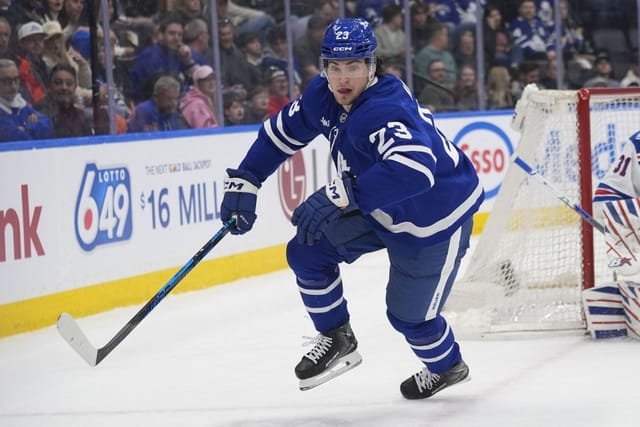
Matthew Knies trade rumors have continued to circulate around the Toronto Maple Leafs, creating questions about whether the young forward could become part of a major deal.
Toronto sports host Sid Seixeiro has offered a different interpretation of the speculation. Rather than viewing Knies’ repeated appearance in trade conversations as evidence that the Maple Leafs want to move him, Seixeiro believes it demonstrates how highly other teams may regard the 23-year-old.
Knies is entering an important stage of his career after producing 66 points in 79 games last season. He is also tied to a long-term contract that gives Toronto considerable control while making him an attractive potential asset in discussions involving established NHL talent.
That combination of production, age, contract term and team control explains why Knies’ name can naturally surface whenever Toronto discusses roster changes.
Why Matthew Knies keeps appearing in Maple Leafs trade rumors
Seixeiro’s argument is built around the fundamentals of NHL roster construction.
Knies currently has five years remaining on his contract, according to the discussion surrounding the rumors. His deal also includes a $7.75 million cap hit, while his trade protection is limited during the earlier portion of the agreement.
From an opposing general manager’s perspective, that makes Knies an obvious player to ask about if Toronto enters serious trade discussions.
A young forward who has already demonstrated strong offensive production and remains under contract for multiple seasons can carry substantial trade value. Even if the Maple Leafs have no intention of moving him, other clubs can still ask whether he is available.
That distinction is central to Seixeiro’s assessment.
His view is that trade interest in Knies should not automatically be interpreted as criticism of the player or dissatisfaction from Toronto. Instead, it can be viewed as evidence that rival teams recognize his value.
Sid Seixeiro: “It’s a compliment, not a rip”
Seixeiro summarized his position by saying the continued speculation is “a compliment, not a rip.”
The point is relatively simple: NHL teams do not usually ask about players they believe have little value.
If Toronto’s front office is discussing potential trades with another organization, an opposing general manager could reasonably ask about Knies because of his age, production and contract situation.
That does not mean a trade is imminent.
In fact, it may mean the opposite. A player can be highly desirable to other teams while remaining extremely important to his current organization.
| Matthew Knies Detail | Current Situation |
|---|---|
| Team | Toronto Maple Leafs |
| Age | 23 |
| Contract length | 6 years |
| Contract value | $46.6 million |
| Cap hit | $7.75 million |
| Remaining term discussed | 5 years |
| Previous-season games | 79 |
| Previous-season points | 66 |
Knies’ 66-point season strengthens his trade value
The most obvious reason for the growing interest in Knies is his recent production.
The 23-year-old finished last season with 66 points in 79 games, scoring 23 goals and adding 43 assists.
Those numbers provide Toronto with an important asset: a relatively young forward who has already shown he can contribute consistently at the NHL level.
Production also changes the nature of trade speculation. A developing player with limited NHL results can be considered a prospect, but a 23-year-old coming off a 66-point campaign can be viewed as an established contributor with additional upside.
That combination makes Knies particularly interesting in hypothetical trade scenarios.
Toronto would therefore have to weigh two different forms of value. The first would be the immediate return from trading him. The second would be the value of keeping a productive young forward under contract for several seasons.
Why the Maple Leafs may not want to trade Knies
There is an important strategic reason for Toronto to hold onto Knies even if rival teams express serious interest.
Players in their early 20s who are already producing at a strong level can become foundational pieces of a roster. Trading such a player means giving up not only current production but also the opportunity to benefit from future development.
Knies’ age is therefore one of the strongest arguments for keeping him.
The Maple Leafs also know exactly what type of player they have in their system. Any trade would introduce uncertainty because Toronto would need to evaluate whether the incoming player could provide greater overall value than Knies over the same period.
That does not mean the Maple Leafs should automatically reject every offer. A sufficiently strong return, particularly for an area of the roster that needs improvement, could change the calculation.
But the existence of trade rumors alone is not enough to suggest Toronto is actively shopping him.
Could Matthew Knies be part of a blockbuster trade?
Knies’ contract makes him an intriguing name in any hypothetical blockbuster involving Toronto.
The Maple Leafs have repeatedly been connected with discussions about roster balance, particularly when it comes to improving their overall competitiveness. If the organization decides that a major move is necessary, a young player with significant trade value could naturally become part of the conversation.
However, there is a major difference between being asked about a player and actually offering that player in a trade.
Seixeiro’s comments focus on that difference. If Toronto is involved in talks for a defenseman or another major roster piece, the opposing team may ask whether Knies is available because he is one of the organization’s valuable young assets.
Toronto can simply say no.
That is why the frequency of Knies-related rumors should be treated carefully. Without confirmation of an active negotiation involving the forward, the speculation remains just that: speculation.
Knies’ contract gives Toronto flexibility
Another important factor is the structure of Knies’ contract.
He is signed for six years at $46.6 million, creating an annual cap hit of $7.75 million. The remaining term gives Toronto several seasons of cost certainty.
For a team operating under a salary cap, predictable contracts can be extremely valuable.
Toronto knows how much space Knies will occupy and can build the rest of the roster around that figure. The organization also has time to evaluate whether his production continues to rise.
From a trade perspective, the same contract can make him attractive to other teams because a potential acquiring club would not necessarily be taking on a short-term rental.
That combination of term and production helps explain why Knies can remain part of trade conversations even if Toronto considers him a long-term piece.
| Keep Knies | Trade Knies |
|---|---|
| Retain a 23-year-old productive forward | Potentially acquire an immediate roster upgrade |
| Benefit from continued development | Convert young-player value into another position of need |
| Maintain five years of contract control | Risk losing future production |
| Avoid disrupting team chemistry | Potentially improve roster balance through a major deal |
What would make a Knies trade worthwhile?
If Toronto ever seriously considers moving Knies, the return would likely need to address a significant weakness rather than simply provide short-term value.
The Maple Leafs would need to compare Knies’ projected future contribution with the player or assets coming back.
A deal could make sense if Toronto receives an established difference-maker who fills a major roster need while also fitting its salary structure. But a trade that merely creates movement without improving the team’s overall outlook would carry considerable risk.
This is why young players with strong contracts are often difficult to evaluate in trade discussions. Their value is not limited to what they can provide this season.
Knies potentially represents several years of NHL production, and Toronto would have to place a value on that future contribution before making a decision.
The bigger picture for Toronto
The Knies speculation also reflects the wider pressure surrounding the Maple Leafs.
Toronto is one of the NHL’s most closely watched organizations, meaning even routine roster discussions can quickly become major stories.
When a young player produces 66 points and carries a substantial but manageable contract, other teams are naturally going to be interested. In Toronto, that interest can quickly turn into trade speculation.
For the Maple Leafs, the challenge is separating genuine roster opportunities from noise created by the market.
Knies appears to sit directly in the middle of that conversation because he is valuable enough to attract interest but young enough that trading him could have long-term consequences.
Sid Seixeiro also criticizes Ottawa’s Brady Tkachuk tribute plans
While discussing Knies and the Maple Leafs, Seixeiro also addressed another Canadian hockey storyline involving former Ottawa Senators captain Brady Tkachuk.
The Senators are reportedly planning a video tribute for Tkachuk when he returns to Canadian Tire Centre on October 21 as a member of the Florida Panthers.
Seixeiro strongly disagreed with the idea of honoring Tkachuk in that manner, arguing that the circumstances surrounding his departure from Ottawa should influence how the organization approaches the return.
Tkachuk requested a trade earlier this summer after spending eight seasons in Ottawa. His departure followed the Senators’ first-round playoff elimination by the Carolina Hurricanes.
As a result, his first appearance back in Ottawa is expected to attract significant attention.
Why the Tkachuk situation is different from Knies’ rumors
The two stories highlight two very different types of NHL speculation.
Knies’ situation centers on perceived trade value and whether another team could convince Toronto to move a young, productive player. Tkachuk’s return to Ottawa is instead about the relationship between a former franchise player and the fan base after a requested trade.
| Storyline | Main Question |
|---|---|
| Matthew Knies | Could Toronto trade a young, productive forward? |
| Brady Tkachuk | How will Ottawa fans react to his return? |
| Knies’ situation | Focused on future roster construction |
| Tkachuk’s situation | Focused on his relationship with his former team and supporters |
What should Maple Leafs fans make of the Knies rumors?
For now, fans should avoid treating every mention of Knies as evidence that Toronto is preparing to trade him.
The more useful interpretation is that Knies has become valuable enough to be included in hypothetical discussions involving the Maple Leafs.
That is exactly the point Seixeiro was making. If opposing teams ask about a player, it can indicate that they recognize something valuable in that player.
The next step would be identifying whether there is a legitimate trade framework involving Knies. Until that happens, the rumors should be viewed as part of the normal NHL trade conversation rather than proof of an impending move.
Final verdict
Matthew Knies trade rumors may sound concerning to Maple Leafs supporters, but Sid Seixeiro believes the repeated speculation should actually be interpreted as recognition of the forward’s value.
Knies is only 23, is coming off a 66-point season and has multiple years remaining on a significant contract. Those factors make him a logical player for rival general managers to ask about whenever Toronto explores major trades.
At the same time, none of that establishes that the Maple Leafs want to move him.
Toronto must ultimately decide whether the return from a potential trade would be more valuable than keeping a young forward who has already demonstrated strong NHL production and still has room to develop.
For now, Seixeiro’s interpretation offers a useful perspective: when Matthew Knies’ name appears in trade rumors, it may say more about how other teams value him than about Toronto’s desire to let him go.
For breaking news and live news updates, like us on Facebook or follow us on Twitter and Instagram. Read more on Latest NHL on thefoxdaily.com.






COMMENTS 0