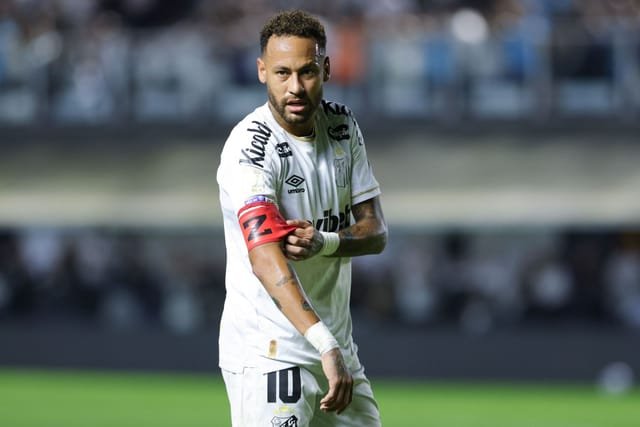
Neymar to Inter Miami has emerged as an intriguing possibility as the Brazilian star approaches the end of his Santos contract, but former Manchester United forward Giuseppe Rossi believes Major League Soccer must consider more than the marketing value of such a move.
Neymar has been linked with a reunion with Lionel Messi and Luis Suarez at Inter Miami, potentially bringing together three members of Barcelona’s famous attacking trio once again. The prospect would immediately generate worldwide interest, particularly because Messi and Suarez are already established figures in MLS.
However, Rossi has questioned whether another global superstar would necessarily help MLS improve as a football league. While acknowledging Neymar’s enormous popularity and ability, he argued that MLS risks prioritizing attention, commercial value and club valuations over the standard of football being produced on the pitch.
The debate arrives at a significant moment for MLS. The league has made considerable progress in attracting internationally recognized players and increasing its global profile, but the next challenge is turning that visibility into sustained sporting credibility.
Why Neymar’s Potential Inter Miami Move Is So Significant
The possibility of Neymar joining Inter Miami is compelling largely because of the history between the Brazilian and the club’s existing stars. Neymar played alongside Messi and Suarez at Barcelona, forming the celebrated MSN attacking partnership between 2013 and 2017.
The trio became one of the most feared attacking units in modern football. Their combination of creativity, movement and finishing helped Barcelona compete successfully across domestic and European competitions.
Reuniting them in MLS would therefore be much more than an ordinary transfer. It would revive one of the most recognizable attacking partnerships of the previous decade while giving Inter Miami an extraordinary global marketing opportunity.
Inter Miami has already transformed its international profile since Messi arrived as a free agent in 2023. The club subsequently added other familiar Barcelona figures, including Suarez, Sergio Busquets and Jordi Alba, while Rodrigo De Paul and Casemiro have also added significant experience to the squad.
Adding Neymar would take that strategy another step further. It would give Inter Miami another player with worldwide recognition and an enormous following, while potentially creating a storyline capable of attracting viewers who might otherwise have limited interest in MLS.
Giuseppe Rossi’s Main Concern Is the Quality of MLS Football
Rossi’s criticism is not primarily about Neymar’s popularity. In fact, he acknowledged that bringing Neymar to Miami would be exciting for fans and could benefit the Brazilian himself.
His concern is what the signing would represent for MLS as a competition.
“This is where MLS are making mistakes, and they continue to make these mistakes. It’s great marketing, it is what it is, but what kind of product are you putting on the field?”
Rossi questioned whether repeatedly pursuing established global stars is the right strategy if MLS ultimately wants to narrow the gap with Europe’s leading domestic competitions.
That argument creates an important distinction between growing the business of a football league and improving the football itself. A competition can become more valuable, more recognizable and more commercially successful without necessarily becoming tactically or technically comparable with Europe’s strongest leagues.
MLS Has Already Changed Its Global Image
There is no question that MLS has made major progress in attracting international stars. David Beckham, Thierry Henry, Andrea Pirlo, Steven Gerrard and Wayne Rooney are among the high-profile names who have played in the competition.
Messi’s arrival, however, represented a different level of global attention. His presence at Inter Miami significantly increased international interest in the club and the league.
The subsequent arrival of former Barcelona teammates strengthened that connection. Inter Miami became associated not only with Messi but also with a particular era of Barcelona football that remains hugely popular worldwide.
From a commercial perspective, the strategy is easy to understand. Major stars attract supporters, media coverage, sponsorship interest and international audiences.
Rossi’s argument is that this should not become the only measure of progress.
The Neymar Question: Marketing Versus Sporting Value
Neymar represents an especially complicated case because his reputation remains enormous even though his recent career has been affected by injuries and periods away from consistent top-level football.
At his peak, Neymar was one of the most technically gifted players in world football. His time at Barcelona demonstrated his ability to combine individual brilliance with elite-level team football.
His partnership with Messi and Suarez was particularly productive. Across all competitions for Barcelona, Neymar scored 105 goals and provided 76 assists in 186 appearances, while helping the club win eight trophies, including the 2014-15 treble.
Those achievements provide a clear explanation for why supporters would be excited by the prospect of seeing him reunited with Messi and Suarez.
The question is whether the Neymar of today can consistently reproduce that level of influence.
Neymar’s Recent Career Adds an Element of Uncertainty
Neymar’s career after Barcelona has been interrupted by injuries, making his long-term availability an important consideration for any potential move.
That does not erase his ability. Even a player whose physical consistency has been affected can possess extraordinary technical quality, creativity and experience.
But a league seeking to improve its sporting reputation needs to consider how much value a player can provide on the pitch rather than simply how much attention his name generates.
This is where Rossi’s criticism becomes more relevant. If Neymar can remain fit and contribute consistently, the move could have both sporting and commercial benefits. If his availability is limited, however, much of the value could come from the publicity surrounding the transfer rather than his contribution during matches.
What Neymar Could Still Offer Inter Miami
Despite his concerns about MLS’s broader strategy, Rossi was positive about Neymar’s individual ability and the possibility of the Brazilian joining Inter Miami.
“It would be great for him, and he’s still a great player. He’s one of the best players of his generation and I think everybody would love to see him play.”
That assessment is important because Neymar’s technical qualities remain relevant regardless of the league in which he plays.
At Inter Miami, he could potentially operate alongside players who understand his style and movement. Messi’s ability to create chances, Suarez’s understanding of attacking spaces and Neymar’s creativity could theoretically provide an extremely difficult combination for opposing defenses.
However, successful football is not built entirely around famous names. The team would still need defensive balance, midfield control, physical availability and tactical structure.
The Barcelona MSN Reunion Would Be Football’s Biggest MLS Story
If Neymar were to join Messi and Suarez, the resulting storyline would be almost impossible for MLS to ignore.
The original Barcelona trio produced a remarkable combination of goals and creativity, with each player bringing a different quality. Messi provided extraordinary creation and finishing, Suarez offered movement and ruthless scoring, while Neymar supplied dribbling, creativity and unpredictability.
Bringing the three together again would not recreate the Barcelona team of the mid-2010s. The players are older, their physical profiles have changed and MLS presents a different competitive environment.
Nevertheless, nostalgia itself has commercial value. Supporters who followed Barcelona during that period would have a reason to watch Inter Miami games, while younger fans could become interested in one of football’s most famous attacking partnerships.
Comparison: Commercial Growth vs Football Development
| Area | Superstar Strategy | Long-Term League Development |
|---|---|---|
| Global attention | Immediately increases interest | Builds gradually through competitive quality |
| Marketing | Strong individual player stories | Strong league-wide identity |
| Fan attraction | Draws supporters of famous players | Encourages supporters to follow clubs and competition |
| Sporting development | Depends on the player’s availability and performance | Requires investment in coaching, academies and infrastructure |
| Long-term impact | Can decline when the star leaves | Can create a sustainable football culture |
This is arguably the central issue behind Rossi’s criticism. Superstar signings can accelerate visibility, but they cannot independently solve every structural challenge facing a football league.
MLS Does Not Have to Choose Between Stars and Development
There is another side to the debate. The argument does not necessarily have to be framed as either signing Neymar or improving the quality of MLS.
A successful league can pursue both objectives simultaneously.
Global stars can bring attention to a competition, while investment in youth academies, coaching standards, scouting, facilities and competitive structures can help convert that attention into sustainable growth.
In that sense, Neymar’s potential arrival could actually be useful if MLS treats the attention surrounding him as a platform rather than the final objective.
The danger would be assuming that one superstar transfer automatically represents progress for the entire league.
What a Neymar-Messi-Suarez Reunion Could Mean for Younger Players
One area that deserves more attention is the potential effect on younger MLS players.
Playing alongside globally experienced footballers can provide young players with access to different training habits, tactical knowledge and professional standards. The value of such experience cannot always be measured by goals or assists.
If Inter Miami can integrate established stars while continuing to develop younger talent, the benefits could extend beyond short-term entertainment.
That would offer a stronger answer to critics who believe MLS relies too heavily on aging international stars. The ultimate test would be whether the league can use those stars to help build its next generation rather than simply replacing one famous name with another.
The Real Challenge for MLS After Messi
Messi’s arrival has created enormous momentum for MLS, but his eventual departure will provide an important test.
If international interest falls sharply once Messi is no longer playing, it could suggest that much of the league’s global attention remains tied to individual personalities.
If MLS can maintain strong audiences, develop competitive clubs and continue producing recognizable players after the current superstar era ends, then the Messi period will have achieved something much more valuable.
This is why the Neymar debate matters. His potential transfer is not just about one player. It raises questions about what MLS wants to become over the next decade.
Prediction: Neymar Could Help MLS, But Only as Part of a Bigger Plan
If Neymar joins Inter Miami and stays healthy enough to play regularly, the immediate benefits would likely be substantial. The reunion with Messi and Suarez would create global headlines and potentially attract new viewers to MLS.
But the long-term sporting value would depend on what happens away from the spotlight.
MLS would need to continue strengthening its football ecosystem, developing domestic talent and ensuring that the league’s competitive identity does not become dependent on celebrity signings.
In other words, Neymar could be a powerful marketing accelerator without being a complete solution to MLS’s footballing ambitions.
Conclusion: Neymar Could Bring Attention, But MLS Needs More Than Attention
Neymar to Inter Miami would be one of the most recognizable transfers in MLS history, particularly because it could reunite the Brazilian with Lionel Messi and Luis Suarez.
Giuseppe Rossi’s warning, however, highlights a bigger issue. MLS has successfully increased its commercial profile and attracted some of football’s biggest names, but continued growth should also be measured by the quality and sustainability of the football being played.
Neymar remains capable of creating spectacular moments, and a reunion with Messi and Suarez would undoubtedly capture the imagination of fans around the world. Yet the strongest outcome for MLS would be to use that attention as a gateway to deeper sporting development.
The next stage of MLS’s evolution will therefore not be defined simply by which superstar arrives next. It will be defined by whether the league can turn superstar-driven attention into a stronger, more competitive and more sustainable football product.
For breaking news and live news updates, like us on Facebook or follow us on Twitter and Instagram. Read more on Latest Football on thefoxdaily.com.






COMMENTS 0