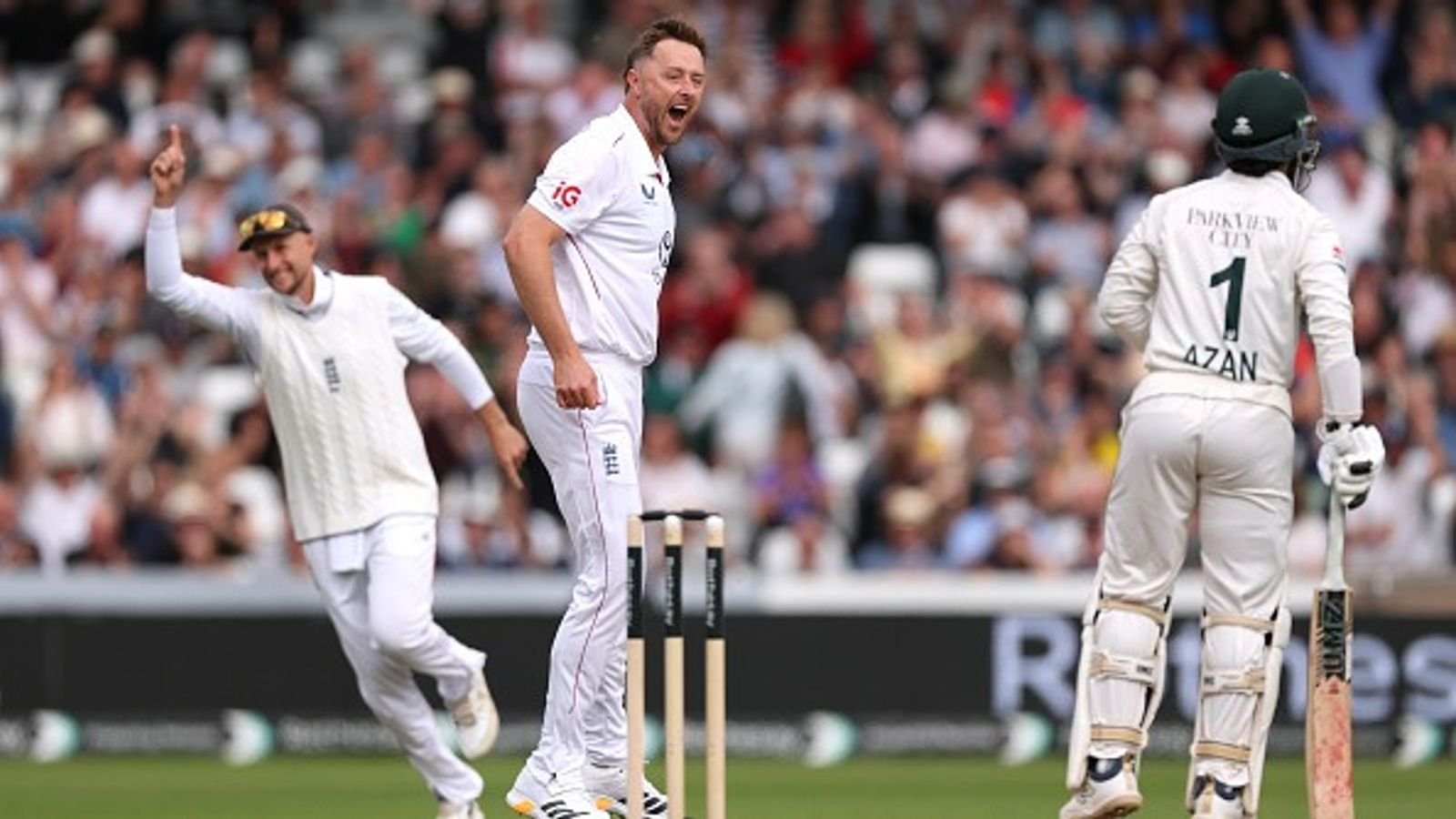
Ollie Robinson‘s first-ball wicket against Pakistan became the headline moment of the opening day at Headingley as England’s fast bowler immediately made an impact in the first Test. After Joe Root won the toss and chose to bowl, Robinson needed just one delivery to give England the breakthrough.
Robinson trapped Pakistan opener Azan Awais leg-before wicket with the opening delivery of the match. Pakistan reviewed the decision, but the dismissal stood, allowing England to celebrate a remarkable start before Pakistan had even opened its account.
The wicket also placed Robinson in an exclusive piece of Test history. He became only the second bowler to dismiss a Pakistan batter with the first ball of a Test, matching the achievement of Indian legend Kapil Dev, who accomplished the feat against Mohsin Khan in 1983.
Ollie Robinson produces a dream opening delivery
England entered the Test with a clear opportunity to put Pakistan’s inexperienced opening combination under pressure. Root’s decision to bowl first handed the new-ball attack the responsibility of exploiting the early conditions.
Robinson responded immediately.
The England seamer’s opening delivery resulted in an lbw decision against Awais. Pakistan’s decision to review the call did not save the opener, leaving Robinson with a wicket from the very first ball of the match.
For any fast bowler, starting a Test with a wicket is an exceptional achievement. Doing so against Pakistan while opening a major three-match series makes the moment even more significant.
Robinson emulates Kapil Dev after 43 years
The most remarkable part of Robinson’s dismissal was its historical connection to Kapil Dev.
In 1983, Kapil Dev dismissed Pakistan’s Mohsin Khan with the first ball of a Test at Gandhi Stadium in Jalandhar. More than four decades later, Robinson has repeated the same feat against another Pakistan opener.
| Bowler | Opponent | Batter dismissed | Venue | Year |
|---|---|---|---|---|
| Kapil Dev | Pakistan | Mohsin Khan | Jalandhar | 1983 |
| Ollie Robinson | Pakistan | Azan Awais | Headingley | 2026 |
The comparison is particularly special because Kapil Dev is one of India’s greatest fast-bowling all-rounders, while Robinson has been trying to re-establish himself in England’s Test plans.
The two achievements are separated by 43 years, showing just how rarely this particular combination occurs in Test Cricket.
Why first-ball Test wickets are so rare
A Test match gives bowlers five days to take wickets, but the first delivery offers almost no room for error. The bowler has not yet seen how the pitch is behaving, while the batter has not faced a delivery.
Fast bowlers can nevertheless exploit the new ball because the surface is fresh and the ball can move through the air or off the pitch.
The challenge is finding the correct line and length immediately. A delivery that is slightly too wide can simply be left alone, while one that is too short may give the batter enough time to attack.
Robinson found the perfect outcome on his opening delivery, turning the first ball of the Test into an immediate examination for Pakistan.
Headingley adds another historical connection
Robinson’s achievement also carries significance because of the venue.
According to the match report, the first instance of a first-ball Test wicket in England occurred at Headingley a century ago. That makes Robinson’s achievement another memorable chapter in the ground’s long association with Test cricket.
The report also notes that no visiting bowler has taken a wicket with the first delivery of a Test played in England, underlining the rarity of such an opening moment.
Headingley has traditionally been regarded as a venue where fast bowlers can become influential, particularly when conditions offer movement. Robinson’s immediate success fitted that broader pattern.
Robinson strikes again to deepen Pakistan’s problems
The first-ball wicket was not the end of Robinson’s influence.
The England pacer soon removed former Pakistan captain Shan Masood in his third over, giving the hosts another major breakthrough at the top of the order.
Two wickets so early in the innings meant Pakistan had little opportunity to settle into the Test.
For England, it was the ideal beginning. The bowlers were able to attack with a relatively aggressive mindset, while Pakistan’s remaining batters were forced to focus on rebuilding rather than immediately scoring freely.
Joe Root’s decision to bowl first pays immediate dividends
Root’s decision at the toss carried additional significance because this was his first match back as England’s full-time captain, according to the supplied report.
Choosing to bowl first is always a tactical gamble in Test cricket. Captains must balance the possibility of early bowling assistance against the advantage of batting first and putting runs on the scoreboard.
Robinson’s first-ball wicket made Root’s decision look inspired almost instantly.
The captain could now attack Pakistan’s top order with close catchers and maintain pressure while the new ball remained effective.
Pakistan entered the series without Babar Azam
Pakistan’s task was made more complicated by the absence of injured captain Babar Azam at the start of the three-Test series.
The visitors therefore needed their other senior batters to provide stability at the top of the order. Instead, Robinson’s early double strike left Pakistan under pressure before the innings had properly developed.
Early wickets are particularly damaging in Test cricket because they can force the middle order to arrive earlier than planned. That changes the entire rhythm of an innings.
Weather interrupts England’s momentum
England’s strong start was interrupted by the weather, with play halted after only around 50 minutes.
Pakistan reached 23 for 2 before the early stoppage, leaving Abdullah Shafique and Imam-ul-Haq at the crease.
The interruption prevented England from continuing its attack uninterrupted, but it did not erase the significance of Robinson’s opening spell.
For Pakistan, the break offered valuable time to regroup and assess how to counter England’s fast bowlers when play resumed.
Robinson’s comeback gains momentum
Robinson’s performance also needs to be viewed in the context of his return to England’s national setup.
The fast bowler had already impressed during the preceding home series against New Zealand, and his performance against Pakistan continued that positive momentum.
A first-ball wicket is spectacular, but the bigger challenge for a Test bowler is maintaining discipline throughout a long spell. Robinson’s second wicket against Masood suggested that his impact was not simply the result of one fortunate delivery.
His ability to attack both edges of the bat and create pressure with the new ball could become an important weapon for England throughout the series.
What Robinson’s performance means for England
England’s fast-bowling resources have been an important part of the team’s Test strategy, particularly in home conditions.
Robinson’s return gives England another experienced option capable of operating with the new ball and creating movement.
His early wickets also reduce the pressure on the rest of the attack. When a bowler removes key batters early, other bowlers can attack the incoming players rather than waiting for breakthroughs.
That creates a potentially dangerous cycle for the batting side: one wicket increases pressure, and increased pressure can produce another mistake.
The historical comparison with Kapil Dev is about more than numbers
Robinson matching Kapil Dev’s record is an impressive statistical coincidence, but the comparison should not be taken as a claim that the two careers are identical.
Kapil Dev built one of the most influential careers in Indian cricket, combining fast bowling, batting and leadership. Robinson’s career is still being shaped by his performances and fitness.
What connects the two moments is the extraordinary rarity of the achievement.
Both bowlers began a Test against Pakistan with the perfect outcome: a wicket before the opposition had a chance to score.
A first-ball wicket can shape an entire Test
One of the fascinating aspects of Test cricket is how quickly momentum can change.
Had Awais survived the opening delivery, Pakistan’s innings could have developed completely differently. Instead, the immediate wicket placed England on the front foot.
Early wickets also affect the mental approach of the batting side. Openers normally have the job of seeing off the new ball and allowing the middle order to arrive later. When one opener disappears immediately, the remaining batter has to shoulder more responsibility.
That is why Robinson’s first delivery could prove more significant than the single wicket column suggests.
England’s challenge is to maintain the pressure
Despite the brilliant start, England cannot afford to assume that the Test will remain one-sided.
Test matches are long contests, and a strong partnership can quickly neutralize an impressive bowling spell.
Pakistan’s remaining batters will have the opportunity to rebuild once conditions settle, particularly if the weather reduces the number of overs available to England’s seamers.
England’s next objective will therefore be straightforward: convert the early advantage into sustained pressure and prevent Pakistan from recovering.
Conclusion: Robinson creates a moment for the history books
Ollie Robinson’s first-ball wicket against Pakistan was the perfect beginning to England’s Test campaign at Headingley.
By dismissing Azan Awais with the opening delivery, Robinson not only gave England an immediate advantage but also matched a remarkable record previously achieved by Kapil Dev in 1983.
The 43-year gap between the two moments highlights just how unusual the achievement is. Robinson then strengthened England’s position by dismissing Shan Masood soon afterward.
Joe Root’s decision to bowl first therefore received an immediate reward, while Pakistan found itself two wickets down before it could establish any rhythm.
Weather eventually interrupted the contest, but Robinson had already made his mark.
The bigger question now is whether England can transform that spectacular opening into a commanding performance across the Test. If Robinson continues to bowl with the same discipline and aggression, his first-ball strike could become the opening chapter of a much bigger contribution to the series.
For breaking news and live news updates, like us on Facebook or follow us on Twitter and Instagram. Read more on Latest Cricket on thefoxdaily.com.






COMMENTS 0