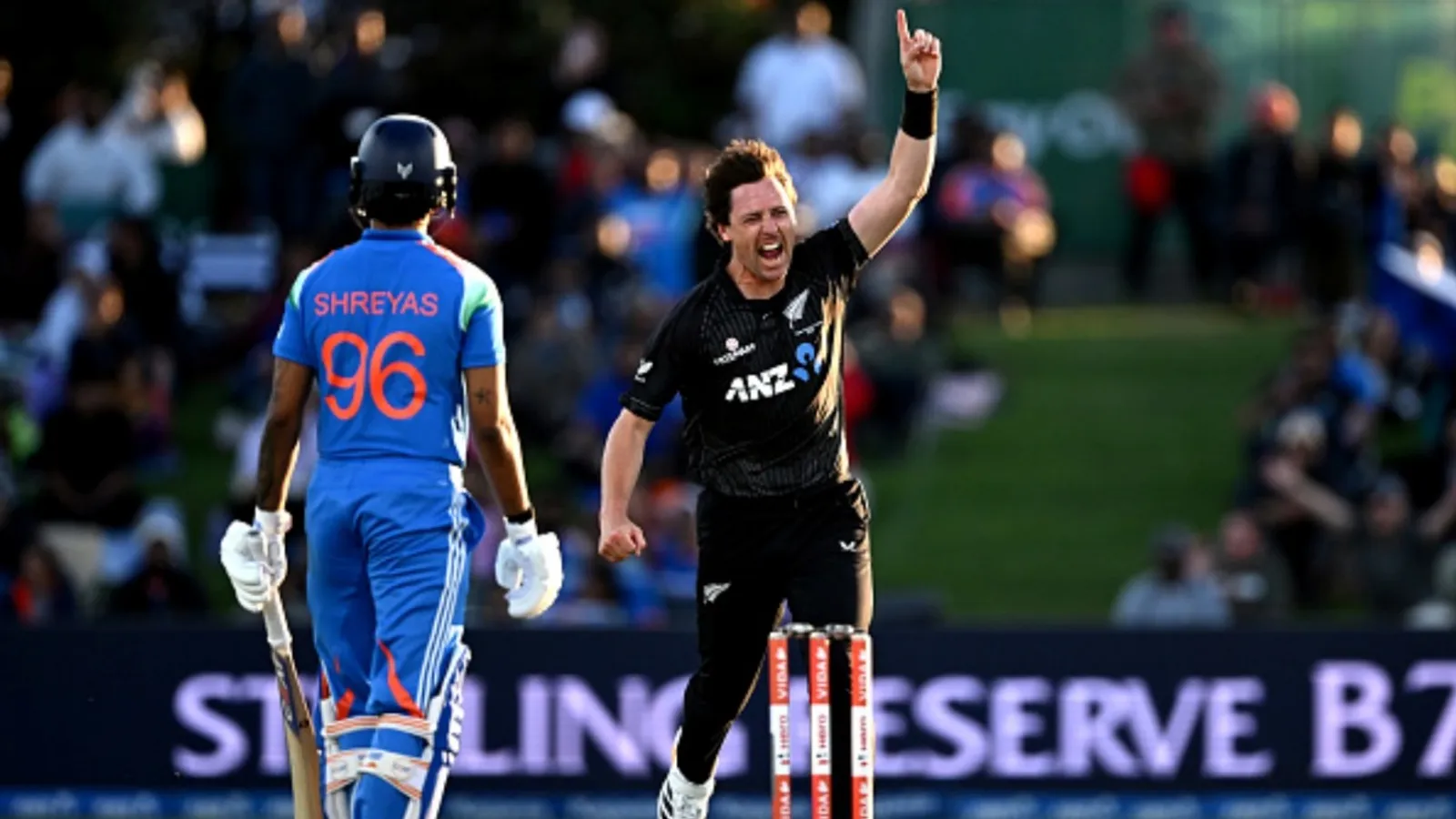
New Zealand produced a dominant performance against India in the fourth ODI, securing a massive 244-run victory at Bay Oval in Mount Maunganui on November 13. Matt Henry delivered a devastating bowling performance, claiming his maiden six-wicket haul in ODI cricket against India as the visitors collapsed for just 89 while chasing 334.
The defeat marked India’s second-heaviest loss in ODI cricket in terms of runs and left Shreyas Iyer with a disappointing result in his first match as ODI captain in the absence of Shubman Gill. New Zealand, meanwhile, kept the five-match series alive after losing two of the opening three matches.
Henry set the tone with a remarkable opening spell, taking three wickets without conceding a run. His performance helped New Zealand dismiss India for their sixth-lowest ODI total and their lowest score in the format since 2019.
Matt Henry Destroys India’s Batting Lineup With Six-Wicket Haul
India’s chase began disastrously when Henry struck with the very first delivery of the innings. Returning after recovering from an injury, the New Zealand fast bowler dismissed Rohit Sharma for a golden duck. He then removed Virat Kohli with a delivery that stayed unusually low before trapping captain Shreyas Iyer in front of the stumps.
The three early dismissals created an unwanted piece of history for Indian cricket. For the first time in ODI history, India lost their first three wickets without scoring a run. Henry’s extraordinary start included a triple-wicket maiden that immediately put New Zealand in control.
Kyle Jamieson added to India’s problems by dismissing Ruturaj Gaikwad. Axar Patel received a reprieve when Nick Kelly dropped a catch at backward point, but India had already lost four wickets for just nine runs in 5.3 overs.
Ishan Kishan and Axar attempted to rebuild the innings, but Matthew Fisher ended their partnership by dismissing Axar for 21 off 36 deliveries. India soon found themselves five wickets down for 53 runs after 17.1 overs.
Henry returned to the attack and removed Kishan, who scored 27 from 53 balls with four boundaries. Fisher then dismissed Auqib Nabi for five, while Henry completed his five-wicket haul by sending Kuldeep Yadav back to the pavilion.
Naman Dhir briefly provided some resistance, hitting Fisher for two consecutive sixes. However, his attempt to keep the innings moving ended when he was dismissed by a short delivery. Dhir scored 21 from 24 balls.
Henry finished the match by dismissing Kumar Kushagra Brar, completing a six-wicket haul and ending India’s innings at 89 in 26.4 overs. His figures underlined the impact of his disciplined bowling and ability to exploit the conditions.
Matthew Fisher Supports Henry With Three Wickets
While Henry led the attack, Matthew Fisher played an important supporting role by claiming three wickets. His dismissals of Axar Patel, Auqib Nabi and Naman Dhir ensured India never recovered from their early collapse.
Jamieson also contributed with the wicket of Gaikwad, leaving India’s middle order under pressure from the beginning. The New Zealand bowlers consistently challenged the batters with deliveries that moved off the surface, making it difficult to establish partnerships.
Henry’s six-wicket performance was particularly significant because it made him the second New Zealand bowler to claim six wickets in an ODI against India since Shane Bond achieved the feat in 2005.
Will Young Scores a Brilliant Century as New Zealand Post 333
Earlier in the match, New Zealand had produced a strong batting performance after Shreyas Iyer won the toss and elected to bowl first. The hosts eventually scored 333 in 50 overs, setting India a challenging target of 334.
Will Young played a leading role with an excellent 125 off 108 deliveries, including 14 fours and four sixes. His innings provided stability throughout the New Zealand batting effort, although he received multiple opportunities after India failed to hold on to important catches.
Auqib Nabi created two chances in his opening over, but Young survived after Rohit Sharma dropped him at first slip and wicketkeeper Ishan Kishan missed another opportunity. Those missed chances allowed the New Zealand batter to continue building his innings.
At the other end, Tim Seifert attacked the Indian bowling and reached his maiden ODI half-century in just 39 deliveries. His aggressive approach helped New Zealand establish an opening partnership worth 85 runs before Brar dismissed him with a short ball.
Seifert scored 58 from 48 deliveries, giving New Zealand a strong start. Young continued to build his innings and reached his half-century from 48 balls.
Finn Allen Adds Momentum to New Zealand’s Batting
After the opening partnership ended, New Zealand continued to score at a healthy rate. Axar Patel dismissed Nick Kelly, while Auqib Nabi removed Dean Foxcroft cheaply. However, Finn Allen ensured that the Indian bowlers could not settle into a rhythm.
Allen scored 41 from 30 deliveries, using his attacking approach to put pressure on the bowling attack. Kuldeep Yadav struggled to contain the New Zealand batters, with Young particularly effective against the spinner through sweeps and reverse sweeps.
Axar eventually broke the partnership by dismissing Allen. Young, meanwhile, continued his impressive innings and reached his fifth ODI century in the 32nd over, taking only 88 deliveries to complete the milestone.
Young’s ability to combine controlled batting with attacking shots helped New Zealand maintain momentum through the middle overs. His century became the foundation of the hosts’ competitive total.
India Continue to Miss Catching Opportunities
India’s fielding problems continued after the dismissal of Allen. Shreyas Iyer introduced Naman Dhir into the attack in the 37th over, and the decision produced an important breakthrough when Dhir dismissed Young for 125.
In the following over, Brar removed James Bracewell, who scored 15 from 20 deliveries, with Dhir completing the catch at deep backward square leg.
However, India missed another opportunity when Rohit dropped Mitchell Santner in the 41st over. Santner took advantage of the reprieve and struck Dhir for two sixes before Arshdeep Singh finally dismissed him for 24 off 29 balls.
New Zealand crossed the 300-run mark in the 46th over. Kristian Clarke contributed 22 from 22 deliveries before Nabi dismissed him. Arshdeep kept the penultimate over tight, conceding no boundaries, while Nabi gave away eight runs in the final over.
Henry and Fisher were run out off the final two deliveries while attempting to get Jamieson on strike. New Zealand were eventually bowled out for 333 in 50 overs.
Shreyas Iyer Admits New Zealand Bowlers Outplayed India
Following the heavy defeat, Iyer acknowledged that India’s missed catching opportunities had affected the team’s performance. He also praised Henry for delivering an outstanding opening spell and making the most of the conditions.
Speaking during the post-match presentation, Iyer said:
“A tough one, I guess, to take that. There was a huge difference in the first innings and the second innings in terms of wicket, but also credit where it’s due, the way Henry bowled in the right areas right from ball one. I think that was sensational,” Iyer said in the post-match presentation.
Iyer explained that India had expected the pitch to remain favourable for batting after New Zealand scored 333. The team believed it could chase the target, but the movement generated by the New Zealand bowlers made the task considerably more difficult.
He also addressed the dropped catches and defended the batters against suggestions that they had thrown their wickets away. Iyer said:
“I think we tried almost everything in the first innings, the way they were playing on the rise. And we thought that the wicket was better to bat on, considering they got 330 after that. Obviously, a couple of dropped catches, but that definitely happens in a game. But yeah, when we got into the dressing room, we thought that we would be cruising through the chase as well. But the way the ball was seaming in and out, you couldn’t basically decide from inside that this is how I’m going to play. Or even if you saw the wickets, no one threw the wicket away. It was good deliveries,” Iyer said after a heavy defeat.
The Indian captain stressed the importance of moving on from the disappointing performance and drawing confidence from the team’s victories in the first two ODIs.
New Zealand Keep ODI Series Alive Ahead of Final Match
The 244-run victory gives New Zealand an important opportunity to level the five-match ODI Series. After losing two of the first three matches, the hosts needed a strong response, and their performance in Mount Maunganui delivered exactly that.
The fifth and final ODI is scheduled to take place at the same venue on November 15. India will look to recover from their batting collapse and finish the series strongly, while New Zealand will aim to carry their momentum into the deciding encounter.
One important factor heading into the final match is the unavailability of Henry and Jamieson, who are set to begin preparations for the upcoming two-Test series. Their absence could influence New Zealand’s bowling combination as the hosts attempt to complete a comeback.
For India, the immediate focus will be on improving their batting approach against movement, taking their fielding chances and avoiding another early collapse. For New Zealand, Henry’s remarkable six-wicket haul and Young’s century have provided the confidence needed to keep the series contest alive.
For breaking news and live news updates, like us on Facebook or follow us on Twitter and Instagram. Read more on Latest Cricket on thefoxdaily.com.






COMMENTS 0