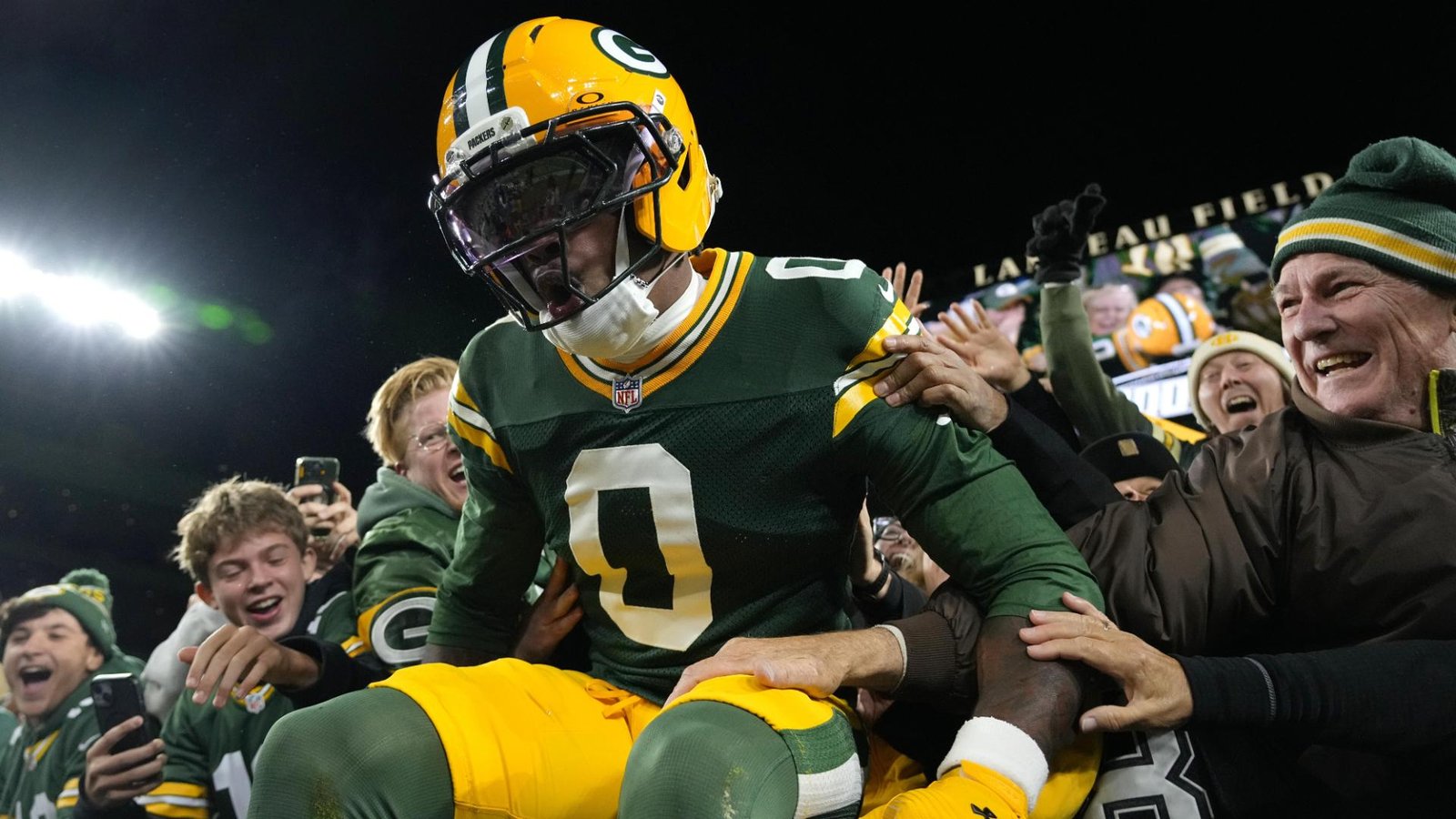
The Green Bay Packers continued their impressive run with a 23-13 victory over the Dallas Cowboys on Sunday night, extending their winning streak to three games and improving their record to 4-2. After opening the season with a disappointing 1-2 start, Green Bay has regained momentum and is emerging as one of the NFL’s hottest teams.
Green Bay’s victory was built on timely defensive turnovers, improved third-down conversions and an effective passing attack led by quarterback Jordan Love. The Packers established an early lead and maintained control throughout the contest, preventing Dallas from mounting a serious comeback.
The defeat marked the Cowboys’ second consecutive loss, dropping them to 2-4 after six games. Dallas struggled to generate consistent offense, committed costly turnovers and continued to experience problems on third down. Although the Cowboys showed some improvement in their pass rush, their overall performance was not enough to challenge a confident Green Bay team.
Unlike last season’s dramatic 40-40 tie between the two teams in Dallas, Sunday’s matchup lacked a late-game thriller. The Packers took control early and capitalized on Dallas’ defensive weaknesses to secure a comfortable 10-point victory.
Packers Improve to 4-2 With Third Consecutive Victory
Green Bay’s latest win represents another positive step after its uneven start to the season. The Packers have now won three straight games, giving them one of the longest active winning streaks in the NFL outside the league’s remaining undefeated teams.
The team’s turnaround has been particularly encouraging because its early-season struggles raised questions about its consistency. Since falling to 1-2, however, Green Bay has found ways to produce results, combining an aggressive passing offense with a defense capable of creating important turnovers.
Against Dallas, the Packers established an early advantage and avoided the kind of mistakes that might have allowed their opponents back into the game. Their ability to convert third downs helped sustain drives, while two first-half interceptions disrupted the Cowboys’ offensive rhythm.
Green Bay did not dominate every aspect of the contest. Its running game remained ineffective, producing just 58 rushing yards despite facing a Dallas defense that entered the game with the league’s worst rushing numbers. Nevertheless, the Packers compensated with their passing attack and defensive playmaking.
The result leaves Green Bay at 4-2 ahead of a significant divisional matchup against the Detroit Lions in Week 7. That game will provide another opportunity for the Packers to demonstrate that their recent success can continue against a challenging opponent.
Jordan Love Leads Green Bay’s Passing Attack
Quarterback Jordan Love continued to attack defenses downfield, building on the approach he used during the Packers’ previous game against the Chicago Bears. His willingness to target receivers on deeper routes helped Green Bay exploit Dallas’ defensive weaknesses and generate explosive plays.
The Cowboys entered the contest with significant problems defending the pass, and Green Bay repeatedly tested them with aggressive throws. The Packers’ opening drive provided an immediate example of how their passing game could take advantage of Dallas’ struggles on third down.
Although the offense did not finish every promising possession with a touchdown, it generated enough successful plays to keep the Cowboys under pressure. Green Bay’s ability to move the chains on third down proved especially important, allowing the team to maintain possession and establish an early lead.
Love did throw an interception during the game, giving Dallas a rare opportunity to create a defensive breakthrough. However, the Packers’ offense continued to find ways to produce points, and the defense responded by creating turnovers of its own.
Green Bay’s passing game remains a major strength, particularly when its receivers capitalize on opportunities downfield. The next challenge will be converting more of those chances into touchdowns while reducing the drops that prevented the Packers from producing an even more convincing offensive performance.
Matthew Golden Delivers a Big Performance Despite Drops
Rookie receiver Matthew Golden emerged as one of Green Bay’s most productive offensive players, finishing with six receptions for 104 yards and a touchdown. His performance demonstrated his ability to create opportunities downfield, although several missed chances prevented him from having an even bigger game.
Golden’s touchdown came on the Packers’ opening drive, when he caught a nine-yard pass from Love on third-and-six. The conversion gave Green Bay an early scoring breakthrough and highlighted the team’s improved execution in a situation that had caused problems during the first five games.
Golden also produced several important gains as Green Bay continued to attack the Dallas secondary. His 104 receiving yards made him a key contributor to the Packers’ passing success and helped stretch the field against a defense that struggled to contain deep throws.
However, Golden left points on the field with multiple drops. In the second quarter, he failed to secure a deep pass that would have resulted in a 43-yard touchdown. He also dropped another pass in the third quarter.
According to ESPN Research, Golden entered the game tied for the NFL lead with four drops through the first five contests. He could also have been charged with another drop on a deep attempt that was officially recorded as a pass breakup.
Golden’s production was encouraging, but improving his consistency will be important as the Packers face tougher opposition. Green Bay could have increased its scoring total significantly if it had converted more of its deep passing opportunities.
Green Bay’s Third-Down Offense Finds Its Rhythm
One of the most surprising developments was Green Bay’s improved performance on third down. Through its first five games, the Packers had converted just 27.6% of their third-down attempts, the lowest rate in the league.
Dallas offered an opportunity to reverse that trend. The Cowboys entered the matchup with the NFL’s worst third-down defense, allowing opponents to convert 52.6% of their attempts.
Green Bay took full advantage of the matchup on its opening drive, converting a third-and-five, two third-and-13 situations and a third-and-six. The final conversion resulted in Golden’s nine-yard touchdown reception.
The Packers continued their strong start by converting nine of their first 10 third-down attempts. Their only failed conversion in the first half came on third-and-goal from the Dallas two-yard line, forcing them to settle for a field goal.
Green Bay then failed to convert its first third-down opportunity of the second half, but the early success had already established a significant advantage. The improved efficiency helped the Packers sustain drives, control possession and prevent Dallas from gaining momentum.
The performance highlighted how much a favorable defensive matchup can influence an offense’s effectiveness. Green Bay will need to maintain that improvement against stronger defenses, particularly with a difficult game against Detroit approaching.
Packers Defense Creates Two Crucial First-Half Interceptions
Green Bay’s defense played a major role in the victory by creating two first-half takeaways. Interceptions by Evan Williams and Brandon Cisse disrupted Dallas’ offensive progress and gave the Packers additional opportunities to control the game.
Williams recorded his second interception of the season, continuing his productive start. Cisse, Green Bay’s top draft pick this year, secured the first interception of his professional career.
Cisse’s interception came after Cowboys receiver CeeDee Lamb slipped on the Lambeau Field turf. The miscue proved costly for Dallas, which was already struggling to establish a consistent offensive rhythm.
The Packers’ ability to generate turnovers has become a notable strength. No team had recorded more first-half takeaways than Green Bay entering the game, and the interceptions against Dallas increased its total to six.
Those defensive plays were especially important because the Cowboys needed to find ways to keep pace with Green Bay’s offense. Instead, the turnovers interrupted promising possessions and contributed to a frustrating night for quarterback Dak Prescott and the Dallas attack.
Green Bay’s defense did not need to dominate every snap. By producing turnovers at critical moments and preventing Dallas from building sustained momentum, it gave the Packers’ offense the support needed to secure the win.
Dallas Cowboys Fall to 2-4 After Another Offensive Struggle
The Cowboys entered the matchup hoping to respond after a disappointing loss to the Tampa Bay Buccaneers in Week 5. Instead, their offense produced another frustrating performance, and the defeat left them with a 2-4 record.
Dallas had started the season with high expectations for its offense, but those ambitions have not translated into consistent production. Against Green Bay, the Cowboys failed to score in the first half of a game for the first time since 2021.
Prescott struggled to protect the football, throwing two interceptions in the first half. Both turnovers came in Packers territory, making them particularly damaging because Dallas lost opportunities to turn promising field position into points.
The quarterback had also thrown two interceptions in the second half of the Cowboys’ previous game against Tampa Bay. His four interceptions across those two contests have contributed to Dallas’ recent difficulties.
Not every interception was necessarily the result of a poor decision by Prescott. The second interception against Green Bay followed Lamb slipping during his route, while the Buccaneers’ takeaways in the previous game involved passes affected by a teammate’s hands and a face mask.
Nevertheless, the turnovers prevented Dallas from building an offensive rhythm and placed additional pressure on a defense that was already struggling to stop Green Bay’s passing attack.
Cowboys Defense Shows Limited Progress Despite the Loss
Dallas’ defense remained a major concern, even though it produced a few encouraging developments. The Cowboys allowed too many big passing plays, struggled to get off the field on third down and conceded at least 20 points for a franchise-record 13th consecutive game.
The game was particularly important because it marked Dallas’ first appearance since a defensive players-only meeting intended to address the unit’s problems. Despite that discussion, the Cowboys continued to struggle in several key areas.
Green Bay converted its first seven third-down attempts against a Dallas defense that entered the matchup ranked last in the league in third-down efficiency. The Packers’ early success made it difficult for the Cowboys to stop drives and regain possession.
However, Dallas did record its first interception of the season when Dee Winters picked off a Love pass intended for Golden in the second quarter. The play ended a streak of 256 pass attempts dating back to Week 15 of the previous season, when Quinnen Williams intercepted Minnesota quarterback J.J. McCarthy.
The Cowboys also recorded three sacks for the first time this season. Quinnen Williams registered the opening sack of Love, his second of the season, before Elijah Garcia added another. Former Packers defensive tackle Kenny Clark, who arrived in Dallas as part of the Micah Parsons trade, recorded the third sack.
Three sacks represented progress for a defense that had struggled to pressure opposing quarterbacks consistently. It was only the second time in the Cowboys’ previous 11 games that they had recorded at least three sacks.
Still, the improvement was not enough to offset the team’s problems on third down and its inability to contain Green Bay’s passing attack. Dallas will need a more complete defensive performance if it hopes to turn its season around.
George Pickens and the Cowboys’ Running Game Disappoint
While the defense attracted attention for its continued struggles, Dallas’ offense also deserves scrutiny. The Cowboys were unable to generate enough consistent production to challenge Green Bay, and several important components of their attack failed to make a significant impact.
Wide receiver George Pickens was largely quiet, leaving Prescott without the kind of consistent playmaking presence the Cowboys needed. The passing game struggled to sustain drives, and the interceptions further reduced the team’s opportunities to score.
Dallas’ running game also continued to disappoint. The inability to establish an effective ground attack limited the offense’s balance and made it more difficult to keep the Packers’ defense guessing.
The Cowboys’ problems were particularly noticeable in the first half, when they failed to score and repeatedly lost opportunities to build momentum. Although the defense recorded a few positive plays, the offense could not take advantage of them consistently.
Dallas now faces pressure to improve quickly. With the season already six games old and the team sitting at 2-4, another poor performance could make its path toward postseason contention increasingly difficult.
Josh Jacobs’ Potential Return Could Boost Green Bay’s Running Game
Despite the victory, Green Bay’s running game remains an area to monitor. The Packers managed just 58 rushing yards against a Dallas defense that entered the game with the league’s worst rushing defense.
The limited production was a concern because the matchup appeared to offer an opportunity for Green Bay to establish a more effective ground attack. Instead, the Packers relied heavily on Love’s arm and their success on third down to move the ball.
Help could be on the way with the anticipated return of running back Josh Jacobs. Jacobs was expected to come off the commissioner’s exempt list on Monday, potentially making him available for Green Bay’s Week 7 game against the Detroit Lions.
His availability could provide a boost to the Packers’ ground game and give the offense another way to attack opposing defenses. A more productive running attack would also help reduce the pressure on Love and create additional opportunities for the passing game.
Green Bay will need to improve its rushing production if it wants to become a more balanced offensive team. While the passing attack has helped fuel the recent winning streak, a reliable ground game could become increasingly important against stronger opponents.
What’s Next for the Packers and Cowboys?
The Packers will travel to face the Detroit Lions on Sunday, with kickoff scheduled for 4:25 p.m. ET. The matchup will provide a significant test for Green Bay as it attempts to extend its winning streak to four games and strengthen its position in the NFC North.
Detroit presents a different challenge from Dallas, meaning the Packers will need to maintain their offensive efficiency while addressing the issues that remain in their running game. Improving third-down performance against a tougher opponent will also be an important measure of their progress.
The Cowboys, meanwhile, will face the Philadelphia Eagles on October 26 at 8:15 p.m. ET on Monday Night Football. Philadelphia also entered this stage of the season with a 2-4 record, creating an important opportunity for Dallas to respond against a similarly struggling opponent.
The Cowboys have historically faced a difficult path to the playoffs after a start like this. They have never reached the postseason during the Super Bowl era after beginning a season 2-4 through six games, according to the supplied report.
Dallas still has time to improve, but the team must address its turnover problems, offensive inconsistency and defensive struggles. The upcoming matchup against Philadelphia could provide a valuable chance to regain confidence and prevent the season from slipping further away.
Final Takeaway: Packers Capitalize as Cowboys Search for Answers
Green Bay’s 23-13 victory over Dallas showcased the importance of timely turnovers, third-down efficiency and explosive passing plays. The Packers improved to 4-2 and extended their winning streak to three games, continuing their recovery from an uneven start to the season.
Golden’s six catches for 104 yards and a touchdown helped lead the passing attack, while Williams and Cisse produced important interceptions. Green Bay’s improved third-down execution also allowed the offense to sustain drives and build an early advantage.
The Cowboys, meanwhile, fell to 2-4 after another disappointing offensive performance. Although their defense recorded three sacks and its first interception of the season, persistent third-down problems and an inability to stop the Packers’ passing game proved costly.
With Detroit next on the schedule, Green Bay will look to maintain its momentum while improving its ground attack. Dallas faces a critical opportunity against Philadelphia, where it must deliver a more complete performance to get its season back on track.
For breaking news and live news updates, like us on Facebook or follow us on Twitter and Instagram. Read more on Latest NFL on thefoxdaily.com.





COMMENTS 0